
Anti-Corruption, Official Accountability, and Two Forms of Political Justice: The Real Divide Between the Chinese Model and Western Democratic Systems
China’s Institution Secrets #3

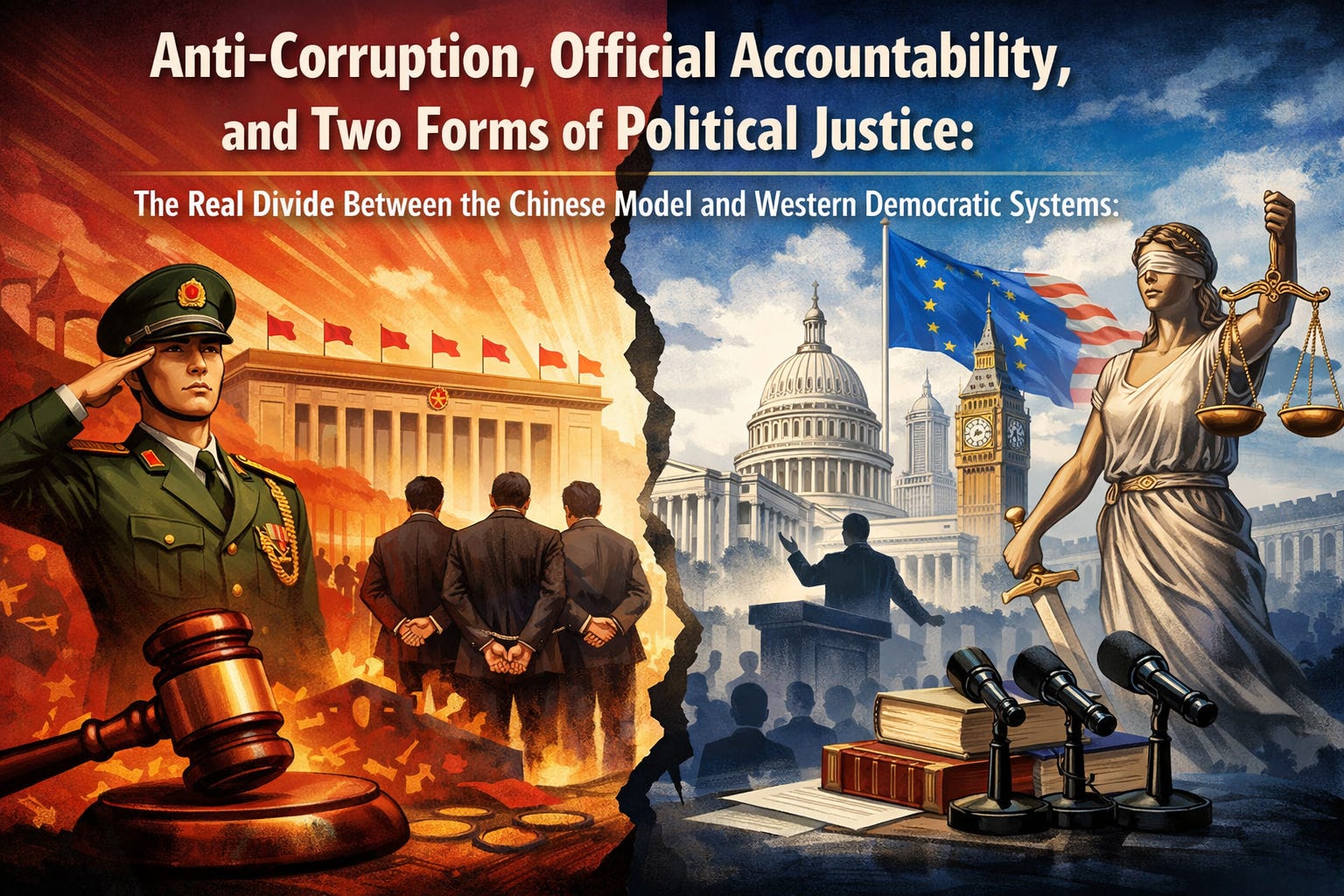
When China’s anti-corruption campaign is discussed in the English-speaking world, the most common narrative is almost always some version of the same story: Western democracies constrain power through procedural justice, while China fights corruption through high-pressure political rectification. That narrative sounds natural because it fits a moral map many people have already internalized: procedure signifies civilization, concentration signifies danger, openness signifies legitimacy, and organized political discipline carries an automatic air of suspicion.
But I believe the biggest problem with this framework is not that it is biased. It is that it is asking the wrong question from the start.
The real divide between China and Western democratic systems on anti-corruption and official accountability is not about who hates corruption more, nor about who likes procedure more. The deeper difference is that the two sides are not primarily afraid of the same kind of institutional failure, and have therefore developed two entirely different hierarchies of accountability. China’s primary fear is that corruption networks, local protectionism, bureaucratic inertia, and organizational dysfunction will gradually hollow out state capacity, causing the state to lose its ability to cleanse itself, correct itself, and execute effectively. That is why, in China, anti-corruption is first designed as a governance instrument capable of penetrating the bureaucracy, continuously disciplining the organization, and recalibrating the administrative machine. Western democratic systems, by contrast, are primarily afraid that the state will use anti-corruption and accountability as a pretext to expand power, disguise political struggle as justice, and wrap administrative coercion in the language of public morality. That is why, in the West, accountability is first designed as a procedural system meant to place the pursuers of accountability themselves inside a cage.
Put differently, China is primarily trying to prevent “corruption from running out of control,” while the West is primarily trying to prevent “anti-corruption from running out of control.”
This is the key to understanding the two systems. It helps explain why China binds together anti-corruption, cadre governance, organizational discipline, and the restoration of state capacity, and why the West disperses accountability across parliament, the media, the judiciary, auditing, independent investigation, and elections. It also explains why so many China-West comparisons end up talking past each other: one side is asking whether the state has the capacity to clear out deep-rooted corruption and bureaucratic inertia, while the other is asking whether the state has been sufficiently constrained so that it cannot cross the line in the name of justice. Both sides are in fact debating the same problem of power, but the center of anxiety is completely different.
Once this starting point is made clear, the debate over “procedural justice” and “substantive justice” stops being an abstract clash of values and returns to a more concrete question: what kind of collapse is a political system trying to prevent first?
I. China Is Primarily Trying to Prevent Corruption from Running Out of Control, While the West Is Primarily Trying to Prevent Anti-Corruption from Running Out of Control
A great deal of analysis on China’s anti-corruption campaign begins with an implicit assumption: Western democratic systems represent the normal, mature, and institutionalized form of accountability, while China represents an exceptional model that may be effective, but ultimately depends on political concentration and high-pressure enforcement. The problem with this assumption is not that it is entirely false. The problem is that it takes the Western procedural framework as the default benchmark, and places China under scrutiny from the very beginning in terms of why it is not more like the West.
I believe this is exactly why so many such comparisons remain shallow. They begin with the assumption that procedure itself is the primary source of political justice. As a result, any institutional arrangement that cannot be easily translated into the grammar of Western proceduralism automatically acquires an aura of diminished legitimacy. The consequence is that, when many people discuss China’s anti-corruption system, they almost never begin with a more fundamental question: if a country possesses highly developed procedures, open oversight, mature media institutions, and electoral mechanisms, yet still fails to continuously clear corruption, fails to effectively discipline its bureaucracy, and fails to restore execution capacity, then where exactly has that system failed?
This is precisely the part that many discussions about China are least willing to confront seriously. Because once the question is posed in this way, the center of debate immediately shifts from whether procedure is elegant to whether the state still retains the ability to govern itself. And for a country like China, with vast territory, deep administrative layering, an enormous bureaucracy, and a policy system that depends heavily on organizational transmission, that is not a secondary issue. It is one of the most fundamental issues of all. China’s primary concern has never been whether supervisory power might become too sharp. Its primary concern is whether the state apparatus might gradually become hollowed out through layered interest networks, local protectionism, and bureaucratic inertia. Once that problem runs out of control, institutions may continue to exist in form while losing their capacity to respond in substance.
The priority structure in Western democratic systems is almost the reverse. Their first concern is not whether the state can punch through the entire bureaucracy, but whether, in punching through the bureaucracy, it may also punch through boundaries that were never supposed to be broken. What they fear is this: once the power to pursue responsibility, impose punishment, and define public morality becomes overly concentrated, institutional tools originally justified in the name of “integrity,” “accountability,” and “justice” can rapidly evolve into a new language for selective targeting, power expansion, and political struggle. That is why the West’s first instinct is not to make supervisory power stronger, but to make it more dispersed, slower, more public, and more mutually constrained.
This is why I believe the real divide between China and the West on this question is not who is more anti-corruption, but which kind of failure each side can least afford. China can less afford corruption running out of control and the hollowing out of the bureaucracy. The West can less afford power running out of control and the expansion of the state beyond proper boundaries in the name of justice. This structural difference is what has produced two institutional arrangements that look radically different on the surface, yet remain internally coherent within their own logic.
So the first step in understanding China’s anti-corruption system is not to ask whether it is “procedural enough.” It is to recognize that the primary question it is trying to answer is not the same as the primary question Western systems are trying to answer. China asks first: does the state still have the capacity to discipline its officials? The West asks first: who disciplines the state itself? As long as that difference in sequence remains unseen, the comparison that follows will almost inevitably lose focus.
II. Anti-Corruption and Official Accountability Are Not the Same Thing
Another reason these discussions become confused so quickly is that many people treat “anti-corruption” and “official accountability” as if they were interchangeable terms. In reality, the two overlap, but they are not the same. If that boundary is not clarified first, subsequent judgments about the differences between China and the West are very easily distorted.
Anti-corruption is mainly concerned with bribery, patronage, rent-seeking, the exchange of power for private gain, the privatization of public office, and abuse of authority. Its center of gravity is corruption itself: how public power is eroded by private interest. Official accountability is much broader. It includes corruption, but it also includes dereliction of duty, misleading the public, conflicts of interest, major governance failures, ethical misconduct, and ultimately the question of who should bear responsibility after policy failure. In other words, anti-corruption asks whether an official has turned public power into a private instrument, while official accountability asks whether an official ought to bear responsibility for his or her actions, judgments, consequences, and institutional role.
Once that distinction becomes clear, the divergence between China and the West immediately becomes much easier to see.
A defining feature of the Chinese system is that it tends to place these two categories of problems inside one larger logic of governing the officialdom. Corruption must of course be dealt with. But in the Chinese context, the issue is never just about money. If a cadre refuses responsibility, fails to act, violates organizational discipline, distorts the chain of execution, causes policy transmission to break down, or commits serious deviations in political responsibility, that too can be brought into the field of accountability. Put differently, China does not treat corruption as an isolated legal deviation. It treats corruption, organizational dysfunction, disciplinary loosening, and governance failure as parts of the same broader problem of state governance. Anti-corruption here is not an isolated judicial act. It is part of a much larger process of organizational rectification.
This is precisely why China’s anti-corruption system often does not look like the kind of narrowly defined anti-corruption campaign familiar to Western readers. It does not focus only on whether someone took money. It also focuses on whether someone failed in duty, crossed institutional boundaries, damaged implementation, or weakened organizational discipline. In that sense, China’s anti-corruption system already partially contains what the West would describe as accountability — except that it achieves this not by disaggregating responsibility, but by integrating it.
The path in Western democratic systems is almost the opposite. They tend to separate these different forms of responsibility. Violations of law go to the judiciary. Misleading the public is pursued through parliament and the media. Conflicts of interest are handled through disclosure regimes and independent review. Policy failure is answered through political responsibility and electoral punishment. A minister may resign for lying. A legislator may be investigated for financial misconduct. A government may pay a political price at the ballot box for policy failure. All of these responsibilities exist, but they are usually not placed inside a single vertical chain. Instead, they are distributed across multiple institutional nodes, handled by different bodies, procedures, and public forces.
I believe this point is extremely important, because it directly shapes the institutional style of each system. China places greater emphasis on the integration of responsibility, while the West places greater emphasis on the dispersion of responsibility. The former is more likely to produce sustained, concentrated, top-down organizational penetration. The latter is more likely to produce public, visible, and contestable procedural boundaries. The former asks how to ensure that the bureaucracy as a whole does not drift out of control. The latter asks how to ensure that no single force can define the entirety of responsibility.
This is also why many Western analysts, when observing China, develop a particular misconception. They assume that China is mixing too many things together — legal responsibility, disciplinary responsibility, political responsibility, and governance responsibility — and that this makes the system somehow impure or conceptually confused. But from the standpoint of the Chinese system itself, this is not confusion at all. It is a deliberate act of integration. Because in the Chinese view, corruption, dereliction, organizational loosening, and governance failure are not isolated problems. They are different manifestations of the same underlying problem of state capacity.
III. China’s Logic: Anti-Corruption Is First and Foremost a Project of State-Capacity Building
If one looks at China’s anti-corruption campaign only through the lens of news narratives, the easiest things to see are phrases like “taking down tigers,” “high pressure,” “deterrence,” and “rectification.” Those descriptions are not entirely false, but they remain too superficial. The real institutional logic of China’s anti-corruption system is not simply to punish corruption. It is to recalibrate the behavioral boundaries of the entire bureaucracy through continuous, high-frequency, and full-spectrum supervision and disciplinary action. I believe a more accurate definition is this: China’s anti-corruption campaign is, first and foremost, a project of state-capacity building.
This matters because it changes the starting point from which we understand “anti-corruption.” In many Western systems, anti-corruption is first treated as a legal or moral problem: how public power is corrected once it has deviated from established rules. In China, anti-corruption is first treated as a question of whether the state apparatus can preserve its capacity for self-cleansing. Its core concern is not how morally corrupt a particular official may be. Its core concern is whether, if such behavior, such networks of interest, and such forms of organizational inertia accumulate across the system, the state can still effectively respond to political objectives, implement policy, mobilize resources, discipline local actors, and maintain public order.
From this angle, what is most important about China’s anti-corruption system is not the dramatic fall of individual high-level officials. It is that the system has evolved into a high-frequency institutional machine with full hierarchical coverage. It is not sporadically removing a few bad apples. It is constantly exerting pressure on the bureaucracy as a whole, forcing it to reset its behavioral expectations. What is really being rewritten is not just the fate of a few officials, but the system’s understanding of risk, discipline, boundaries, and political consequences.
This is also why the real institutional strength of China’s anti-corruption system has never come only from “taking down tigers,” but from its ability to press downward through layer after layer of the state. Its significance does not lie primarily in how many top leaders have been punished over a given number of years. It lies in whether that supervisory pressure can be continuously transmitted down to the province, bureau, county, township, and village levels — down to the actual operational edge of state governance. For a country of continental scale, the real danger has never been only corruption at the top. The deeper danger is that organizational rigidity erodes across countless intermediate layers, so that central objectives are distorted, delayed, diluted, or even intercepted in the course of implementation. Once that trend takes hold, the state may remain intact in form while becoming progressively hollow in substance.
I believe the deeper meaning of China’s anti-corruption drive over the past decade and more has been precisely to prevent that hollowing-out. What it has been trying to address is not only greed, but also diffusion, laziness, delay, evasion, and concealment — and the forms of organizational dysfunction that follow from them. For that reason, China’s anti-corruption campaign is not simply a judicial process of punishing bad people. It is much closer to a process of bureaucratic recalibration. It creates risk through high-pressure punishment, compresses discretionary space through institutional tightening, reshapes cadres’ calculations of the cost of crossing boundaries through sustained rectification, and then gradually deposits those new calculations into a new set of organizational habits.
In that sense, the official Chinese formula of “not daring to be corrupt, not being able to be corrupt, and not wanting to be corrupt” is not merely a slogan. It reflects three distinct mechanisms. The first is to make officials genuinely feel the cost of crossing the line. The second is to reduce the institutional space in which power can be privatized. The third, and deeper layer, is to gradually internalize discipline and risk as part of the bureaucracy’s everyday behavioral boundaries. Many commentators in the English-speaking world see only the first layer, and therefore interpret China’s anti-corruption campaign primarily as a long-term politics of deterrence. But I believe what the Chinese system is ultimately trying to do is the third layer: to sediment high pressure into a new organizational normal.
This is also why, although China is not without procedure, procedure is not primary here. China certainly emphasizes rule-based supervision, procedural coordination, and rights protections. But the primary purpose of those procedural arrangements is not to create an independent center capable of standing in full parallel opposition to supervisory power. Their primary purpose is to make strong supervision itself more standardized, more stable, and more sustainable. Put differently, China’s procedures exist first to ensure that supervisory power can continue operating, not first to blunt the sharpness of that power.
The strengths of the Chinese model are therefore quite clear. Its organizational penetration is strong. Its enforcement capacity is high. Its rectification capability is substantial. It can impose disciplinary pressure continuously across a very wide range of actors, and rapidly reset the bureaucracy’s expectations about risk and consequence. From the more than one million cases formally opened and nearly one million punishments handed down in 2025, to a system of discipline extending from the provincial-ministerial level all the way down to village-level cadres, the real strength of this model lies in its ability to make state supervision into an everyday and continuous organizational reality.
But the costs of the Chinese model are also clear. External independent review is weaker. Openly adversarial procedure is weaker. Social visibility and contestability are generally lower than in typical Western democratic systems. From an external perspective, this model therefore more easily triggers questions about the boundaries of supervisory power, transparency, and the capacity for external review. The World Justice Project’s 2025 ranking placed China at 132 out of 143 on “Constraints on Government Powers,” and that number reflects exactly this kind of outside concern. That indicator should not be treated mechanically or absolutized. But it does at least suggest that, for many international observers, the issue with China is not simply whether anti-corruption exists, but how anti-corruption power itself is constrained.
This is the most fundamental institutional tradeoff in the Chinese model. It understands anti-corruption within the framework of state-capacity building, and is therefore willing to prioritize ensuring that the state still retains the ability to punch through corruption networks, discipline the bureaucracy, and restore the chain of execution. For a large country whose effectiveness depends heavily on organizational power and policy transmission, that ordering is not a secondary matter. It is one of the central conditions for the long-term viability of the system itself.
IV. The Western Logic: Official Accountability Is First and Foremost a Way of Managing the Boundaries of Power
If China is more concerned with how to make supervisory power strong, then Western democratic systems are more concerned with how to put supervisory power inside a cage. The UK’s Ministerial Code requires ministers to maintain the highest standards of propriety, to observe the Seven Principles of Public Life, and states explicitly that ministers are accountable to Parliament for the policies, decisions, and actions of their departments. Canadian parliamentary practice likewise emphasizes that cabinet ministers are individually responsible to Parliament, while also bearing collective responsibility for cabinet decisions. What appears here is not a vertical disciplinary chain of the kind associated with a party discipline system, but rather a public framework of accountability centered on Parliament, the public, the media, and independent scrutiny.
The advantages of this framework are very clear. First, it is public. Second, it is contestable. Third, it places the process of accountability itself under visible public scrutiny. In Western democratic systems, accountability must not only occur. It must occur in a way that can demonstrate its own legitimacy. Whether a minister lied, broke rules, had a conflict of interest, or misled the public is not merely an internal disciplinary matter. It is a public issue into which Parliament, the media, the courts, independent investigators, and the broader public may all intervene.
I believe what Western procedural justice is really trying to prevent is not a situation in which corruption goes unpunished, but a situation in which the state crosses lines it was never supposed to cross in the name of anti-corruption and responsibility. Procedural justice requires evidence, independent investigation, public disclosure, space for defense, parliamentary oversight, and judicial remedy. Its value is not simply that it “follows procedures.” Its value is that it prevents punitive power itself from sliding into arbitrariness. The central anxiety of the Western system has always been this: without sufficiently strong procedural boundaries, terms such as “integrity,” “justice,” and “responsibility,” however noble they sound, can easily become tools of selective targeting.
But the costs of this system are equally clear. First, it is highly fragmented. Parliament, the media, the courts, audit institutions, elections, and independent bodies can all impose accountability. But precisely for that reason, it is rare for any one force to be able to stably, continuously, and concentratively punch through the bureaucracy as a whole. Second, it easily becomes performative. Resignations, hearings, scandals, apologies, and public exposure certainly generate political consequences, but they do not automatically mean that corruption networks have been systematically dismantled, nor do they automatically mean that the state’s chain of execution has been repaired. Third, it often suffers from a major implementation gap. The OECD’s 2026 report found that across OECD countries, the average strength of integrity rules was 63%, while the average level of implementation was only 44%, leaving a 19-percentage-point gap between rules on paper and actual practice. In other words, in many countries the problem is not the absence of rules. It is that the rules do not truly reach reality. Transparency International’s 2025 CPI similarly showed that the global average score had fallen to 42, with more than two-thirds of countries below 50. The report further noted that even established democracies such as the United States and the United Kingdom had declined in recent years, reflecting weakening anti-corruption leadership and enforcement. In other words, procedural completeness does not automatically mean less corruption or stronger accountability.
A country can possess a mature parliamentary tradition, elegant disclosure regimes, a powerful media ecosystem, and extensive judicial remedies, yet still tolerate lobbying networks, revolving doors, regulatory capture, selective enforcement, and a politics in which moral accountability substitutes for substantive accountability. More rules do not automatically mean a greater capacity to clean out corruption. Quite often, they simply mean that accountability has been dispersed across enough institutional nodes that no single node is ever truly strong enough.
V. Procedural Justice and Substantive Justice: Where Does the Real Divide Actually Lie?
Western democratic systems place greater emphasis on procedural justice. The question they are trying to answer is this: who has the right to punish officials, what boundaries must punishment pass through, and how must the pursuers of accountability themselves be constrained? China’s system of state governance places greater emphasis on substantive justice. The question it is trying to answer is this: does the state actually have the capacity to clear corruption, repair governance, and bring the bureaucracy back into alignment with public objectives? The core of the former is boundary; the core of the latter is capacity.
A great deal of Western political narrative treats procedure almost naturally as the main source of legitimacy, as if once procedure is in place, a system retains a higher degree of legitimacy even when governance outcomes deteriorate. But I believe that premise itself needs to be challenged. If a system appears impeccable in procedural terms, yet cannot continuously clear corruption, cannot discipline the bureaucracy, cannot restore execution capacity, and cannot respond to public demands for clean and effective governance, then how long can the legitimacy of that procedure itself really endure? This is precisely the part that many Western analysts are least willing to confront directly.
This does not mean that procedure is unimportant. On the contrary, procedure is extremely important, because it determines how a system prevents punitive power from running out of control. But I believe the value of procedure cannot be completed in isolation from governance outcomes. If a system is unable over the long run to deliver order, execution, integrity, and effective governance, then procedure by itself will find it difficult to remain a sufficient source of legitimacy. In China’s case, the legitimacy of anti-corruption comes to a considerable extent from whether it can actually clear corruption, discipline the bureaucracy, and restore the state machine’s capacity to respond. In many Western systems, by contrast, legitimacy derives more from the demonstrability of procedure itself, even when the outputs of that procedure are not always especially effective.
So the real divide is not that China rejects procedure or that the West rejects results. The real divide is that the two sides are sensitive to different dangers. China is closer to an institutional ordering that prioritizes substantive justice, while the West is closer to an institutional ordering that prioritizes procedural justice. China’s first concern is governance running out of control. The West’s first concern is power running out of control. This difference in priority is the deeper reason the two systems have taken the forms they have today.
VII. Conclusion: This Is Not About Which System Is More Civilized, but About Which Kind of Failure Each System Can Least Afford
If we widen the lens a little further, the essence of this debate is actually quite simple. Modern states face two very real disasters when it comes to anti-corruption and official accountability. The first is corruption running out of control: the bureaucracy is eroded by networks of interest, the state is gradually hollowed out, policy transmission begins to fail, and the organization loses its capacity to respond. The second is power running out of control: the state crosses boundaries in the name of justice, turns punitive authority into a political instrument, and transforms accountability into selective enforcement. China’s institutional ordering is designed to prevent the first disaster first. The West’s institutional ordering is designed to prevent the second disaster first.
That is also why I do not think the real question is which mode of governance is “more civilized,” “more advanced,” or “more consistent with some universal template.” The real question has never been one of moral vanity. It is about how a system deals with the kind of breakdown it can least afford. A country with vast territory, deep administrative layering, a massive bureaucracy, and a policy system heavily dependent on organizational transmission is less able to absorb the erosion of state capacity by corruption networks and bureaucratic inertia, and is therefore more likely to prioritize building strong supervision. A system whose legitimacy is deeply tied to competitive elections, separation of powers, and the boundaries of individual rights is less able to absorb the expansion of state power in the name of justice, and is therefore more likely to prioritize constraining the supervisors themselves.
Procedural justice answers the question of who has the right to punish officials, and through what boundaries punishment must pass. Substantive justice answers the question of whether the state actually has the capacity to clear corruption and repair governance. The institutional strength of China’s anti-corruption system lies in the sharpness of supervisory power: it can penetrate the bureaucracy across a very wide range and generate sustained deterrence. The institutional strength of Western accountability lies in the fact that supervisory power itself remains subject to scrutiny, doubt, and procedural constraint. The former is better at preventing corruption from running out of control. The latter is better at preventing anti-corruption from running out of control. The real question, in the end, is not which system is more moral. It is which kind of failure each system can least afford.
Efficiency of the state apparatus
When on mission
Versus checks on the state apparatus
When off mission
Neither by itself encompasses
The responsibilities of the state apparatus to the people it serves
The state is neither
Simply a potential menace
or indespensible savior
To and for the people
Good analysis -- but. Xi Jinping's disassembly of the committee succession mechanism and attempt to entrench his personal power IS, by this definition, corruption, and the state of China has failed to contain it. The state can be hollowed out from the top just as well as it can be hollowed out from elsewhere.
At a certain point, power running out of control, if centralized in one man, becomes so personalized that it becomes corruption running out of control.
" The question it is trying to answer is this: does the state actually have the capacity to clear corruption, repair governance, and bring the bureaucracy back into alignment with public objectives? "
Apparently not.
They've fallen into the oldest corruption problem of all: the problem of the leader, who is supposed to be the servant of the people, aggrandizing power to himself, at the expense of the public objectives. This is well known to be how the Roman Republic collapsed. It's not as if China doesn't have experience with this problem; it has thousands of years of this problem.
On top of that, there is currently ample evidence that provinces are not complying with central government diktats, and that central government... just changes its diktats after the fact to make it look like they complied. While this might be thought of as a very cooperative way of functioning, so perhaps desirable, it is not substantive state power.
The central government has also started to do certain objectively stupid, scientifically unsound campaigns which are doomed to ineffectiveness and encourage mass noncompliance. This is not conducive to substantive state power. It feels like the personal biases of a few old men.
The history of deliberate tolerance of business corruption for purposes of the agenda of one or another part of the government is also... interesting in this regard.
So for a contrast I think it might be worth looking at another country.
Like... Singapore. Singapore's priorities appear to be similar to what you describe as China's, except Singapore is actually successful at suppressing corruption, and China... has a certain layer of pretense going on.