
China’s Institution Secrets #2: China’s Fifteenth Five-Year Plan: A Strategic Blueprint for Technology, Industry, and National Capacity
Selected Excerpts on Technology and Industry from the Outline of the Fifteenth Five-Year Plan for National Economic and Social Development of the People’s Republic of China

This is part of China’s Institution Secrets, a series on how institutions shape incentives, execution, and long-run outcomes. I track the mechanics of China as an operating system: the governance structure, policy tools, state capacity, and regulatory design that make scale possible—and the institutional frictions that still constrain it.
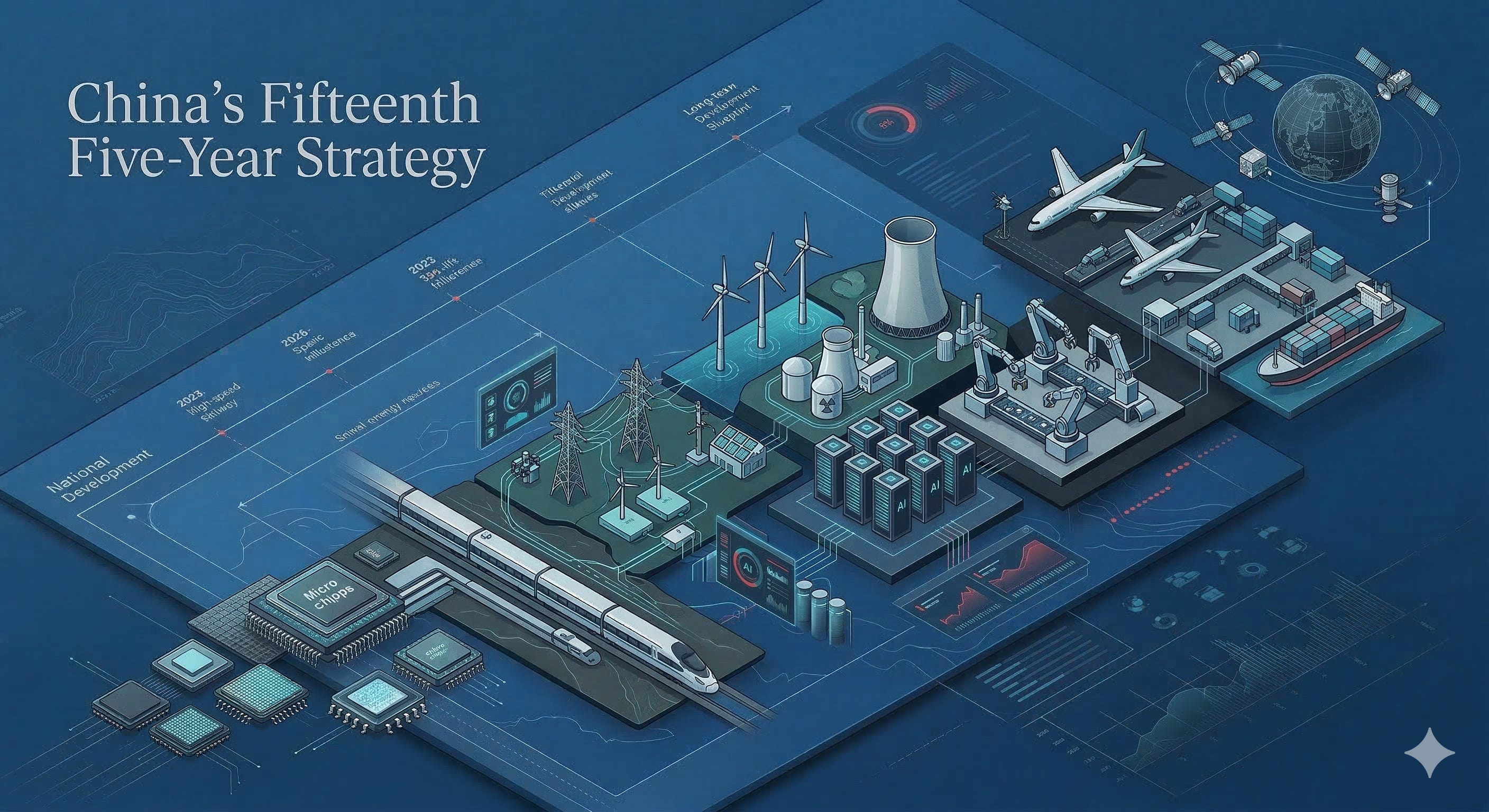
On March 11, the Chinese government officially released the full text of the Outline of the Fifteenth Five-Year Plan for National Economic and Social Development of the People’s Republic of China. Below are some of the key sections related to technology and industry (which I think are the most important), excerpted here both to share and to keep as a reference.
What makes this document worth reading carefully is not only that it lays out which industries, technologies, and projects will be prioritized over the next five years. It is also that it once again reveals a stark contrast between two major powers. While the United States is still waging wars across different regions and being repeatedly drawn into the quagmire of the Middle East, China is methodically rolling out yet another five-year plan, continuing to devote resources to industrial upgrading, infrastructure construction, technological breakthroughs, energy transition, and the accumulation of national capacity.
On the surface, this difference may look like a divergence in policy priorities. In reality, it reflects two fundamentally different logics of statecraft. On one side is a hegemonic inertia that keeps consuming fiscal resources, military power, and strategic attention on wars, sanctions, and geopolitical confrontation. On the other is a continental-scale state that moves in five-year cycles, steadily advancing industrialization, technological upgrading, and modernization, while building up its comprehensive national strength year after year. The most underestimated aspect of China’s modernization has never been any single breakthrough in isolation, but rather this strategic execution capacity sustained across decades and rarely interrupted by external noise.
By the end of 2025, with the conclusion of the Fourteenth Five-Year Plan, China will have completed fourteen consecutive five-year plans, spanning a full seventy years. In the history of modern world politics, very few countries or ruling parties have been able to advance national development over such a long period with such consistency, following the rhythm of one major plan every five years and completing the majority of their core objectives in most phases. What is truly rare is not just the ability to formulate plans, but the ability to deliver on them one by one.
That is why the Fifteenth Five-Year Plan matters not only for what it says, but for what it reminds us of: the real gap between nations is often shaped not by the outcome of a single war, nor by a swing in market sentiment, but by who can sustain strategic focus, organizational capacity, and execution over decades, translating them year after year into the cumulative buildup of industry, technology, infrastructure, and national power.
Chapter 3: Main Objectives
During the Fifteenth Five-Year Plan period, economic and social development is expected to achieve the following objectives.
— Significant progress in high-quality development. On the basis of structural optimization and quality improvement, GDP growth will be kept within a reasonable range, with annual targets to be set in light of actual conditions, laying the groundwork for doubling per capita GDP from its 2020 level by 2035 and reaching the level of moderately developed countries. Total factor productivity will rise steadily, and the contribution of technological progress and institutional innovation to economic growth will continue to increase. The household consumption rate will rise markedly, domestic demand will further strengthen its role as the primary engine of growth, and the economy’s growth potential will be more fully released. Development of a unified national market will be pushed further forward, and the advantages of China’s super-large-scale market will continue to emerge. Major progress will be made in new industrialization, digitalization, urbanization, and agricultural modernization, while the integrity, advancement, and security of the modern industrial system will improve more rapidly. Coordination in urban-rural and regional development will be further strengthened, and major breakthroughs will be achieved in developing new quality productive forces, building a new development pattern, and constructing a modern economic system.
— A substantial rise in the level of scientific and technological self-reliance and self-strengthening. The overall effectiveness of the national innovation system will improve significantly. Society-wide R&D expenditure will grow by more than 7 percent annually on average, and an integrated framework linking education, science and technology, and talent development will basically take shape. Capacity for basic research and original innovation will increase markedly, key core technologies in major fields will achieve rapid breakthroughs, and a number of major original, landmark, and leading scientific and technological achievements will be produced, with clearly more areas moving into global leadership. The deep integration of technological innovation and industrial innovation will continue to strengthen, and the role of innovation-driven development will become more pronounced.
— New breakthroughs in further deepening reform across the board. The modernization of the national governance system and governance capacity will advance in depth. The socialist market economy will become more complete, mechanisms for high-level opening-up will become more robust, and a market environment that is fairer and more dynamic will take shape more rapidly. The institutionalization, standardization, and proceduralization of whole-process people’s democracy will be further enhanced, and the development of a socialist rule-of-law state will reach a higher level.
— A marked rise in the level of social and cultural development. Cultural confidence will become stronger. Mainstream ideology and public discourse will be continuously consolidated and expanded. The core socialist values will be practiced more broadly. The vitality of cultural innovation and creativity across the whole nation will continue to be stimulated. People’s spiritual and cultural lives will become richer, the cohesion of the Chinese nation and the influence of Chinese culture will increase significantly, and the country’s soft power will continue to rise.
— Continuous improvement in people’s quality of life. Employment will remain generally stable, and the surveyed urban unemployment rate will be kept below 5.5 percent, with new progress made toward high-quality and full employment. Growth in household income will remain in step with economic growth, and increases in labor compensation will stay aligned with improvements in labor productivity. The income distribution structure will be optimized, and the middle-income group will continue to expand. The average years of schooling for the working-age population will rise to 11.7 years. People’s needs for elderly care and childcare services will be better met. Life expectancy at birth will rise to 80 years. The social security system will become more optimized and sustainable, and the equalization of basic public services will improve markedly.
— Major new progress in building a Beautiful China. Green modes of production and living will basically take shape, and the carbon peaking target will be achieved on schedule. Carbon dioxide emissions per unit of GDP will be reduced by 17 percent, and a clean, low-carbon, safe, and efficient new energy system will be initially established. The overall quality of the ecological environment will improve comprehensively. Total emissions of major pollutants will continue to decline. The concentration of PM2.5 in cities at or above the prefecture level will fall to below 27 micrograms per cubic meter. The share of good-quality surface water will rise to 85 percent. Forest coverage will reach 25.8 percent, and the diversity, stability, and sustainability of ecosystems will continue to improve.
— Stronger national security safeguards. The national security system and national security capacity will be further strengthened. Total grain production capacity will reach around 1.45 trillion jin, and total energy production capacity will reach 5.8 billion tons of standard coal equivalent. Risks in key areas will be effectively prevented and defused. The level of social governance and public safety governance will improve significantly. Major and especially severe accidents will be effectively curbed. Capacity for natural disaster prevention and response will rise markedly. The centenary goal of military building will be achieved on schedule, and the building of a higher-level Peaceful China will move forward steadily.
On this basis, after another five years of sustained effort, by 2035 China aims to achieve a major leap in its economic strength, scientific and technological strength, national defense strength, overall national power, and international influence. Per capita GDP will reach the level of moderately developed countries, people’s lives will become happier and better, and socialist modernization will basically be realized.
Chapter 4: Upgrading and Optimizing Traditional Industries
Promote innovation across the entire industrial chains of electronics and information and machinery and equipment, develop high-end and supply-constrained products, and accelerate breakthroughs in key components, core parts, and specialized materials.
Implement the industrial foundation reconstruction initiative, speed up breakthroughs in a number of critical foundational technologies, processes, and products, and advance innovative applications in advanced materials and cross-scale manufacturing.
Implement major programs for breakthroughs in critical technical equipment, and achieve advances in a number of landmark major equipment technologies.
Continue strengthening competitive advantages in rare earths, rare metals, and superhard materials, and improve the high-quality and efficient comprehensive utilization of important strategic mineral resources.
Chapter 5: Fostering and Expanding Emerging Industries and Industries of the Future
Accelerate the development of strategic emerging industries such as next-generation information technology, new energy, new materials, smart connected new-energy vehicles, robotics, biopharmaceuticals, high-end equipment, and aerospace.
Expand the development space for the marine economy and promote the healthy and orderly development of the low-altitude economy.
Encourage the development of strategic products and services, promote the large-scale and serialized development of domestically produced large aircraft, strengthen innovative applications of the BeiDou system, steadily advance key technological innovation in intelligent driving, next-generation solar cells, and new energy storage, and support the clinical use of innovative medicines.
Target key fields that will lead future development, build a full-chain cultivation system for future industries, and foster quantum technology, biomanufacturing, hydrogen energy and fusion energy, brain-computer interfaces, embodied intelligence, and sixth-generation mobile communications (6G) as new drivers of economic growth.
Chapter 7: Building a Modern Infrastructure System
Improve the modern comprehensive transportation system. Build high-quality strategic trunk corridors along the coast, border regions, major rivers, Xinjiang-Tibet routes, and the western land-sea corridor; basically complete the main “eight vertical and eight horizontal” high-speed rail corridors and the national expressway network; upgrade high-grade inland waterways; and basically establish world-class port clusters and airport clusters.
Step up construction of new energy infrastructure. Advance the safe, reliable, and orderly substitution of fossil fuels by non-fossil energy, pursue the parallel development of wind, solar, hydropower, and nuclear, and implement a ten-year doubling action plan for non-fossil energy. Coordinate local consumption and long-distance transmission, build clean-energy bases such as wind and solar in the Three-North regions, integrated hydro-wind-solar bases in the southwest, coastal nuclear power, and offshore wind power, strengthen nearby development and utilization of distributed energy, deploy the development of green hydrogen, ammonia, and methanol, and actively promote solar thermal power generation and geothermal energy utilization.
Make strong efforts to build a new-type power system, comprehensively improve the complementarity, mutual support, safety, and resilience of the power system, optimize the national layout of power flows and interregional transmission corridors, accelerate the construction of smart grids, improve urban and rural distribution networks, scientifically deploy pumped-storage hydropower, and vigorously develop new energy storage.
Carry out appropriately forward-looking construction of new infrastructure, improve information and communications networks, deepen the scaled deployment of 5G and gigabit optical networks, advance the development of 5G-Advanced, 10-gigabit optical networks, and 6G innovation, and promote the independent upgrading of the mobile Internet of Things. Further advance the East Data, West Computing initiative, build a multi-layer computing infrastructure system and a national integrated computing network. Implement the national blockchain network construction project. Improve civilian space infrastructure, coordinate the development of satellite communications, navigation, and remote sensing systems, and accelerate the deployment of the low-earth-orbit satellite internet.
Chapter 8: Strengthening Original Innovation and Breakthroughs in Core Technologies
Fight and win the battle for key core technologies. Focus on strategic must-win fields and weak links in industrial and supply chains, adopt extraordinary measures, and promote full-chain breakthroughs in key core technologies across major fields such as integrated circuits, industrial machine tools, high-end instruments, foundational software, advanced materials, and biomanufacturing.
Strengthen the scientific and technological layout in strategic frontier fields. Target the frontiers of world science and technology, strengthen systematic deployment, implement strategic programs in artificial intelligence, quantum technology, biotechnology, and new energy, accelerate breakthroughs in basic theory and foundational technologies, and promote commercialization and application. Organize high-level technology foresight and forecasting, establish a national list of critical and emerging technologies, and continuously advance frontier technology R&D.
Comprehensively raise the level of basic research. Strengthen the strategic, forward-looking, and systematic layout of basic research, and coordinate both goal-oriented and free-exploration basic research. Accelerate the formation of a diversified funding structure for basic research, increase fiscal support, improve tax incentive policies, guide qualified local governments, enterprises, social organizations, and individuals to support basic research, encourage the establishment of public-interest funds for basic research, and significantly raise the share of basic research funding within total R&D spending.
Chapter 9: Improving System-Level Innovation Capacity
Strengthen the leading role of national strategic scientific and technological forces. Optimize the positioning and layout of national laboratories, national research institutions, high-level research universities, and leading technology enterprises. Give full play to the leading role of national laboratories, support them in taking the lead on major national science and technology missions, explore new models of scientific research organization, and strengthen the construction of national key laboratories. Support high-level research universities in creating world-class academic environments and in serving as the main force for basic research and talent cultivation.
Strengthen support for science and innovation resources. Expand the scope of the lump-sum funding system for government research projects, granting scientists greater authority over technology pathways, budget allocation, and resource coordination. Strengthen independent support capacity for scientific infrastructure and conditions, coordinate the construction of innovation platforms and bases, systematically deploy major scientific infrastructure, enhance conditions for high-end scientific instruments, scientific journals, and scientific data, and strengthen open sharing of resources.
Chapter 10: Strengthening the Principal Role of Enterprises in Technological Innovation
Promote the concentration of innovation resources in enterprises. Increase corporate participation in national major science and technology decision-making, treat industry-wide common key technology needs as an important direction for national science and technology plans, and bring qualified major corporate technology projects into the national science and technology planning system. Give priority support to leading technology enterprises in building national innovation platforms and bases, and expand enterprise access to national scientific data, engineering test data, and talent programs.
Strengthen enterprise-led collaboration across industry, academia, research, and finance. Encourage enterprises to work jointly with universities and research institutes on R&D based on industrial needs. Support leading technology enterprises in taking the lead to form innovation consortia. Guide universities and research institutes to license technological achievements to small and micro enterprises under a use first, pay later mechanism.
Guide universities and research institutes to license scientific and technological achievements to SMEs under a use first, pay later arrangement.
Chapter 11: Advancing the Integrated Development of Education, Science, Technology, and Talent
Build an education center, science center, and talent center with global influence. Accelerate the development of national strategic talent capacity around innovation needs, and intensify support for the training and development of strategic scientists, leading technology talent, basic research talent, and young scientific talent.
Promote the coordinated cultivation of innovative talent. Focus on advantageous disciplines and urgent strategic needs, moderately expand the scope of the Double First-Class initiative, and establish a number of new research-oriented universities. Improve the adjustment mechanism for higher education disciplines and majors, make extraordinary arrangements for urgently needed disciplines in emerging fields such as artificial intelligence and integrated circuits, and deeply implement plans for breakthroughs in basic disciplines and interdisciplinary fields.
Adopt evaluation systems for applied research and technology development centered on user and market feedback, and make new technologies and new products important criteria for performance evaluation, professional title assessment, and talent program support. Grant employers greater autonomy in talent evaluation, and prevent the simple use of titles and credentials as the basis for compensation and resource allocation.
Establish a high-tech talent immigration system and attract and cultivate outstanding talent from around the world.
Chapter 12: Strengthening Efficient Supply of Computing Power, Algorithms, and Data
Coordinate the development of computing infrastructure, model and algorithm advancement, and high-quality data resources, and consolidate the foundation for digital-intelligent development.
Accelerate the construction of national hub computing clusters, support qualified regions in moderately expanding computing capacity based on low-latency application needs, and promote coordinated development across cloud, edge, and terminal. Strengthen the supply of high-performance, high-quality intelligent computing resources, and study the construction of ultra-large-scale intelligent computing clusters.
Accelerate breakthroughs in AI basic theory and core technologies, advance improvements in AI model architectures and algorithm optimization, and strengthen coordinated innovation across models, chips, cloud, and applications. Build a task-oriented, flexibly authorized, and cross-domain collaborative model for algorithm innovation, and accelerate research into more efficient training and inference methods. Encourage innovation in multimodal systems, intelligent agents, embodied intelligence, and swarm intelligence, and explore pathways toward artificial general intelligence.
Chapter 13: Advancing the Empowerment of Digital and Intelligent Technologies on All Fronts
Comprehensively implement the “AI Plus” initiative, strengthen the integration of artificial intelligence with scientific innovation, industrial development, cultural development, public welfare, and social governance, seize the commanding heights of AI industrial application, and empower all sectors of the economy and society.
Expand the core industries of the digital economy, develop sectors such as next-generation communications technology, cloud computing, and blockchain, raise the level of industries such as high-end chips, optoelectronic devices, foundational software, and industrial software, and build internationally competitive digital industry clusters.
Promote the orderly application of digital and intelligent technologies in areas such as AI-assisted diagnosis, precision medicine, health management, medical insurance services, elderly care, and disability assistance.
Chapter 16: Expanding Effective Investment
Strengthen investment in human resource development and the all-round development of people, implement a number of public welfare projects in areas such as services for the elderly and children, primary healthcare, the expansion of general high schools and high-quality higher education, and vocational skills training, and raise the share of government investment devoted to public welfare and livelihood.
Improve the long-term mechanism for private enterprise participation in major project construction, encourage and support private enterprises in participating in projects in fields such as railways, nuclear power, hydropower, and water supply, and further raise the equity share of private enterprises in qualified projects.
Chapter 17: Deepening the Development of a Unified National Market
Protect the property rights of all forms of ownership equally, lawfully, and over the long term, and impose equal responsibility, equal conviction, and equal punishment for violations against the property rights and lawful interests of all ownership types.
Formulate fair competition compliance guidelines for key sectors, strengthen the binding force of fair competition review, and remove barriers in areas such as factor access, qualification recognition, tendering and bidding, and government procurement.
Chapter 18: Fully Stimulating the Vitality of All Types of Business Entities
Promote the concentration of state-owned capital in important industries and key fields related to national security and the lifeblood of the national economy, in public services, emergency capacity, and public-interest fields related to national welfare, and in forward-looking and strategic emerging industries, while strengthening strategic restructuring and specialized integration.
Continue to promote the fair opening of competitive infrastructure sectors to private enterprises. Support capable private enterprises in taking the lead on major national technological breakthrough tasks, and further open major national research infrastructure and public R&D platforms to private firms.
Chapter 21: Actively Expanding Autonomous Opening-Up
Promote orderly opening-up in sectors such as telecommunications, the internet, education, culture, and healthcare, prudently implement pilot opening measures in areas such as value-added telecommunications, biotechnology, and wholly foreign-owned hospitals, and advance comprehensive pilot demonstrations for the expansion of the services sector.
Advance the internationalization of the renminbi, expand its use in international trade and investment financing, raise the level of capital account opening, build an independent and controllable cross-border RMB payment system, and develop the offshore RMB market.
Expand imports of advanced technology and equipment, high-quality agricultural products, and producer services urgently needed domestically.
Innovate in and develop digital trade and green trade, expand opening-up in the digital sphere in an orderly manner, support the development of new business forms and models such as cross-border e-commerce, optimize the layout and functions of overseas warehouses, and improve the policy environment for bonded repair and remanufacturing and new offshore trade models.
Guide more foreign investment into areas such as advanced manufacturing, modern services, high technology, and energy conservation and environmental protection, support foreign firms in participating in upstream and downstream industrial chain coordination, and strongly attract foreign-invested enterprises to establish regional headquarters and R&D centers in China.
Chapter 23: Advancing High-Quality Belt and Road Cooperation
Deepen cooperation on important economic corridors and hub ports, and improve multi-dimensional land, sea, air, and information connectivity. Raise the development level of China-Europe (Asia) freight rail services and actively participate in the Trans-Caspian International Transport Corridor.
Advance the high-quality construction of projects such as the China-Kyrgyzstan-Uzbekistan Railway and the Hungary-Serbia Railway. Promote the integrated development of ports, shipping, and trade under the “Silk Road Maritime” framework, improve the quality and efficiency of the Air Silk Road, and strengthen cooperation on the Space Information Corridor.
Continue to expand trade and investment cooperation with Belt and Road partner countries, build pilot zones for Silk Road e-commerce cooperation to high standards, and open up new areas of cooperation in green development, artificial intelligence, digital economy, public health, tourism, agriculture, meteorology, and BeiDou applications.
Chapter 55: Striving to Improve the Quality and Efficiency of National Defense and Military Modernization
Strengthen strategic deterrence capabilities and safeguard global strategic balance and stability.
Promote the scaled, combat-ready, and system-based development of new-domain and new-quality combat forces, accelerate the development of unmanned intelligent combat capabilities and counter-capabilities, and strengthen the upgrading and transformation of traditional combat forces.
Coordinate the construction and application of networked information systems, strengthen the development and utilization of data resources, and build an intelligent military system.
Implement major national defense development projects, intensify defense science and technology innovation and the conversion of advanced technologies, and accelerate the development of advanced weaponry and equipment.
For a full list of my publications, pls visit:
