
China’s Industrialization Secrets #1: Fourth Industrialization: The Compression of Time
How China condensed what historically took other economies a century into a few decades

I write about how major powers compete through technology and industry — and how this competition reshapes energy systems, capital flows, and global geopolitics.
This article outlines the core framework behind many of my later analyses of China’s industrial rise.
Much of the Western debate about China is framed in strategic terms: long-term plans, geopolitical ambition, and the possibility that Beijing seeks to replace the United States at the center of the global order.
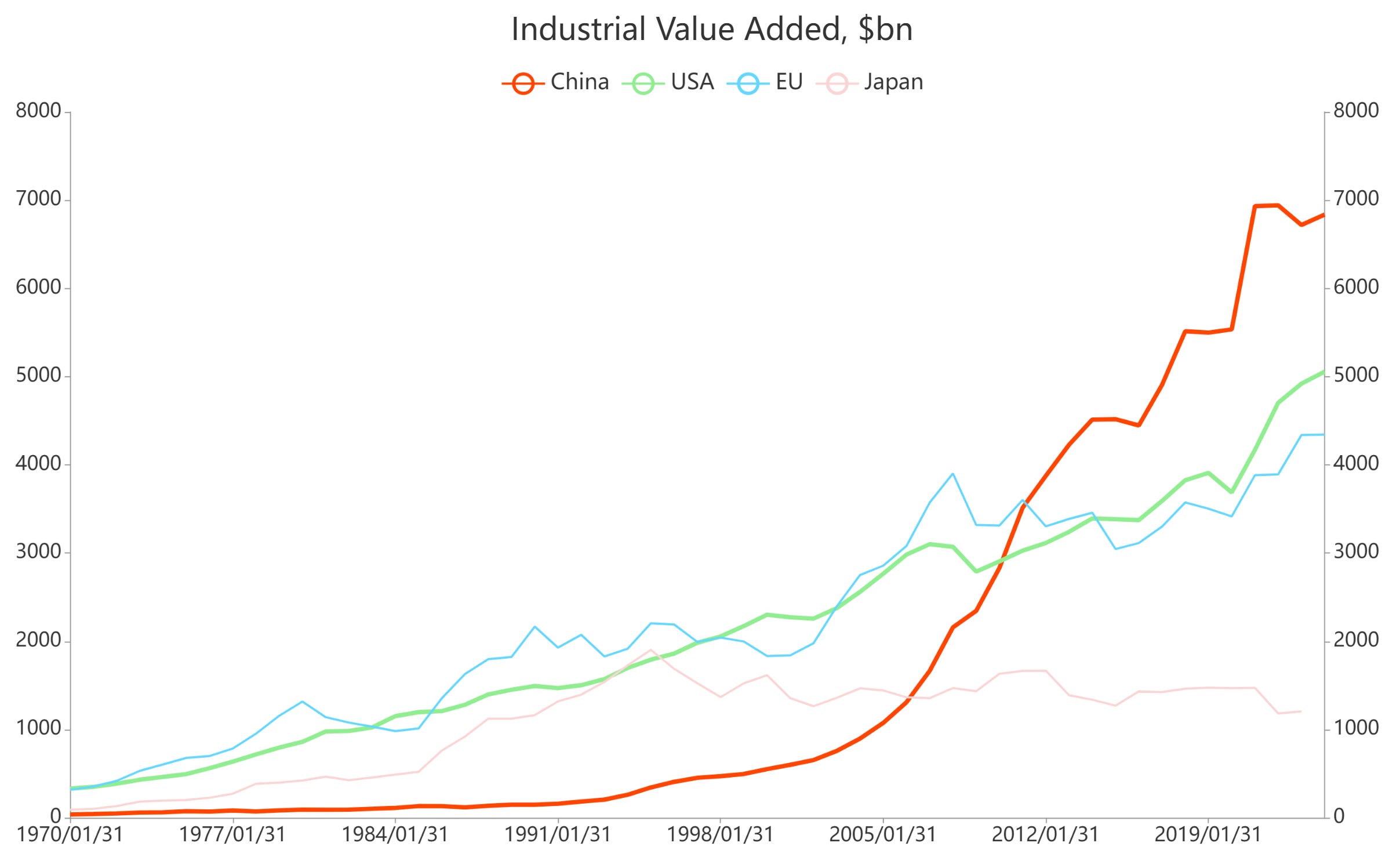
But many developments that appear strategic may have a simpler explanation rooted in political economy. China’s rise can be understood as a compression of industrialization cycles. What historically took other economies a century or more unfolded in China within just a few decades.
This acceleration helps explain why phenomena such as industrial scale, export surges, and supply-chain dominance often appear disruptive or even threatening. In many cases, however, they reflect structural economic change rather than a coordinated geopolitical design.
The Making of an Economic Superpower: Unlocking China’s Secret of Rapid Industrialization, written by Professor Wen Yi of Tsinghua University, is, in my view, the most intellectually illuminating work to date on how China’s rise should be understood.
In this book, Professor Wen introduces a framework he calls the “embryonic development” theory to explain the core historical logic of industrialization. Through this lens, he systematically reconstructs and interprets the key steps, mechanisms, and practical know-how that underpinned China’s rapid industrialization and profound socioeconomic transformation since 1978. At the same time, China’s experience is used to shed new light on a long-standing and unresolved question in economic history: the mystery of Britain’s Industrial Revolution.
Executive Summary / Framing Note
Why This Framework Matters—and What It Gets Wrong in Conventional Views of China’s Rise
Much of the Western discussion of China’s rise oscillates between two unsatisfactory explanations. One treats China’s growth as an anomaly driven by cheap labor, state coercion, or globalization’s “one-off dividend.” The other frames it as an unsustainable deviation from a presumed universal model of market-led, institution-first development. Both views miss the core mechanism.
The framework presented here argues that China’s post-1978 transformation is best understood not as a statistical growth story, nor as a political exception, but as a compressed industrial revolution—one that rediscovered and activated the same internal logic that powered Britain’s, America’s, and Japan’s industrial takeoffs, while executing it at unprecedented scale and speed.
At the heart of this argument is a correction to a deep misconception in both academic economics and popular commentary: industrialization is not primarily about technology, capital, or formal institutions in isolation. It is about the creation of large, unified markets capable of sustaining specialization, mass production, and continuous product innovation—and about who bears the enormous coordination costs required to create those markets.
From this perspective, China’s rise does not contradict industrial history; it follows it with remarkable fidelity.
First, the framework challenges the belief that high GDP growth alone signals industrial transformation. Many countries have achieved years—or even decades—of rapid growth without triggering an industrial revolution. What matters is not growth rates, but sequence: proto-industrialization in rural areas, followed by labor-intensive light industry, and only then large-scale heavy industry and capital goods production. China succeeded where others failed precisely because it followed this order.
Second, it corrects the assumption that markets naturally emerge once property rights and prices are liberalized. In agrarian societies, unified markets for goods, labor, and finance do not arise spontaneously. They require massive investments in infrastructure, social trust, enforcement, and coordination. In historical cases where a strong merchant class could not shoulder these costs, industrial revolutions were ignited only when the state itself acted as a market creator. China’s local governments in the 1980s and 1990s played this role—not as planners allocating output, but as highly incentivized public entrepreneurs organizing markets, mobilizing labor, and integrating regions.
Third, the framework reframes the role of the state. Rather than viewing state involvement as a distortion of markets, it shows that in early stages of development the boundary between state and market is inherently blurred. The decisive distinction is not “state versus market,” but state capacity versus coordination failure. Many developing countries suffer less from market failure than from government failure—specifically, the inability to create the conditions under which markets can function at scale.
Finally, this logic dispels the notion that China represents a sui generis “China model.” What appears unique is largely a function of scale, timing, and speed. The underlying political economy—the need for stability, a unified market, mercantilist state support, and gradual industrial upgrading—is strikingly consistent with the historical experiences of Britain, the United States, Japan, and later East Asian economies.
Why does this matter today?
Because misdiagnosing China’s rise leads to systematic errors in policy, strategy, and expectation. It fuels underestimation, followed by surprise; moralized narratives, followed by fear; and policy responses aimed at symptoms rather than causes. Understanding China as a late but accelerated industrializer—rather than as an aberration—offers a clearer lens through which to assess its economic trajectory, its constraints, and its future evolution.
In short, this framework does not argue that China’s path should be emulated wholesale. It argues something more fundamental: industrial revolutions obey structural logic, and ignoring that logic—whether in analysis of China or in development policy more broadly—has been one of the most persistent intellectual errors of the modern era.
China’s Fourth Industrialization as a Compression of Three Centuries of Western History
China’s post-1978 reform and opening marked a rediscovery of the “secret formula” of the Industrial Revolution—a mysterious “double-helix” self-reinforcing mechanism that triggers explosive growth in enterprise organization. This fact has been almost entirely overlooked by Western academia and the media. As a result, we observe profound confusion and systematic underestimation in the West (and even among many Chinese themselves) regarding the speed and scale of China’s rise, followed by fear, suspicion, and entrenched prejudice. Yet even within the Western world, more than two centuries after the Industrial Revolution first unfolded, scholars have still not fully explained its internal mechanisms.
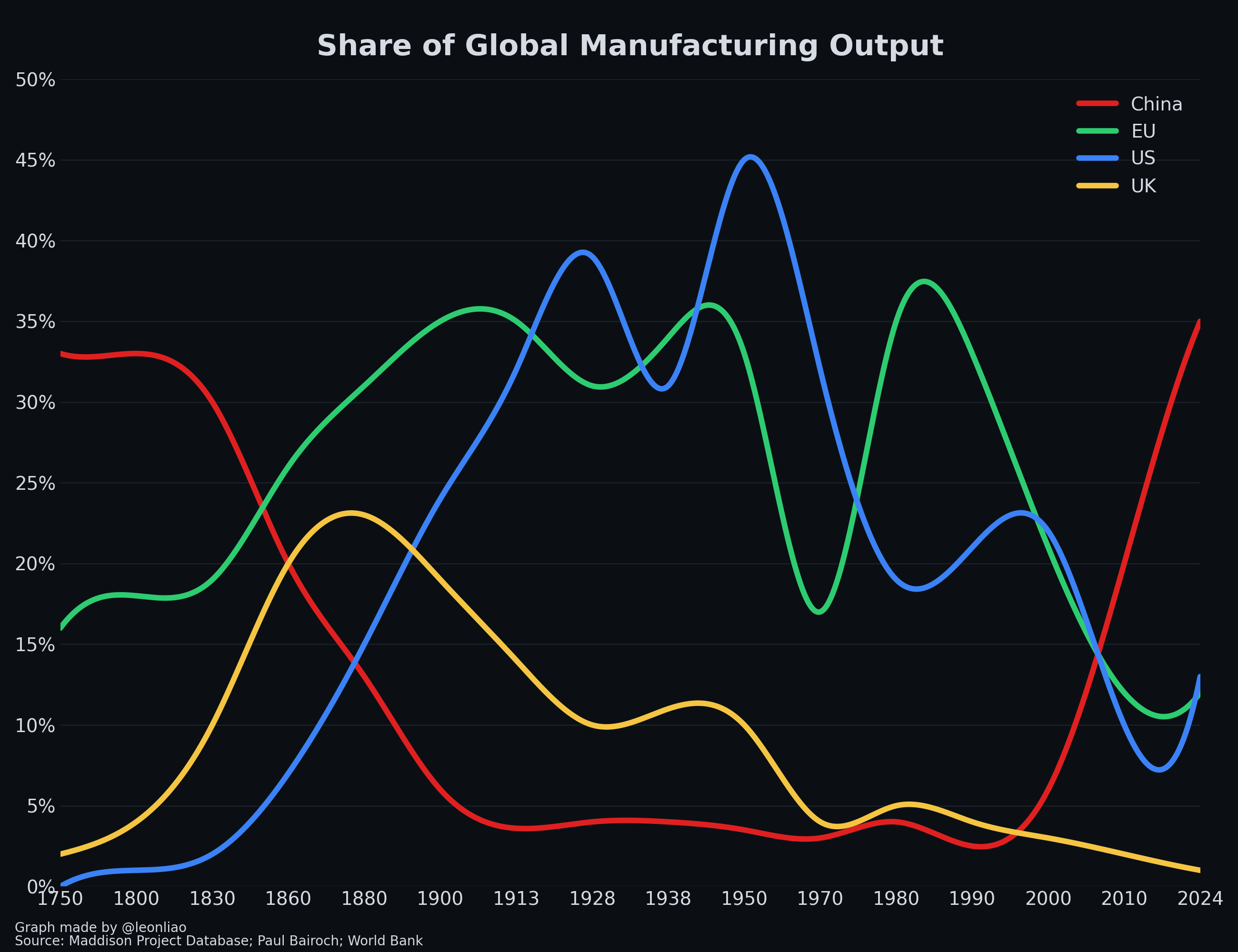
China effectively compressed the revolutionary economic transformations experienced by Britain between 1700 and 1900, the United States between 1760 and 1920, and Japan between 1850 and 1960 into the span of a single generation. Viewed through the chronology of industrialization, China had already completed its First Industrial Revolution during the first 15 to 20 years after the 1978 reforms, through the boom of township and village enterprises. By the late 1990s, it ignited its Second Industrial Revolution. By 2015, China was at the peak of the second and standing at the threshold of the third.
It must be emphasized that the economic reforms initiated in 1978 were not China’s first ambitious attempt to industrialize its vast territory and massive population. Rather, they represented China’s fourth attempt at industrialization over the 120 years since the Second Opium War in 1860.
China’s first attempt took place between 1861 and 1911. The Qing dynasty’s efforts, however, amounted to a massive failure, culminating in defeat by semi-industrialized Japan in the Sino–Japanese War of 1894–1895 and the extraction of an enormous war indemnity.
After the Xinhai Revolution, the Republic of China sought to promote industrialization by comprehensively emulating the United States: adopting democratic and decentralized political institutions, modern private property laws, modern corporations and universities, encouraging free trade, and attracting foreign capital. This attempt, too, ended in failure.
Following the founding of the People’s Republic of China in 1949, a third industrialization effort was launched through the emulation of the Soviet-style planned economy. This attempt also failed.
The failure of the third industrialization led to Deng Xiaoping’s economic reforms in 1978—China’s fourth industrialization attempt in 120 years. The impact of this rise on global economic power has been twenty times greater than that of the United States’ ascent in the late nineteenth century (when the U.S. population was about 60 million), and one hundred times greater than that of Britain’s industrial takeoff in the early nineteenth century (when Britain’s population was about 10 million).
Getting the sequence and steps of economic development right is of fundamental importance. Pragmatic industrial policies and development strategies, grounded in a country’s initial political and economic conditions, are critical. Industrialization requires the highest degree of coordination among all social classes and interest groups, and the mobilization of grassroots society—especially the vast peasantry—along with all natural, social, and political resources. Despite profound differences in initial social, economic, cultural, institutional, and international conditions, China’s development path follows the same internal logic as Britain’s Industrial Revolution more than two centuries ago, reflecting similar underlying laws of what may be called “developmental political economy.”
The Key Steps and Techniques Through Which China Triggered Its First Industrial Revolution
The two principal driving forces behind capitalism and the Industrial Revolution are, first, large-scale mass production propelled by demand and intense market competition, and second, rapid innovation in consumer goods varieties, likewise driven by demand and competitive pressure.
Mass production based on specialization and the division of labor depends on the emergence of large markets. The creation of such markets requires society to bear unprecedented coordination costs and to exert extraordinary collective effort. A vast, organized, non-violent, and trust-based unified market is a prerequisite for large-scale production and division of labor. Without it, even if technologies for mass production exist, no farmer, artisan, or entrepreneur would dare to invest in trade or significantly expand output beyond personal consumption needs. Countries that fail to create a politically stable and unified large market capable of sustaining mass production are destined to remain trapped indefinitely in subsistence smallholder economies and a Malthusian equilibrium.
Agricultural production differs fundamentally from industrial production. It exhibits rapidly diminishing marginal returns to labor input and relies far less on large-scale labor coordination. As a result, even in Western industrialized countries, agriculture has consistently been the last sector to modernize. In the United States, for example, fully mature mechanized farming was not achieved until the 1940s, in stark contrast to the mechanization of the textile industry as early as the 1850s.
Deng Xiaoping’s reforms initiated in 1978 introduced the household responsibility system—allocating land-use rights to individual families—without altering public ownership of land. This was an exceptionally wise and correct reform.
Why, then, did agriculture fail to achieve self-sufficiency or escape the food-security constraint and the Malthusian trap during the Qing dynasty and the Republican era, despite the existence of private property and free markets at the time? The main reasons were as follows.
First, the ownership of agricultural surplus. Without land reform dismantling landlord control over land, it is difficult to imagine that farmers under a household responsibility system would have sufficient incentives to work harder and generate surplus. During the Qing and Republican periods, land was privately owned but overwhelmingly concentrated in the hands of landlords, leaving peasants without meaningful residual claims.
Second, rural irrigation systems and transportation networks linking villages to towns and cities. Without the basic public irrigation infrastructure, electrification, and local transportation networks constructed through continuous mass mobilization of peasants during the Mao era from 1949 to 1977, the productivity gains of the household responsibility system would likely not have materialized. By 2009, China had 87,085 dams, 99 percent of which were built between 1949 and 1979.
Third, a large market with strong demand for diversified agricultural products, along with rural proto-industries capable of absorbing surplus rural labor. Without the establishment of local and national agricultural markets, specialization and commercialization of agricultural production could not have advanced.
China’s township and village enterprises , a distinctly Chinese form of rural industrialization, closely resemble Britain’s proto-industrialization. Between 1600 and 1850, rural workshops—primarily in textiles—flourished across the English countryside and prospered for more than a century and a half. As a unified domestic market took shape in Britain, alongside the expansion into continental European markets and the deepening of global trade, these proto-manufacturing activities—based on rudimentary division of labor, industrial clustering, and long-distance trade—eventually evolved into full-time industrial labor and large-scale factory production.
This proto-industry, which emerged in rural areas on the eve of the Industrial Revolution, differed fundamentally from the urban handicraft workshops described by Marx as early capitalism. The latter primarily served local demand for basic industrial goods, whereas the former aimed to supply much larger domestic and international markets through long-distance trade. Such activities were concentrated in rural areas to take advantage of cheap surplus labor and were typically located near coastlines, canals, or major road networks. Similarly, China’s most developed township and village enterprises regions were coastal provinces with easy access to foreign trade.
The crucial difference between China’s township and village enterprises boom and Europe’s early proto-industrialization lies in organization. In Europe, rural industrial production and long-distance trade were led by a powerful merchant class. In China during the 1980s, these organizational functions were assumed by central and local governments.
China’s local governments played a decisive role in fostering rural enterprises and accelerating market creation and development. This is one of the keys to understanding China’s rapid proto-industrialization and economic takeoff. The incentives driving local governments stemmed from a top-down national ideology: under conditions of political stability and social order (adherence to the Four Cardinal Principles), economic development was to be pursued by all possible means. This pragmatic development strategy leveraged the powerful administrative networks and social resources built during the preceding three decades of planned economy, effectively transforming governments at all levels into a highly incentivized class of public entrepreneurs.
Through merit-based selection and regional competition, a new generation of officials emerged—individuals with both commercial negotiation skills and administrative capacity. They attracted external investment through low taxes and inexpensive land, promoted local products, negotiated business deals, ensured raw material supplies, built distribution networks, and opened domestic and international markets. They provided low-interest loans, strengthened payment supervision, organized industrial and trade exhibitions, and acted as crucial intermediaries for rural enterprises.
This wave of rural industrialization and township and village enterprises expansion finally ignited China’s long-awaited First Industrial Revolution in the late 1980s. Its defining feature was the nationwide emergence of labor-intensive factories based on large-scale production and division of labor.
With sharp increases in agricultural productivity and improved food security, modern factories offering higher wages drew massive numbers of surplus rural workers into manufacturing based on coordinated specialization. By 2000, employment in township and village enterprises exceeded 128 million workers, accounting for 30 percent of the rural labor force. Rural industrial output value increased 225-fold, while real output rose 66-fold. This pace far surpassed that of Britain’s First Industrial Revolution. The reasons likely lie in the superior organizational efficiency of China’s top-down local governments compared to Europe’s merchant-led coordination, the vastly larger scale of China’s unified domestic market, and the even greater size of the global market China faced. In textiles, for instance, China became the world’s largest producer and exporter as early as 1995.
A Powerful Mercantilist State and the Creation of a Unified Large Market
By 1995–2000, China stood at the threshold of its Second Industrial Revolution. At this point, China’s capacity for mass production of labor-intensive light industrial goods, combined with surging domestic and international demand for “Made in China,” generated demand so enormous for energy, power machinery, infrastructure, and equipment that domestic large-scale production of heavy industrial goods became economically viable.
The Second Industrial Revolution essentially consists of producing the tools and intermediate goods used to manufacture final industrial products, also through mass production. Following China’s accession to the WTO, the country formally entered the stage of heavy industrialization. Supported by international demand for textiles and other light industrial goods—and by the massive domestic savings accumulated as a result—China launched large-scale production of chemicals, cement, electricity, steel, metal products, internal combustion engines, trucks, automobiles, ships, highways, railways, agricultural machinery, textile machinery, and machine tools.
Once the First and Second Industrial Revolutions are ignited in the correct sequence, their self-reinforcing and profit-generating dynamics become nearly unstoppable. This process mirrors the development strategy adopted by the mercantilist U.S. government from the nation’s founding: an orderly progression from proto-industrialization to light industry and then to heavy industry.
Early Western mercantilism was, in essence, a form of economic nationalism that sought to ground national prosperity and power in commerce and manufacturing. It aimed to enrich the state by restricting imports of manufactured goods and encouraging exports, while organizing and protecting a semi-militarized global trading system for the merchant class to secure monopoly profits and market share.
During the Qing and Republican periods, China lacked a unified national will and strategic vision capable of guiding merchants to create deep domestic and international markets for rural industry and urban workshops—particularly in textiles and global cotton supply chains. In the absence of large markets and effective market creators (whether merchant classes or China-style “public merchants”), this task could only be accomplished by a powerful mercantilist state, such as Meiji Japan, directly leading and participating in bottom-up commercial and manufacturing activities.
In welfare states such as today’s United States and Europe, governments have not withdrawn from the economy, but their role has shifted toward income redistribution. In China and other developing countries, however, the primary role of government should be to enlarge the economic pie by creating market foundations—social order, trust, infrastructure, and commercial networks. The earlier the stage of development, the harder it is to draw clear boundaries between state and market.
The state is not merely an instrument for controlling violence and maintaining order. It is also a powerful social force and a critical tool for correcting or overcoming market failures in developing economies.
Unified domestic markets for goods, labor, and finance do not naturally emerge from self-sufficient agricultural societies—not always because of predatory governments, but because of the enormous coordination costs and investment required. In the absence of a strong merchant class capable of overcoming these barriers, such costs can only be borne through state will and government support.
China—following Japan, Singapore, South Korea, and Taiwan—has once again demonstrated how central and local governments can rapidly ignite industrial revolutions through active market creation and global market expansion. The widespread lack of enterprise growth and commercial vitality in developing countries more often reflects government failure (a lack of state capacity), rather than market failure, and certainly not the absence of universal suffrage or popular elections.
Gradual Upgrading of Manufacturing Structure as the Decisive Factor
The decisive factor determining whether an industrial revolution can truly be ignited lies in the gradual upgrading of manufacturing structure and the cultivation of markets for related industrial goods.
Between 1750 and 1840, Britain’s average annual GDP growth rate was only 1–1.5 percent. Yet Britain was undergoing the first Industrial Revolution in human history because it had spent one to two centuries prior building the world’s largest trade network, textile markets, and wool and cotton supply chains—completing the proto-industrial accumulation necessary for industrialization. Between 1765 and 1784, textile output increased more than thirtyfold. During the takeoff period of 1803–1833, the number of looms rose from 2,400 to 100,000, an increase of more than fortyfold, with an average annual growth rate of 13 percent. (This makes it critically important to understand the stage of industrial revolution China currently occupies. Around 2015, China may have been entering the takeoff phase for key raw materials, core components, and high-end equipment, as well as the initial stage of manufacturing intelligence.)
In the mid-twentieth century, many Latin American and Southeast Asian countries achieved average growth rates of 7 percent or higher for decades, yet still failed to ignite industrial revolutions. India and Vietnam both experience 5–8 percent growth today, but Vietnam appears to follow the correct sequence—starting with labor-intensive industries such as textiles and electronics assembly—whereas India has yet to find the path. Introducing a handful of capital-intensive firms or multinational corporations does not produce genuine industrialization, because this approach ignores the embryonic proto-industrial stage of industrial revolution, leading to short-lived booms.
Large-scale production based on division of labor requires unified large markets and extensive marketing networks to operate profitably. Between 1860 and 1894, the Qing government established more than 150 modern large factories, mostly in major commercial cities. Meanwhile, proto-industry, rural workshops, and broad rural commercial activity were neglected or suppressed. The Republican era continued this top-down modernization approach.
By contrast, Japan’s proto-industrial development before the Meiji Restoration played a decisive role in later industrialization. The Edo period (1603–1868) served as a critical preparatory stage for industrial revolution, characterized by commercial prosperity, market development, political stability, agricultural commercialization, regional integration, infrastructure construction, flourishing rural handicrafts, and the emergence of a wealthy merchant class. The Meiji government further accelerated this proto-industrialization by developing labor-intensive small textile and food-processing factories in rural areas, gradually establishing an internationally competitive light manufacturing base.
Industrialization during the Meiji era was essentially a light-industry revolution, shifting Japan from importing to exporting consumer goods. Heavy industries such as steel, shipbuilding, chemicals, and electrical machinery remained in early stages and depended heavily on imports.
Once Japan completed its First Industrial Revolution by the early twentieth century, massive domestic demand for infrastructure and machinery triggered the Second Industrial Revolution. The Meiji government initially established state-owned heavy industries using imported Western machinery and technology. As engineers mastered operations and technological reproduction, these enterprises were gradually privatized, leading to the growth of private heavy industry. By the late Meiji period, private firms entered shipbuilding, railways, and machinery, while engineers trained in state arsenals moved into private industry or founded their own firms. (This parallels contemporary China’s information industry, which has generated demand for semiconductor materials, equipment, and large-scale fabs, making profitability at scale possible. Through introduction and absorption, China may ultimately establish its own core materials, components, and large-scale chip manufacturing technologies.)
Just as Japan’s industrial success relied on a mercantilist state, political stability, and a gradual industrial path, U.S. industrialization—supported by a mercantilist government—unfolded through large-scale proto-industrialization in vast rural areas in the early nineteenth century, rather than in already-developed ports and financial centers.
In this sense, there is no uniquely “Chinese model.” What exists is a broadly universal path of industrialization—igniting the First Industrial Revolution through proto-industrialization, upgrading industries step by step, and triggering the Second Industrial Revolution—under specific preconditions: political and social stability, a unified large market, and a mercantilist state.
For a full list of my publications, pls visit:
