
Geopolitics & New World Order #1: From “Systemic Rival” to “Economic War Opponent”
How Trump 2.0’s National Security Strategy Repositions China

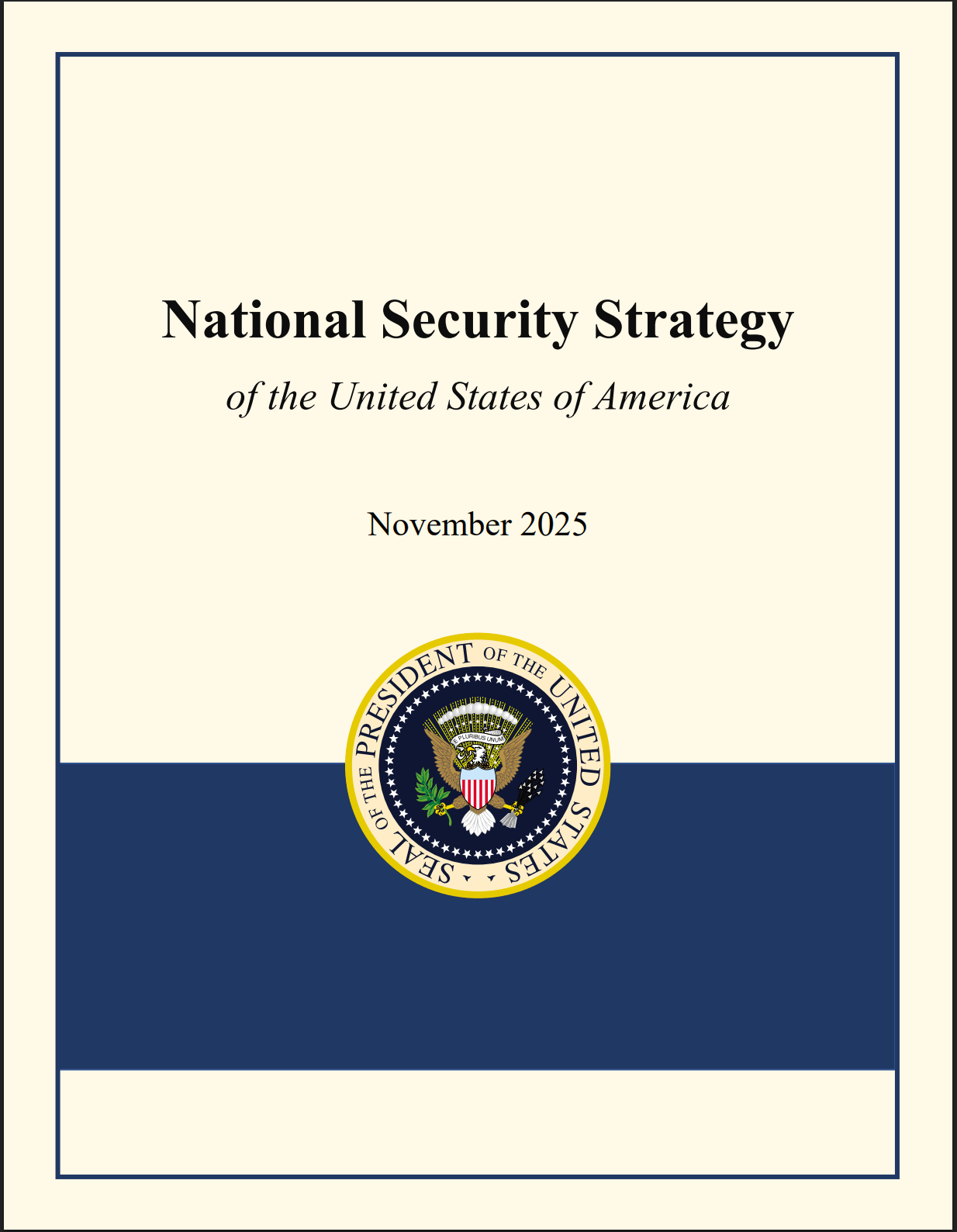
This is part of Geopolitics & New World Order, a series on how wars, alliances, technology blocs, and energy logistics are dismantling the old rules—and what replaces them. I track the mechanics of geopolitics as a material system: industrial capacity, defense production, supply constraints, and credibility—focusing on how power is built, sustained, and depleted under pressure.The new National Security Strategy (NSS) is not a routine policy statement. It is a strategic reset.
Externally, it signals how the United States intends to deploy tariffs, military spending, energy policy, and alliances. Internally, it functions as a political roadmap for Congress and voters. For China, however, it serves a more consequential role: a master document outlining how Washington plans to compete across trade, technology, security, and the Global South over the coming years.
What makes this NSS especially noteworthy is not its confrontational tone—competition with China is already a given—but how China is now being redefined inside U.S. strategic thinking.
Three shifts stand out:
China is no longer framed primarily as an ideological or systemic challenger, but as America’s principal economic and geoeconomic adversary.
The Western Hemisphere and the Indo-Pacific are elevated as two primary theaters, with Chinese activity in Latin America, Africa, and parts of Asia explicitly treated as security issues rather than commercial ones.
Tariffs, supply-chain restructuring, defense industrial policy, and energy dominance are fused into a single framework—signaling a move from episodic confrontation toward long-term structural economic competition.
Understanding these shifts is essential to grasp what “Trump 2.0” actually means for China.
I. From Global Policeman to a Western Hemisphere Fortress
If the Biden administration’s 2022 NSS read like a textbook on defending the liberal international order, the 2025 Trump NSS reads more like a strategic balance sheet.
Its organizing principle is clear:
secure the homeland first, consolidate the backyard, then compete selectively abroad.
Across more than 30 pages, the document repeatedly emphasizes sovereignty, re-industrialization, energy dominance, tariffs, and the rebuilding of the U.S. defense industrial base. Multilateral institutions are framed less as guarantors of order and more as constraints on American autonomy. Allies are warned against “free-riding” on U.S. security and trade arrangements.
Most striking is the revival—and expansion—of a Trump-style Monroe Doctrine. An entire section commits the U.S. to reasserting control in the Western Hemisphere and explicitly rejecting the presence or influence of “extra-hemispheric competitors” in strategic assets across the Americas.
Within this reordered world map, China’s relative position subtly shifts.
Under Biden, China was described as “the only competitor capable of reshaping the international order.” Under Trump 2.0, China appears later in the document, embedded within a chapter titled “Asia: Winning the Economic Future and Avoiding War.”
The sequencing matters.
America’s top priority is no longer maintaining global order—it is geoeconomic advantage anchored in the Western Hemisphere and the Indo-Pacific.
II. Reframing China: From Ideology to Economic Imbalance
The most consequential change lies in how China itself is described.
The language of ideological confrontation largely disappears. Instead, the NSS builds its case around economic assumptions gone wrong.
The document argues that since China’s opening in 1979, the U.S.–China relationship has been built on fundamentally flawed premises: that China would remain a low-income economy and gradually converge with Western norms. Those assumptions, it claims, persisted long after China became a near-peer economic power.
Rather than accusing China of exporting ideology, the NSS accuses it of exploiting asymmetries:
China’s exports to low-income countries doubled between 2020 and 2024.
Today, China exports nearly four times more to low-income countries than to the United States.
Although direct exports to the U.S. have fallen to just over 2% of China’s GDP, indirect exports via Mexico and other intermediaries continue to expand rapidly.
In this narrative, China is not a revolutionary power seeking to remake institutions. It is a highly adaptive economic actor, using global supply chains and rule arbitrage to sustain its export model.
The implication is blunt:
China will not “return” to the old system. The system itself must be rewritten.
III. Economic War First, Military Deterrence Second
The chapter title is unusually candid: Winning the economic future comes before avoiding war.
The NSS outlines an economic competition strategy built around:
Tariffs and stricter rules of origin
Supply-chain surveillance and reshoring
Industrial and defense-base reconstruction
Financial and development tools aimed at countering China’s overseas expansion
Only after laying out this economic framework does the document turn to military deterrence.
Taiwan, notably, is framed less as a values issue and more as a geoeconomic and geostrategic node—central to semiconductor supply chains and controlling access between the first and second island chains.
The strategic logic is sequential:
constrain China’s economic leverage first, then stabilize the military balance.
IV. What This Means for China
The implications are substantial.
First, decoupling in sensitive sectors is no longer cyclical or political—it is structural.
Semiconductors, advanced manufacturing, critical minerals, and defense supply chains will remain under permanent pressure.
Second, the Global South—especially Latin America—is no longer neutral ground.
Ports, power grids, telecom networks, and cloud infrastructure are increasingly treated as strategic assets rather than commercial projects.
Third, large-scale military conflict remains unlikely—but friction will be constant.
High-intensity deterrence, arms sales, military exercises, and information campaigns will persist as the background condition for economic competition.
Conclusion: A De-Ideologized Cold War
This National Security Strategy is not about spreading democracy or defending a universal order. It is about balance sheets, supply chains, energy flows, and strategic geography.
China is no longer framed as a system to be transformed—but as a competitor to be managed, constrained, and offset.
That may sound less emotional than ideological confrontation. In reality, it may be more dangerous.
Because when competition becomes arithmetic rather than moral, every port, every factory, and every export corridor becomes a battlefield.