
How Europe Reverse-Engineered China’s White Gold
Why did Europeans desire not just Chinese porcelain objects, but the raw materials, formulas, kilns, and production system behind them?

Europe did not simply copy Chinese porcelain. It tried to decode Jingdezhen’s raw materials, kilns, division of labor, and production logic — and then place that knowledge inside European courts, laboratories, factories, and industrial markets.
This essay is part III of the Myth of Stolen Technology, in the series of Rethinking the Great China Debates.


Key Discussions
Why was Jingdezhen not merely a craft town, but one of the most complex global manufacturing clusters of the pre-industrial world?
Why did Europeans desire not just Chinese porcelain objects, but the raw materials, formulas, kilns, and production system behind them?
Why did the letters of the French Jesuit François Xavier d’Entrecolles from Jingdezhen become key texts in Europe’s understanding of Chinese porcelain production?
How did Meissen, Sèvres, and Wedgwood turn Chinese porcelain knowledge into European industrial capability?
Why was China’s global porcelain advantage defeated not by a formula, but by the industrialization of porcelain in Europe?
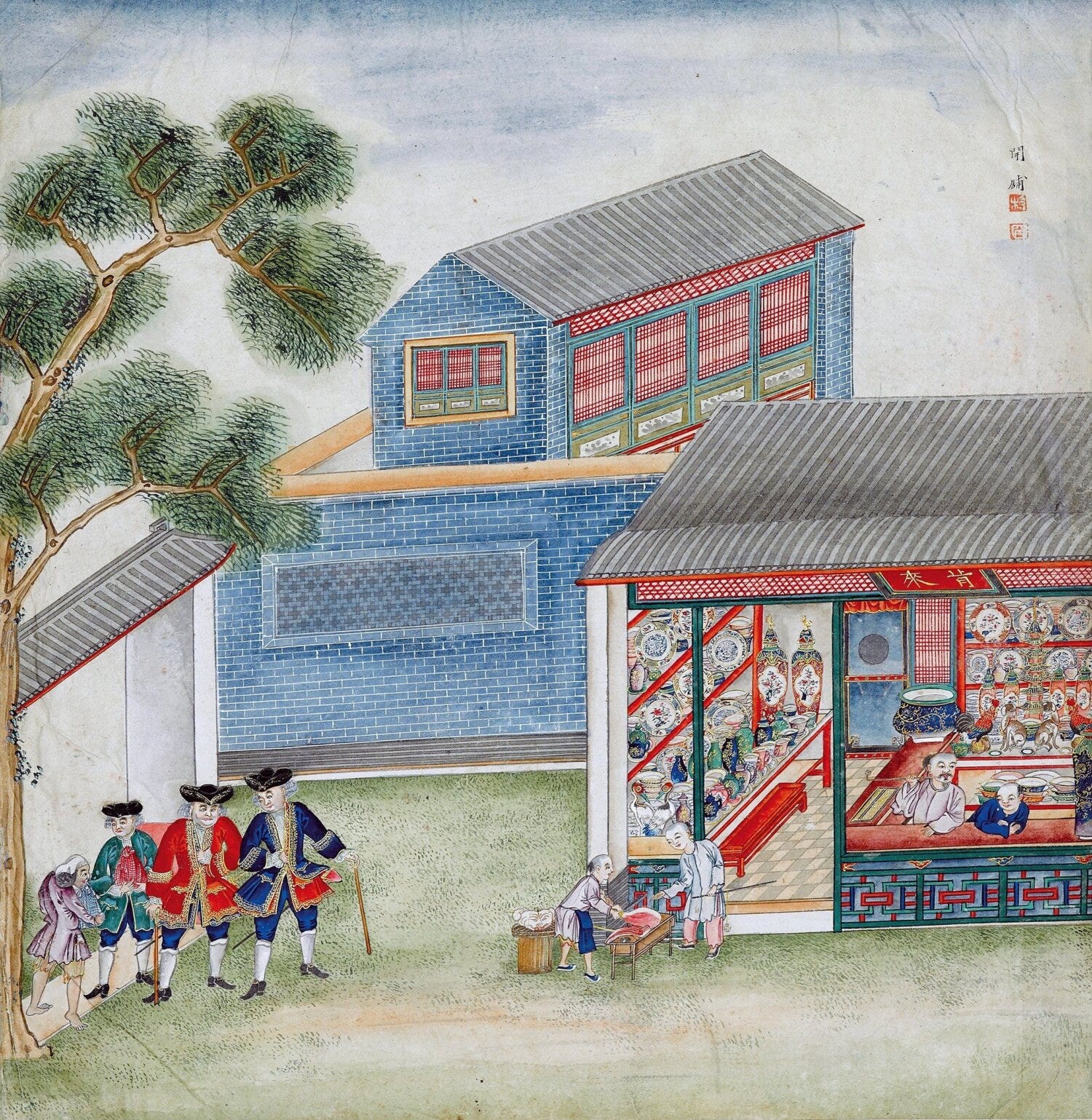
Porcelain Production and Transport Paintings (瓷器制运图), Qing Dynasty
This export painting series follows porcelain from raw material extraction and workshop labor to firing, packing, transport, and foreign trade. It turns Jingdezhen from an abstract symbol of Chinese craftsmanship into a visible industrial system — exactly the system Europe tried to decode, imitate, and reorganize into its own porcelain industry.
For a long time, Europeans possessed Chinese porcelain without truly possessing porcelain.
They could fill palaces with Chinese ceramics. They could display blue-and-white, famille rose, wucai, white porcelain, and large vases in dining rooms, libraries, and cabinets of curiosity. Merchants in Amsterdam, London, Paris, and Dresden could continue importing new objects from the East. But as long as Europe could not manufacture hard-paste porcelain by itself, it remained a buyer inside China’s porcelain system.
That was the lure of “white gold.”
Porcelain looked light, refined, glossy, and fragile. But to European courts and merchants, it carried the value of gold. It was not an ordinary vessel. It was a symbol of wealth, rank, taste, technology, and the mystery of the East. Its whiteness, hardness, translucency, glaze, and firing stability made European earthenware and soft-paste porcelain look technically inferior for a long time.
Europeans saw a cup, a plate, a vase.
But what fascinated them was the production secret behind those objects.
What clay did the Chinese use?
How was it washed?
How was the paste kneaded?
How was the form shaped?
How was the glaze prepared?
How was the kiln loaded?
How was the fire controlled?
Why could Jingdezhen turn earth into hard, white, semi-translucent, vitrified porcelain, while Europe produced coarse pottery, soft-paste porcelain, or unstable imitations?
What Europe really wanted was not more Chinese porcelain.
It wanted Jingdezhen.
More precisely, it wanted Jingdezhen as a production system.
That is the story of this essay.
It is not simply a story of Europe stealing Chinese porcelain technology. That claim contains some truth, but it remains too shallow. What Europe attempted was closer to a long reverse-engineering of one of China’s most mature manufacturing systems: observation, purchase, disassembly, documentation, missionary access, sampling, translation, experimentation, imitation, secrecy, factory organization, mechanization, standardization — and finally the relocation of China’s “white gold” into European courts, laboratories, mining systems, factory organization, and consumer markets.
Europe did not simply copy Chinese porcelain. It tried to decode Jingdezhen’s raw materials, kilns, division of labor, and production logic, and then industrialize that knowledge.
Jingdezhen Was Not a Workshop. It Was an Industrial System.
Before Europe could truly produce hard-paste porcelain, Chinese porcelain was already one of the most admired manufactured goods in the global market.
The achievement of Jingdezhen is often romanticized as craftsmanship or Eastern aesthetics. But to understand it only in those terms is to underestimate its historical significance.
Jingdezhen was not merely a craft town.
It was one of the most complex manufacturing clusters of the pre-industrial world.
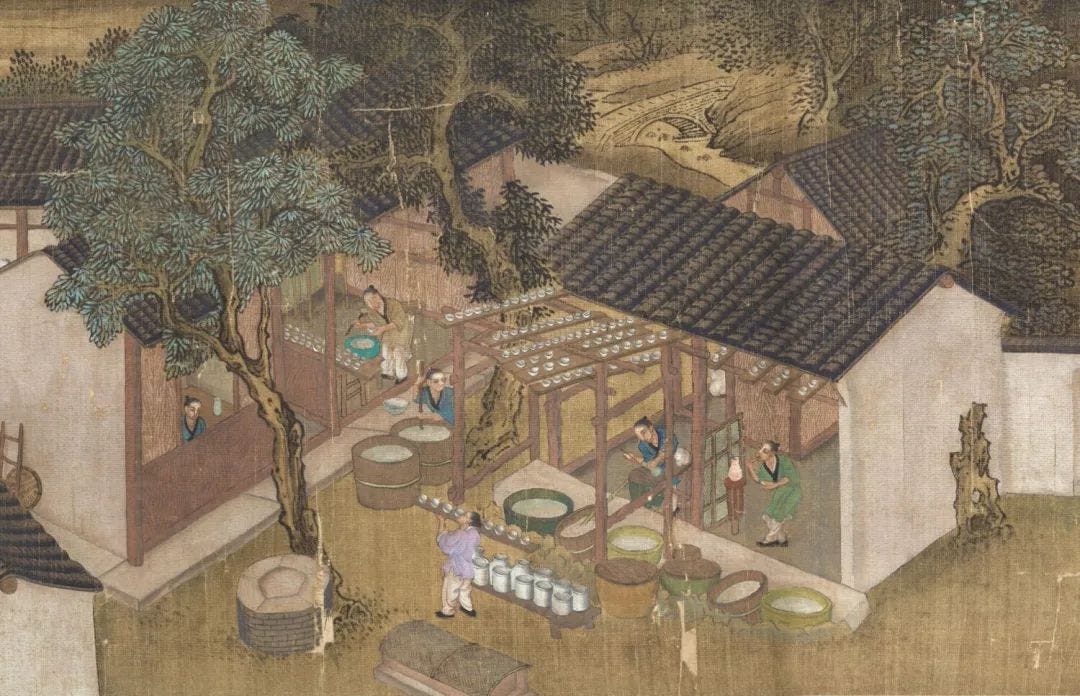
Porcelain Production Scroll (陶冶图卷), Qing Dynasty
Known as the “porcelain capital,” the town had more than 2,000 kilns and produced more than 100 million porcelain pieces a year, roughly 30 percent of which were exported through maritime trade. It produced not only imperial porcelain, but also goods for China’s domestic market, Southeast Asia, the Islamic world, Europe, and the Americas. It could adjust shapes, motifs, colors, sizes, and packaging according to orders. It could also manufacture export porcelain specifically for foreign tastes.
Europeans bought individual porcelain objects.
What Jingdezhen really exported was an organized production capability.
That capability rested on a long combination of raw materials, processes, division of labor, transport, and foreign trade. Kaolin was mined from the mountains, washed, settled, filtered, refined, and turned into workable porcelain paste. Its preparation was divided into 72 steps. Glazes had to be formulated. Bodies had to be shaped. Painters had to apply designs. Kiln workers had to judge placement and firing. After firing, the products had to be graded, selected, packed, and shipped to market.
The beauty of porcelain came from the final object.
The power of porcelain came from the system behind it.
Jingdezhen’s industrial chain was not confined to the town center. It stretched from raw-material extraction in Yaoli to glaze preparation in Sanbaopeng and then to the shaping, painting, and firing workshops of the town itself, forming a manufacturing cluster that extended over more than 100 kilometers. It connected mountain resources, river transport, craft workshops, kiln systems, local merchants, foreign-trade ports, and overseas markets.
This is why Europe could buy Chinese porcelain for a long time without being able to make Chinese porcelain.
Europeans could copy motifs. They could imitate shapes. They could paint Chinese landscapes, figures, pavilions, flowers, and birds on European wares. But the real difficulty lay in what could not be seen: body material, glaze composition, kiln temperature, firing control, division of labor, defect rates, transport, orders, worker experience, and long-accumulated process judgment.
Europeans saw porcelain.
What sustained porcelain was a manufacturing system.
The English word “china” itself shows the place Chinese porcelain occupied in Europe’s imagination. Europeans associated these white, hard, semi-translucent, glossy objects with China itself, tracing the term to Changnan, a name associated with Jingdezhen. From then on, “china” meant both porcelain and China.
This was not ordinary product naming.
It was a moment when a civilization became represented by a manufactured good.
By the late eighteenth century, Chinese porcelain exports remained large. Annual porcelain exports reached roughly 5,000 dan. When the Macartney mission visited China in 1793, it purchased 2,400 porcelain pieces, including a Nine-Dragon Wall ceramic sculpture as tall as 1.8 meters, with a single piece valued at as much as 2,000 taels of silver (roughly equivalent to today’s 200k dollars).
In European eyes, Chinese porcelain was art, luxury, trade good, and technological puzzle.
The more beautiful it was, the more anxious Europe became.
Because as long as Europe could not manufacture it, Europe still had to buy it from China.
And in an era when commercial capital, court competition, and state finance were increasingly intertwined, the inability to manufacture meant the inability to control.
Europe Wanted Not Porcelain, but the Method Behind Porcelain
Europe’s fascination with Chinese porcelain went far beyond consumption.
Princes and aristocrats collected Chinese porcelain. Merchants imported it through the East India companies and other trade networks. Courts displayed it as a symbol of power and taste. European craftsmen and alchemists repeatedly tried to crack the secret of “white gold.”
The central difficulty was hard-paste porcelain.
Earthenware and soft-paste porcelain were not equivalent to Chinese hard-paste porcelain. True Chinese porcelain required the right body material, the right mineral combination, the right glaze, high-temperature firing, and stable kiln control. Europe could imitate the appearance, but for a long time it struggled to match Chinese porcelain’s whiteness, hardness, translucency, and durability.
The problem was not only the formula.
The formula was only the visible part.
The deeper problem was the production system. Without the right minerals, without stable raw-material supply, without kiln experience, without division of labor, without large-scale trial and error, without consumer markets and fiscal support, even technical information would not automatically become an industry.
Still, Europe had to try.
The profits behind Chinese porcelain trade were enormous. If Europe could produce porcelain domestically, it could reduce dependence on Chinese imports, satisfy court and middle-class consumption, create a new domestic industry, and keep within Europe wealth that had once flowed to China.
That is why porcelain secrets became the object of pursuit by European states, courts, merchants, alchemists, missionaries, and manufacturers.
Europe did not merely admire Chinese porcelain.
Europe wanted to take it apart.
From object to raw material, from raw material to process, from process to kiln, from kiln to factory, from factory to market.
It wanted to turn a Chinese commodity into a European industry.
The Industrial Report Sent from Inside Jingdezhen
One of the people who systematically transmitted knowledge from inside Jingdezhen to Europe was a French Jesuit.
His name was François Xavier d’Entrecolles.
D’Entrecolles arrived in China in 1698 and later spent a long period in Jingdezhen. He served in a pastoral role connected to the local community of porcelain workers, came into contact with artisans, observed workshops, consulted local sources, and gradually learned the actual processes behind porcelain production. For Europe, his position was extraordinarily valuable: he could enter China’s interior and translate what he observed into texts Europeans could read.
He did not send Europe a vase.
He sent Europe the operating manual of Jingdezhen.
In letters sent to Europe in 1712 and 1722, d’Entrecolles described the Chinese porcelain-making process in detail. He wrote about how raw materials were selected, how baidunzi and kaolin were used, how the clay was washed, how the paste was kneaded, how molds were formed, how glazes were prepared, how bodies were glazed, how porcelain was loaded into kilns, how firing was controlled, how large pieces were made, how new porcelain could be made to look old, and even how some nearly lost methods were practiced.
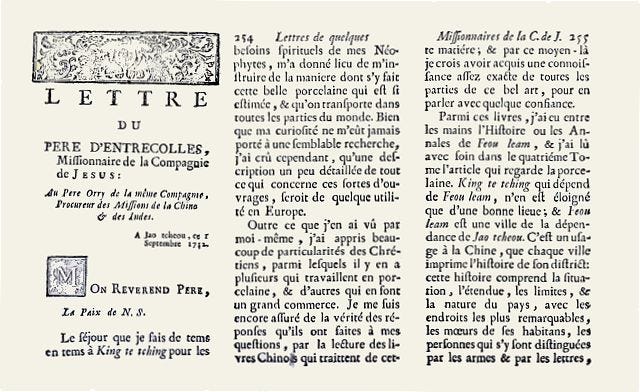
Section of the letter from d'Entrecolles, 1712, re-published by Jean-Baptiste du Halde in 1735
He also sent samples of porcelain raw materials from Jingdezhen, including baidunzi and kaolin.
This mattered.
Europe needed not only texts. It needed samples. The secret of porcelain did not exist only in process descriptions. It also existed inside the minerals themselves. The relationship among kaolin, porcelain stone, glaze, and fire was the result of long accumulated Jingdezhen experience. Merely writing “use this kind of earth” did not automatically tell Europe how to find similar materials, how to process them, how to combine them, or how to fire them.
The importance of d’Entrecolles’ letters lay in the fact that they translated knowledge dispersed among Jingdezhen workshops, kilns, and artisan experience into a form the European knowledge system could absorb.
He recorded not only how porcelain was made.
He recorded how an industry worked.
Where the clay came from. How it was processed. Who shaped it. Who painted it. Who glazed it. How kilns were loaded. How fire was managed. How defects appeared. How large pieces were made. How antiquing was done. How the different stages were divided.
It was an industrial report from inside the porcelain capital.
More importantly, these letters did not remain private correspondence. They were later included in Jean-Baptiste Du Halde’s Description of the Chinese Empire, cited, translated, and circulated across Europe. In 1738, Du Halde’s work was translated into English. Later, Diderot’s Encyclopédie also absorbed related material.
Workshop experience from Jingdezhen entered the knowledge machine of the European Enlightenment.
A secret accumulated orally and internally among artisans became a text readable by philosophers, manufacturers, factory owners, and industrial reformers.
This is what technology diffusion looked like in the eighteenth century.
It was not modern patent licensing. It was not transparent international cooperation. It mixed missionary access, observation, contact, purchase, translation, samples, letters, publication, and state competition.
D’Entrecolles’ actions also show that Europe’s acquisition of Chinese technology did not stop at the level of the product.
It tried to penetrate the commodity and enter the production system behind it.
Yet knowing how Jingdezhen made porcelain did not mean Europe could immediately reproduce Jingdezhen.
That is the crucial point.
A letter could shorten the learning curve, but it could not build Europe’s raw-material system, kiln system, artisan system, factory organization, or consumer market.
Europe still had to reorganize knowledge into an industry of its own.
Meissen and Europe’s Search for White Gold
Before and around the time d’Entrecolles’ letters reached Europe, European states had already been trying for a long time to crack the secret of Chinese porcelain.
The most famous breakthrough occurred in Saxony.
Augustus the Strong, Elector of Saxony, was almost obsessed with porcelain. He viewed Chinese and Japanese porcelain as symbols of wealth, power, and courtly taste. For him, cracking the secret of porcelain was not only a matter of luxury consumption. It was also a matter of state finance and court prestige.
Johann Friedrich Böttger, an alchemist originally expected to manufacture gold, was redirected toward the search for “white gold.” Ehrenfried Walther von Tschirnhaus, a mathematician and experimenter, along with technicians from mining and metallurgy, also took part in the experiments. Europe’s breakthrough in hard-paste porcelain did not come from an isolated flash of inspiration. It came from court finance, alchemy, mineral knowledge, kiln experiments, clay trials, and a state secrecy system.
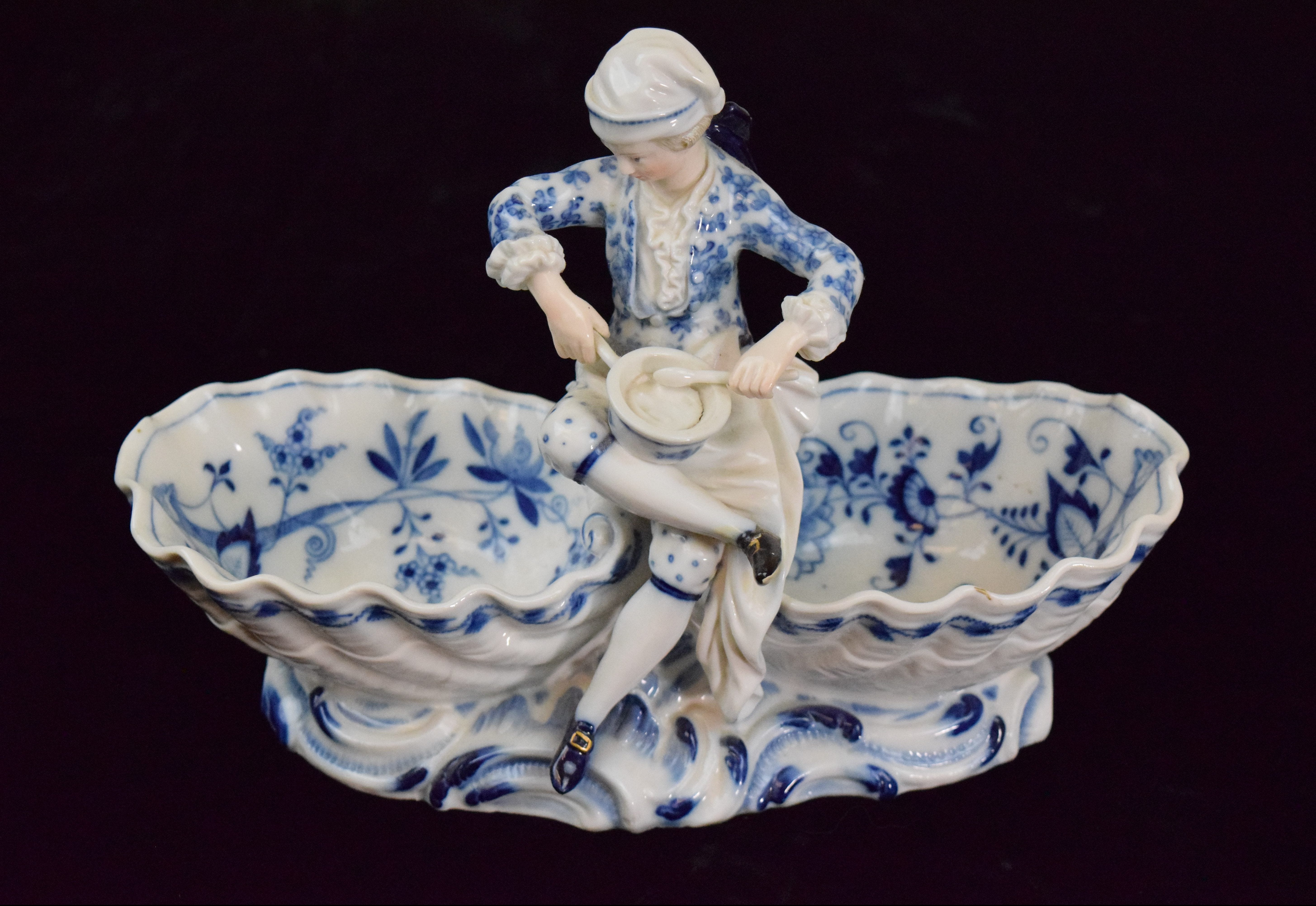
In 1708, Saxony succeeded in firing European hard-paste porcelain. In 1710, the Meissen porcelain manufactory was founded, becoming Europe’s first hard-paste porcelain factory.
There is an important detail here.
Meissen’s breakthrough was not the direct result of d’Entrecolles’ letters, because his first letter did not reach Europe until 1712. Europe’s solution to hard-paste porcelain came from multiple channels: long importation and observation of Chinese porcelain, court collecting and imitation, alchemy and mineral experimentation, the involvement of mining technicians, and later the Jesuit description of Jingdezhen’s processes.
This actually strengthens the argument.
Technology diffusion is not a story in which one document changes the world.
It is the convergence of multiple streams of knowledge inside an institutional environment.
Europe did not discover porcelain by accident. It mobilized court power, mineral knowledge, experimental science, artisan skill, and industrial secrecy to recreate something China had long produced.
There was also an irony. Once Europe cracked Chinese porcelain, it immediately turned its own porcelain technology into a heavily guarded secret. Meissen’s porcelain-making methods were confined inside a castle; workers were controlled; formulas and processes were treated as state and commercial secrets.
When Europe pursued Chinese technology, it spoke the language of discovery, exploration, experiment, and learning.
Once Europe possessed the technology, it too began to speak the language of secrecy, monopoly, and protection.
This is not surprising. The language of technology changes with the position of power.
But Meissen’s significance was not only that it cracked the secret. It proved Europe could produce hard-paste porcelain. The next question was whether that capability could move from court secrecy into industrial production.
The answer became clearer in Britain.
Wedgwood Turned Jingdezhen into Factory Logic
Eighteenth-century Britain was entering the Industrial Revolution.
The key was not only machinery. It was organization. Division of labor, standardization, cost accounting, factory discipline, marketing, branding, transport, and scale production were reshaping traditional crafts.
Porcelain and ceramics were no exception.
In 1738, the English translation of Du Halde’s Description of the Chinese Empire was published. A few years later, a young Englishman determined to transform the ceramics world began reading its sections on Chinese porcelain production carefully. His name was Josiah Wedgwood, later known as the father of British ceramics.
Wedgwood was interested not only in the aesthetics of Chinese porcelain.
He was more interested in the production logic behind Jingdezhen’s complex division of labor.
Jingdezhen’s strength did not come only from artisan skill. It came from separating raw materials, body-making, painting, glazing, firing, sorting, and foreign trade into highly specialized stages. No single worker needed to master the entire process, but the whole system could produce large quantities of high-quality goods consistently.
Wedgwood placed this logic inside Britain’s industrial environment.
In 1769, he established one of Europe’s most important assembly-line-style ceramic factories. He broke down the traditional potter’s 12 craft operations into 78 standardized steps. Workers no longer needed to master the whole craft from throwing to glazing, firing, and finishing. They needed only to perform specific tasks with skill and repetition. The result was that the production time for each ceramic or porcelain product fell from three days to six hours, while costs fell to one-fifteenth of their previous level.
This was not simply imitating Jingdezhen.
It was connecting Jingdezhen’s craft division of labor to the factory system of the British Industrial Revolution.
In 1775, Wedgwood’s factory introduced steam power to drive blast kilns, raising kiln temperatures from 1,200°C to 1,350°C and reducing firing cycles from 72 hours to 18 hours. Production efficiency rose further, and costs fell to roughly one-third of Chinese porcelain. By 1790, the discovery of similar kaolin in Cornwall further removed the raw-material bottleneck.
From this point, the nature of competition changed.
Europe was no longer merely trying to imitate Chinese porcelain.
Europe began to redefine porcelain production through industrial methods.
Wedgwood’s success was not only technical. It was commercial. He understood branding, aristocratic demand, sample books, orders, showrooms, customization, and middle-class consumption. He turned ceramics from court luxury into a broader consumer product, connecting production and demand through factory organization and marketing.
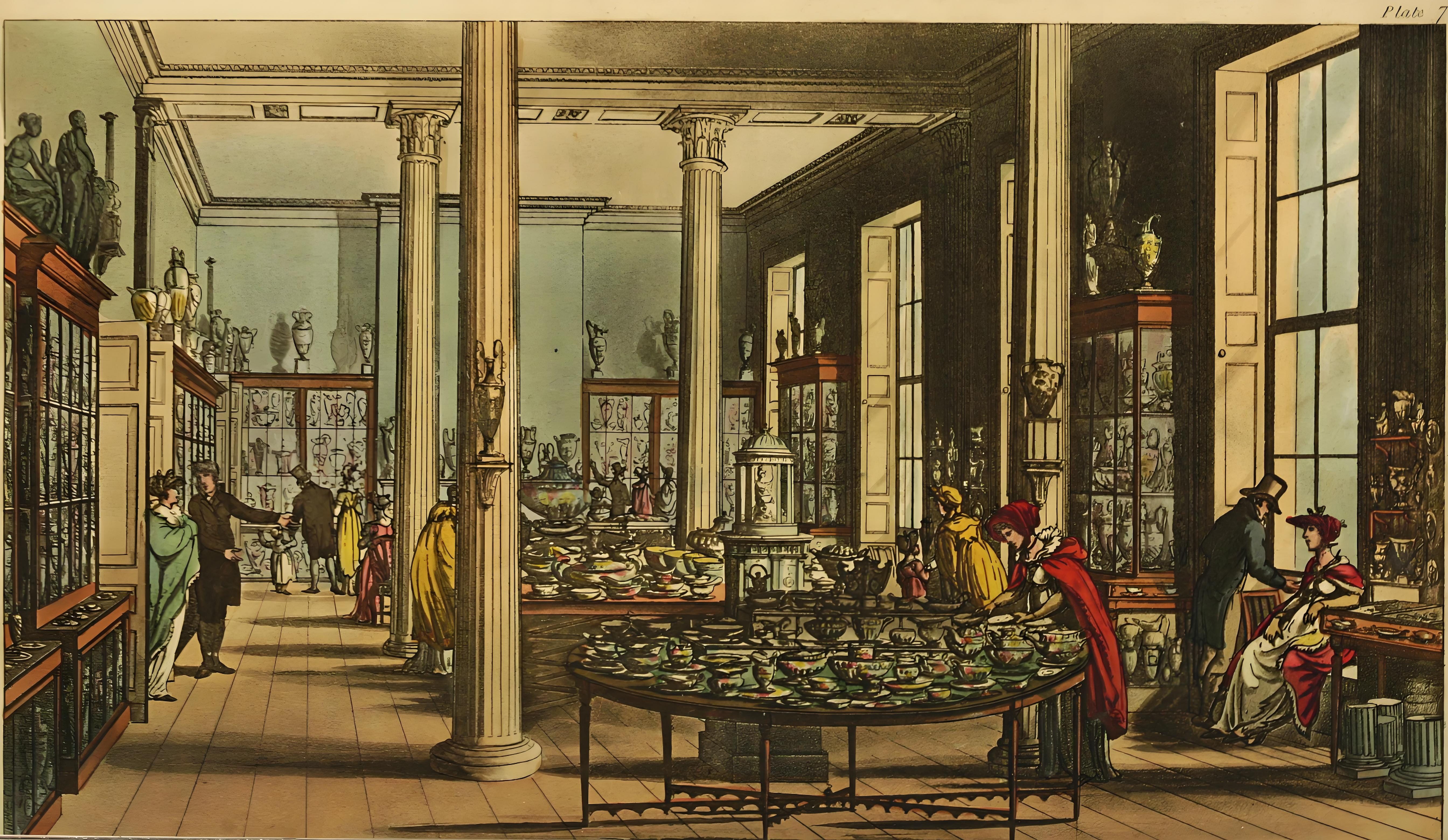
Wedgwood & Byerley in St James's Square; the London showroom in 1809
This was Europe’s real strength.
It did not only learn how porcelain was made.
It learned how to industrialize porcelain.
Europe’s breakthrough was not merely that it acquired knowledge of Chinese porcelain. It was that it placed that knowledge inside machinery, coal, factories, finance, brands, markets, and trade protection.
What Europe ultimately completed was not the copying of a Chinese porcelain object, but the conversion of Jingdezhen’s craft-based division of labor into the factory logic of the Industrial Revolution.
This also explains why the global porcelain trade would reverse so quickly.
When White Gold Changed Hands
By the late eighteenth century, Chinese porcelain’s position in the European market began to decline sharply.
After 1790, China’s share of the European porcelain market fell from about 75 percent to about 30 percent.
In 1794, the Dutch East India Company purchased only around 50,000 pieces of porcelain, less than 10 percent of its peak volume.
In 1791, the British East India Company stopped importing Chinese porcelain altogether.
After 1820, Chinese handmade porcelain exports fell by roughly 40 percent; by 1850, only around 2,000 dan remained.
At the same time, European states increasingly used trade protection to raise import duties on Chinese porcelain. European domestic porcelain factories expanded. From Meissen to Sèvres, from British ceramic factories to manufacturing centers across Europe, porcelain production was no longer a technological system monopolized by China.
After the Opium War, the reversal became even more visible.
Large quantities of machine-made porcelain from Japan and Europe entered the Chinese market. By 1850, Britain sourced around 75 percent of its porcelain imports from colonies, while China’s market share fell to about 12 percent. Japan, after the Meiji Restoration, also developed its ceramics industry rapidly, importing European technology and incorporating ceramics into its modern industrial program. By the end of the nineteenth century, China had lost its most important overseas porcelain markets — Europe and Japan — and Chinese porcelain had largely retreated from the center of the world market.
This did not happen because Europe finally learned a mysterious formula.
The formula was only the beginning.
What truly destroyed China’s global porcelain advantage was Europe’s industrialization of porcelain. Raw materials, kilns, factories, standardization, steam power, branding, trade protection, consumer markets, and colonial trade networks combined to turn China’s long-accumulated craft advantage into Europe’s industrial advantage.
The secret of porcelain did not destroy Chinese porcelain.
The industrialization of porcelain did.
This point matters.
It moves the question from morality back to industrial logic.
Europe certainly acquired Chinese technical knowledge. D’Entrecolles’ letters, raw-material samples, Jingdezhen’s processes, and Europe’s long observation and imitation of Chinese porcelain were all part of this knowledge transfer. But none of these things automatically produced Europe’s porcelain industry.
What created power was Europe’s placement of this knowledge inside new systems: Meissen’s court-backed experimental system, Sèvres’ state manufacturing system, Britain’s factory organization, Wedgwood’s standardization, steam power, Cornish raw materials, European branding, and domestic market protection.
China did not lose a vase.
China lost a long competition between one industrial system and another.
Europe Did Not Merely Copy China. It Reorganized What It Took.
The porcelain story can easily be written as “Europe stole Chinese porcelain technology.”
That claim contains truth.
Europe spent a long time trying to crack the secrets of Chinese porcelain. D’Entrecolles did record and transmit a large amount of technical information from inside Jingdezhen. Through observation, collection, translation, experimentation, and imitation, Europe gradually acquired the hard-paste porcelain knowledge that China had long used to maintain its advantage.
But if the story stops there, it remains too simple.
What Europe really did was not only steal.
It disassembled, translated, and reorganized.
It disassembled the movable knowledge of Jingdezhen: kaolin, baidunzi, porcelain stone, glaze, shaping, firing, kiln loading, division of labor, antiquing, large-piece production, and quality control.
It translated that knowledge into texts, samples, experiments, and factory rules Europeans could understand.
It then reorganized the knowledge inside its own institutional environment: court finance, mineralogy, alchemy, experimental science, factory division of labor, steam power, branding, trade protection, and industrial markets.
What emerged was not a simple copy of Chinese porcelain.
It was the European porcelain industry.
This industry used Chinese porcelain knowledge, but it no longer depended on Jingdezhen. It absorbed Chinese technology, but redefined porcelain production through European minerals, machines, capital, markets, and state protection.
This is the central mechanism in the history of technology diffusion:
Acquiring knowledge is not the endpoint. Reorganizing knowledge is power.
A country can acquire a formula, but without raw-material supply it cannot make a stable product. A country can know the process, but without worker training and factory organization it cannot scale. A country can copy the appearance, but without kiln control and cost advantage it cannot enter the global market. A country can maintain traditional craft leadership, but if it cannot continue raising productivity, lowering costs, expanding markets, and renewing organization, it will eventually be overtaken by a new industrial system.
The real lesson of porcelain is not that technology does not need protection.
It is that technology becomes power only when it enters a system capable of scaling it.
This is also why the term “technology theft” is often insufficient when discussing China’s technological rise today.
China has certainly learned from foreign technology, absorbed global knowledge, and experienced intellectual-property disputes, market-access problems, and technology-transfer pressures. But if China’s rise in 5G, electric vehicles, batteries, solar PV, robotics, and AI is explained mainly as “theft,” then the most difficult part of the story is missed: the ability to place external knowledge inside domestic manufacturing systems, engineering communities, supply-chain networks, infrastructure, market scale, and policy environments, and turn it into continuously operating industrial capability.
The history of Europe’s porcelain industry shows precisely that technology flow is only the beginning.
The decisive question is always the system.
Who can absorb?
Who can reorganize?
Who can scale?
Who can turn a piece of knowledge into an industry?
Who can turn an industry into a durable advantage in the global market?
These questions explain the transfer of industrial power more effectively than asking who first possessed a piece of knowledge.
Returning to Today’s Technology Debate
Today, when America and Europe discuss China, they often describe China’s industrial catch-up as “technology theft.”
In some local cases, this claim may capture part of the truth. Technology can indeed be illegally obtained. Trade secrets can be stolen. Companies do need intellectual property protection. A healthy innovation system cannot ignore property rights, contracts, and rules.
But history tells us that technology diffusion has never been a simple moral story.
When Europe pursued Chinese porcelain, it used the language of mission, exploration, collecting, science, experiment, and manufacture. Later, similar actions in the modern international order might be described as commercial espionage, technology transfer, or intellectual-property infringement. Different vocabularies often reflect different positions of power.
When a country is a latecomer, it emphasizes learning, introduction, exploration, and development.
When a country becomes a leader, it emphasizes property, order, rules, and protection.
This does not mean all technology transfer is legitimate. It means we cannot explain industrial history through one moral label alone.
The more important question is how a society turns knowledge into capability.
Jingdezhen was once a mature manufacturing system. Europe extracted key knowledge from it and placed that knowledge inside a new system: Meissen, Sèvres, Wedgwood, mineral experimentation, steam power, standardized factories, and European consumer markets. Global porcelain trade was transformed as a result.
Today’s China, in many modern industries, is doing something structurally similar: absorbing external knowledge, learning global technologies, training engineers, building supply chains, investing capital, expanding markets, participating in standards, competing on cost, and recombining all of these into domestic industrial systems.
This is not to say that China today and eighteenth-century Europe are the same.
History never repeats so simply.
But the mechanism is similar: once technology moves, it is reshaped by the new system that absorbs it. If the former leader focuses only on what others took, and fails to understand how others reorganized it, it will misread the true source of competition.
Europe did not automatically become a porcelain power because it learned a porcelain formula.
It became a porcelain power because it possessed an industrial system capable of turning formulas, raw materials, kilns, and processes into factories, brands, cost advantage, and market control.
Similarly, many of China’s industrial capabilities today cannot be explained merely by saying it obtained a certain technology. What matters more is whether China can turn technology into supply chains, factories, cost curves, product iteration, export capacity, and the next round of innovation.
That has been the core argument of the first two essays in this series.
China’s industrial rise is not a simple story of theft.
The histories of Britain’s tea empire and Europe’s porcelain industry remind us that Europe’s own commercial and industrial expansion was never a story of pure internal invention.
Before becoming a defender of the global technological property order, Europe was also a learner, absorber, disassembler, and reorganizer of external knowledge.
America, in particular, should not forget this.
Because in its own early industrialization, America too was a latecomer trying to pull European machines, artisans, and manufacturing knowledge across the Atlantic.
That will be the subject of the next essay in this series.
If this framework helps you understand China, industrial power, state capacity, capital, technology, and global order beyond the usual headlines, please consider subscribing to China as a System.
Paid subscriptions help support this work. A like, restack, comment, or share also helps this work reach more readers.
For a full guide to the publication and its main research series, start here: China as a System: Publication Map.

I've been a regular visitor to Jingdezhen for 15 years, and continually marvel at the goods produced there. I inherited a few pieces of Wedgwood and Royal Daulton porcelain from grandparents, and have compared the products to pieces I own from Falangci and other kilns in Jingdezhen.
Wedgwood may have developed systems to manufacture porcelain that satisfied his customers, but when one holds a Wedgwood piece and a Falangci piece in their hands, the differences are stark. The Wedgwood, in comparison to Falangci, is heavy crude junk. Even the materials are crude; they may have found kaolin to suffice, but they still weren't able to duplicate the pure white China stone, since it is only found (so far) in one place on Earth...Yaoli, up the valley from Jingdezhen.
Without Yaoli White China stone, the good stuff is still out of reach, not to mention the hand painting and decoration of Royal Daulton and Wedgewood is a joke compared to the Chinese craftspeople, who are still creating masterpieces. You can still see them at work at Taoxichuan (陶溪川), the old industrial kiln area renovated into an arts and performance complex.
So, industrial systems were reformed and reworked to satisfy Europeans, but the stuff is still junk compared to the finest Jingdezhen porcelain.