
Industrialization Before Liberal Democracy, Part I: Asia
The industrialization of South Korea, Taiwan, Singapore, Hong Kong, and Japan all took place before mature liberal democracy arrived.

Asia’s most successful industrialization stories were not cases of liberal democracy first creating industrialization. Taken together, South Korea, Taiwan, Singapore, Japan, and Hong Kong show a different historical sequence: rapid industrialization took place under authoritarian or non-liberal political structures; democracy, quasi-democracy, or more open political orders emerged only later, after these new industrial societies had already been built.
This essay is part of State Governance and Capacity series.
Executive Summary
Today’s liberal-democratic narrative often presents industrialization, market economy, rule of law, liberal democracy, and developed society as one natural continuum: countries supposedly released market dynamism because they had liberal democracy; they completed industrialization because markets became dynamic; and they became rich because industrialization followed. The real historical sequence was more complex, and much less comfortable. Most industrializing countries that later entered the ranks of developed economies were not mature liberal democracies in the modern sense during their industrial takeoff and early-to-middle industrialization stages.
South Korea’s industrial takeoff occurred under Park Chung-hee’s military-authoritarian regime; democratization came only after 1987. Taiwan’s rapid industrialization occurred under Kuomintang one-party authoritarian rule and long-term martial law; the lifting of martial law and direct presidential elections came after export manufacturing, electronics, and semiconductor policy had already taken shape. Singapore became a high-income economy without first becoming a competitive liberal democracy in the Western textbook sense. Japan’s first industrialization took place under Meiji oligarchy, the emperor system, imperial bureaucracy, and expanding military power; postwar constitutional democracy inherited a country that had already industrialized, while the high-growth era itself unfolded under the long dominance of the Liberal Democratic Party’s one-party-advantage system.
Continental Europe does not support the simple narrative that liberal democracy created industrialization either. German industrialization took place inside a Prussian-led monarchical, bureaucratic, and military empire. It had a Reichstag and male suffrage, but not modern parliamentary democracy. French industrialization was deeply shaped by the central administrative state, Second Empire railways and public works, state engineers, and Paris finance. Belgium, one of the earliest industrializers on the European continent, industrialized while suffrage remained highly restricted. Italy and Spain modernized through limited elections, authoritarian rule, state intervention, and postwar reconstruction. Nordic welfare democracy was not a precondition for industrialization; it was a political result that emerged after industrialization, urbanization, labor organization, fiscal capacity, and state capacity had matured. Switzerland, often treated as a democratic model, did not grant women federal voting rights until 1971.
The same applies to the Anglo settler societies that appear closest to the liberal-democratic narrative: Britain, the United States, Australia, Canada, and New Zealand. Britain’s Industrial Revolution took place under parliamentary oligarchy and limited suffrage; the suffrage expansions of 1832, 1867, 1884, 1918, and 1928 all came after the core phase of the Industrial Revolution. America’s rapid nineteenth-century industrialization unfolded inside a white male republic, alongside slavery, Indigenous land dispossession, protective tariffs, railroad land grants, and the expansion of state capacity during the Civil War. Women gained national voting rights only in 1920, while effective protection for Black voting rights in the South required the 1965 Voting Rights Act. Australia, Canada, and New Zealand were closer in their early stages to white settler democracies than to fully inclusive liberal democracies; their high-income development long coexisted with Indigenous exclusion, racialized immigration regimes, imperial markets, and colonial land orders.
This essay does not argue that liberal democracy cannot govern developed societies. Mature liberal democracy can protect rights, constrain the state, manage distributional conflict, organize welfare states, and provide industrial societies with more stable legitimacy. The myth this essay challenges is stronger and more common: the claim that liberal democracy was the precondition for most countries’ first industrial takeoff. The historical record points in another direction. Early-to-middle industrialization required high efficiency, fewer veto points, strong state capacity, fiscal concentration, and policy continuity. In most cases, those conditions existed only under authoritarian rule or limited liberal-democratic political systems. When low-income societies enter highly fragmented mass democracy too early, state capacity often has not yet formed, while veto power has already arrived. Long-term industrial investment becomes trapped by short-term distributional politics, local resistance, interest groups, and electoral cycles. This is also one of the institutional reasons why many countries in South Asia, Latin America, Africa, and Southeast Asia have struggled to industrialize or have remained stuck in the middle-income trap.
Of course, authoritarian politics is not a sufficient condition for industrialization. Many authoritarian states have repression without construction; protectionism without productivity growth; concentrated power without technological learning or professional bureaucracy. Authoritarianism is, at most, one common necessary political condition in the early-to-middle stages of industrialization. I will address this more fully in future essay series. The conclusion of this series is narrower, but also harder to refute: modern liberal democracy was not the precondition for most countries’ industrial takeoff. The developed world did not industrialize because it was already liberal-democratic. The more common historical sequence was that countries industrialized first, and only later gradually became liberal democracies.

Scenery on the Road to Rui’ao (瑞奥道中写景), Zhang Daqian (张大千).
A luminous mountain passage wrapped in clouds and color — a fitting image for East Asia’s industrial ascent: compressed, difficult, highly organized, and moving upward before mature liberal democracy arrived.
In May 1961, South Korea was not yet the industrial country later associated with Samsung, Hyundai, LG, SK, POSCO, shipbuilding, automobiles, semiconductors, and batteries.
It was a poor country on the Cold War frontline. The Korean War had ended only a few years earlier. Infrastructure had been destroyed. The industrial base was thin. Export capacity was weak. Foreign exchange was scarce. Fiscal resources were limited. Firms were small. The economy depended heavily on U.S. aid. The country had markets, merchants, entrepreneurs, and some manufacturing capacity, but it had not yet entered the export-industrialization path that later became familiar.
Then came Park Chung-hee’s military coup.
The most important two decades of South Korea’s industrialization did not take place under a mature liberal-democratic system. They took place under a military-authoritarian regime. From the 1960s to the 1980s, South Korea moved from a poor agrarian society into an export-manufacturing country, a heavy-industrial country, and a significant participant in the global industrial system. By the time the democratization wave arrived in 1987, South Korea already had steel, shipbuilding, automobiles, electronics, petrochemicals, machinery, and large export-oriented business groups.
This sequence matters.
Today, South Korea is often placed inside the story of “successful democratization.” That story is not wrong. South Korea did later complete a democratic transition, building competitive party politics, elected presidents, active media, and a strong civil society. But if the question is whether South Korea was already a liberal democracy when its industrial takeoff began, the answer is clear: no.
South Korea’s factories came before South Korea’s mature democracy. Its export machine came before its liberal politics. South Korean industrial capitalism had largely taken shape before democratization.
This was not an isolated East Asian exception.
When Taiwan, Singapore, Japan, Italy, Spain, Germany, France, Belgium, Sweden, Switzerland, Russia, the Soviet Union, Britain, the United States, Australia, Canada, and New Zealand are placed side by side, they keep colliding with the same modern myth: many economies that later became developed countries, liberal democracies, or high-income societies were not modern liberal democracies during their early-to-middle stages of industrialization.
This essay is not about whether liberal democracy can govern developed societies. It can. It can protect rights, constrain the state, manage distributional conflict, expand welfare, regulate the relationship between capital and labor, and provide more stable legitimacy in high-income societies.
The real question is more specific, and more damaging:
When the countries that later became developed industrial societies were actually taking off, were they liberal democracies?
The historical answer is less comfortable than today’s mainstream narrative.
1. South Korea: The Industrial Miracle Before Democratization
South Korea’s democratization is a story that belongs after 1987. South Korea’s industrial takeoff belongs to the period from the 1960s to the 1980s.
The two are connected, but the sequence cannot be reversed.
After Park Chung-hee came to power, South Korea entered a period of military-authoritarian rule. The state suppressed opposition forces, restricted labor movements, controlled the financial system, pushed export-oriented development, and later promoted heavy and chemical industrialization. South Korean business groups expanded during this period. The export sector formed during this period. The heavy-industrial base was laid during this period.
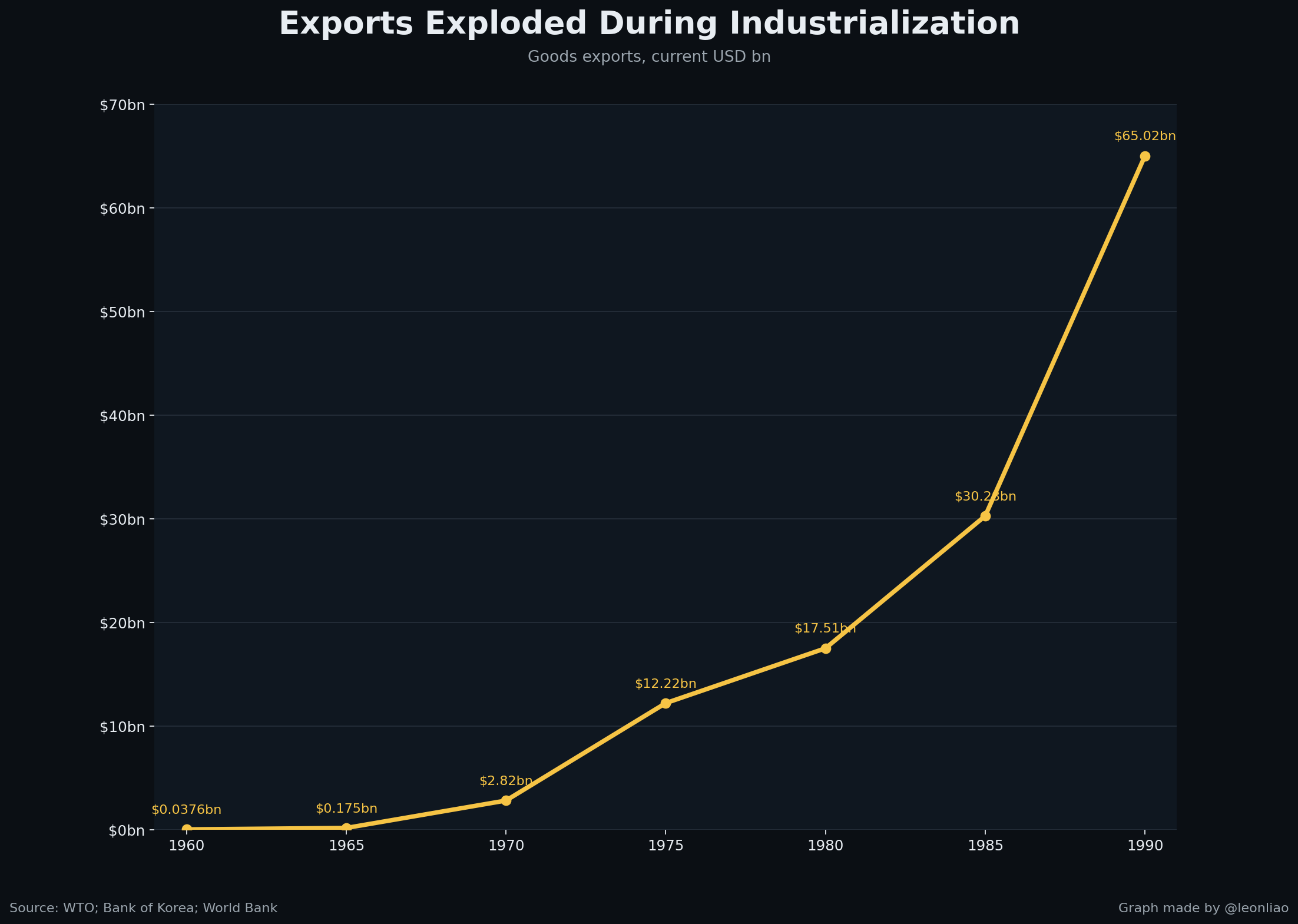
In 1960, South Korea’s exports were only $0.376 billion, with almost no international competitiveness. By 1970, exports had exceeded $2.8 billion, with light industrial goods becoming the main export category. By 1980, exports reached $17.5 billion, as heavy industrial products began to scale. By 1990, exports had reached $65 billion, with electronics, automobiles, and shipbuilding forming the core. South Korea’s export-driven growth model was fully in place. In three decades, South Korean exports expanded roughly 170 times.
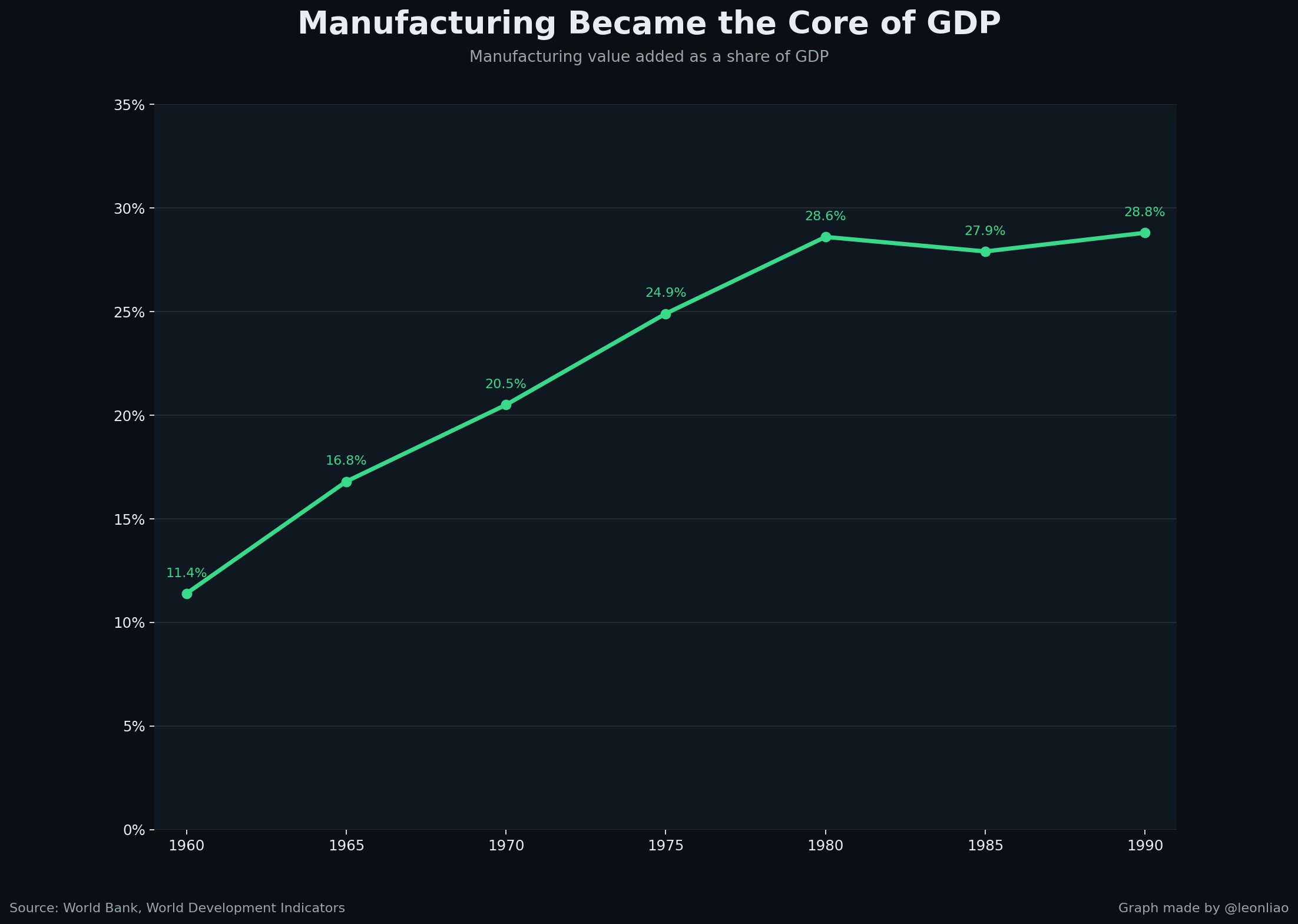
The Heavy and Chemical Industry Drive of the 1970s pushed South Korea into steel, shipbuilding, petrochemicals, machinery, automobiles, and electronics. POSCO, Hyundai Shipbuilding, and the later electronics sector all belonged to this stage of industrialization. From 1960 to 1970, manufacturing value added rose from 11.4% to 20.5% of GDP, as labor-intensive export industries such as textiles, wigs, and footwear expanded rapidly. From 1970 to 1980, the heavy and chemical industrialization strategy — steel, shipbuilding, petrochemicals, and automobiles — pushed the manufacturing share above 28%. From 1980 to 1990, manufacturing remained at a high level of 27%–29% of GDP, while electronics and semiconductors gradually replaced traditional heavy industries as the new pillars.
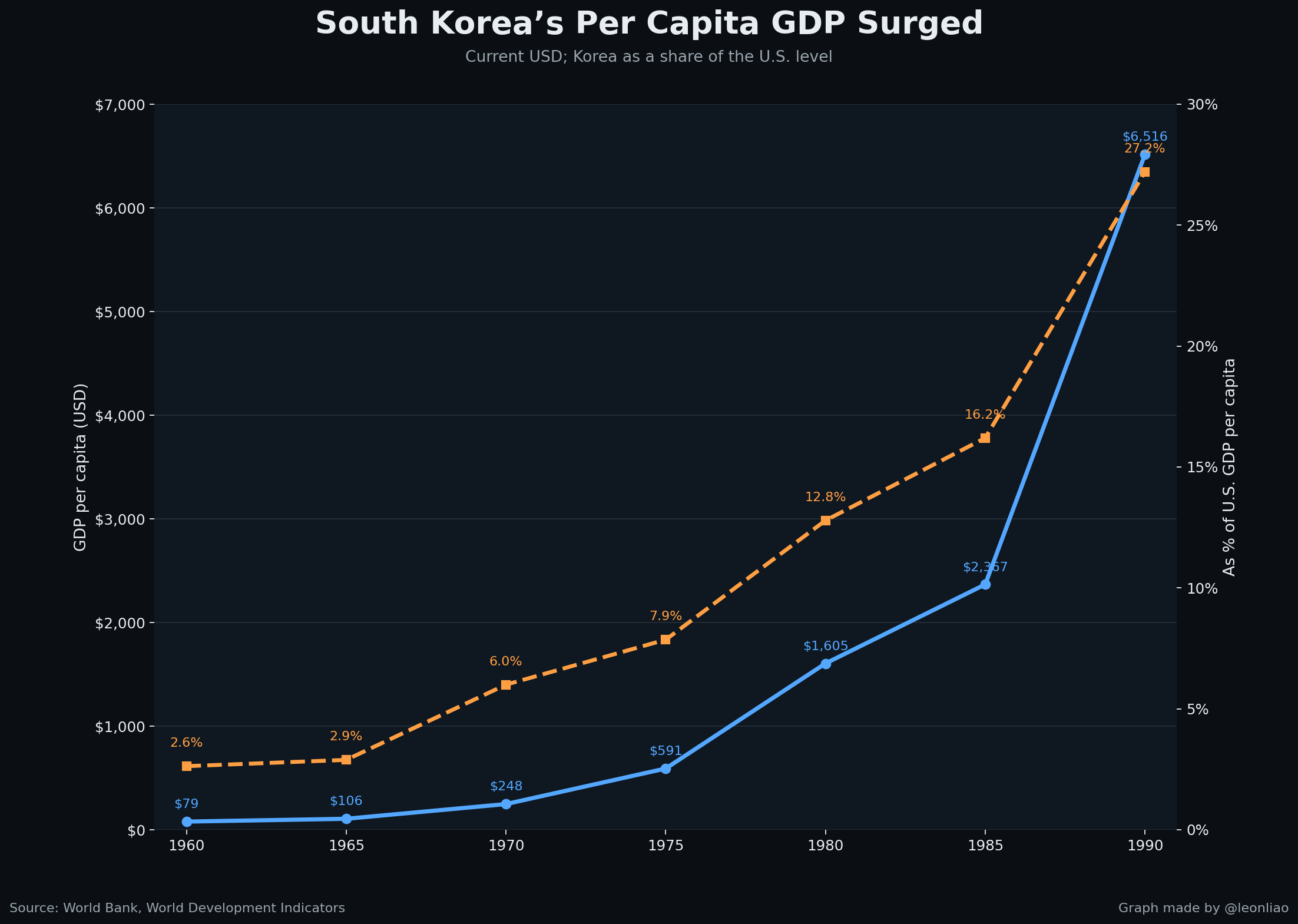
By the time South Korean society truly entered mass democratization in the late 1980s, South Korea was no longer a low-income agrarian country. By 1990, South Korea’s GDP per capita had already reached 27% of the U.S. level.
The democratization of 1987 was not the starting point of South Korea’s industrialization. It was the political result of social-structural change after industrialization. The urban middle class, university students, industrial workers, business groups, export economy, and more complex social organizations had already formed during the authoritarian industrialization period. South Korea later became a developed democracy, but the critical stage in which it entered the ranks of industrial countries was not launched by liberal democracy.
The ticket to becoming a developed country is extremely scarce, and South Korea is one of the very few non-Western countries in postwar Asia that truly moved from a poor agrarian society into the ranks of developed industrial economies. The history of South Korean industrialization shows a clear sequence: industrial takeoff occurred under military-authoritarian rule; mature democracy arrived after industrialization.
2. Taiwan: Industrialization Under Martial Law
Taiwan’s sequence is equally clear.
From the 1950s to the 1980s, Taiwan completed land reform, export-manufacturing expansion, the early formation of the electronics industry, the growth of SME networks, the construction of industrial-technology institutions, and the policy layout for semiconductors. During this period, Taiwan was under Kuomintang one-party authoritarian rule and long-term martial law.
After 1949, the Kuomintang regime retreated to Taiwan. Politically, Taiwan entered a highly controlled order. Party bans, press restrictions, martial law, intelligence and security systems, authoritarian administration, and Kuomintang control over the state apparatus formed the political background of postwar Taiwan. Opposition forces were constrained for a long period, and mature competitive democracy did not emerge.
But Taiwan’s economic structure changed profoundly during this period.
Land reform in the 1950s weakened the landlord class and reorganized rural society. Export-processing zones in the 1960s pushed Taiwan into the global manufacturing-order system. State-owned enterprises controlled electricity, petrochemicals, steel, transportation, and basic materials. The establishment of the Industrial Technology Research Institute in 1973, followed by the Electronics Research and Service Organization, Hsinchu Science Park, UMC, and TSMC, pushed Taiwan onto the path of electronics and semiconductor upgrading.
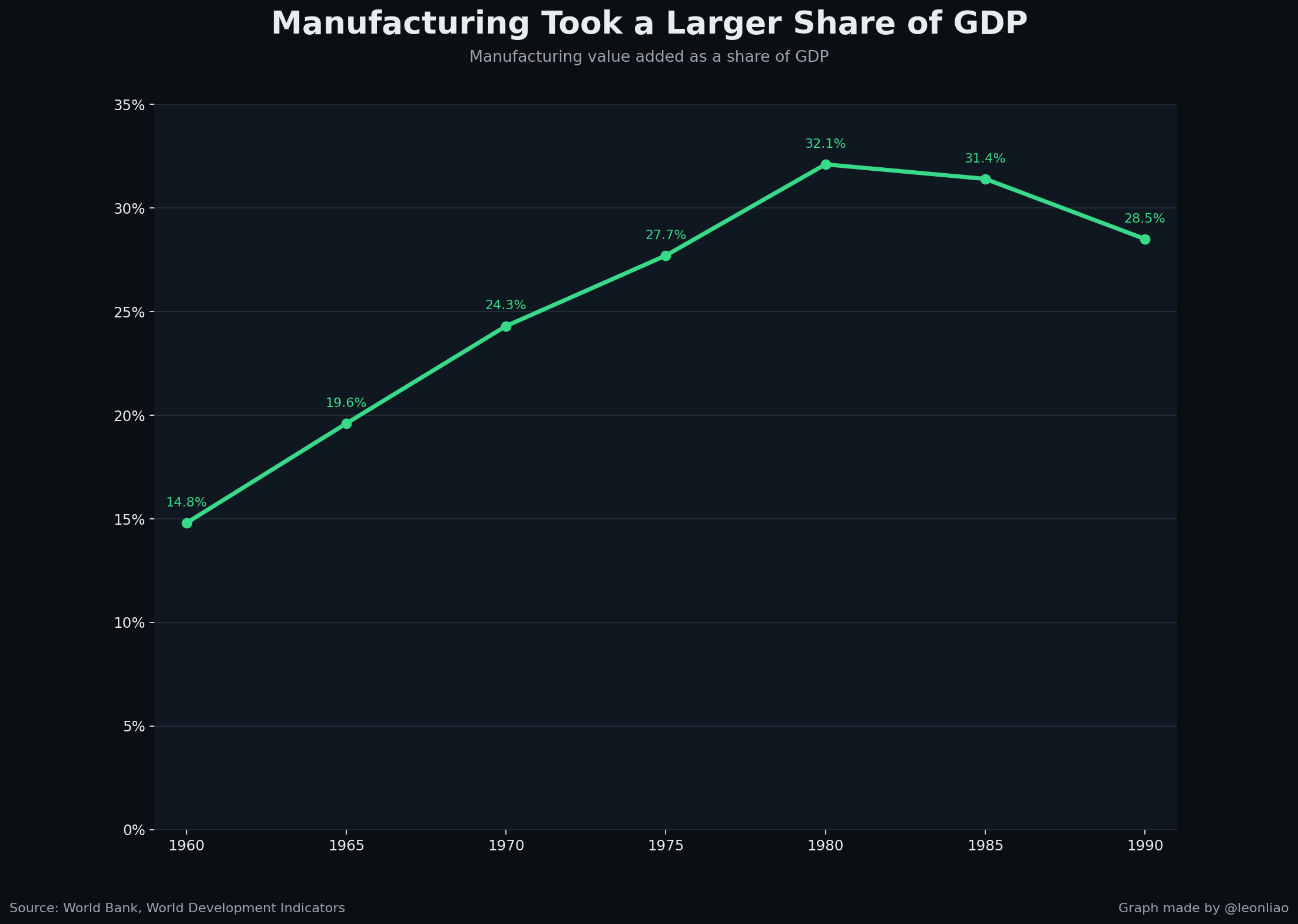
From 1960 to 1970, Taiwan’s manufacturing share rose from 14.8% to 24.3% of GDP, as the Kaohsiung Export Processing Zone drove labor-intensive exports such as textiles, plastics, and footwear. From 1970 to 1980, support for heavy and chemical industries expanded petrochemicals, steel, and machinery, pushing manufacturing to 32.1% of GDP by 1980. Over the following decade, traditional light industries moved outward, while electronics and information technology became the new pillars. Manufacturing’s share gradually fell to 28.5%, but value added rose substantially.
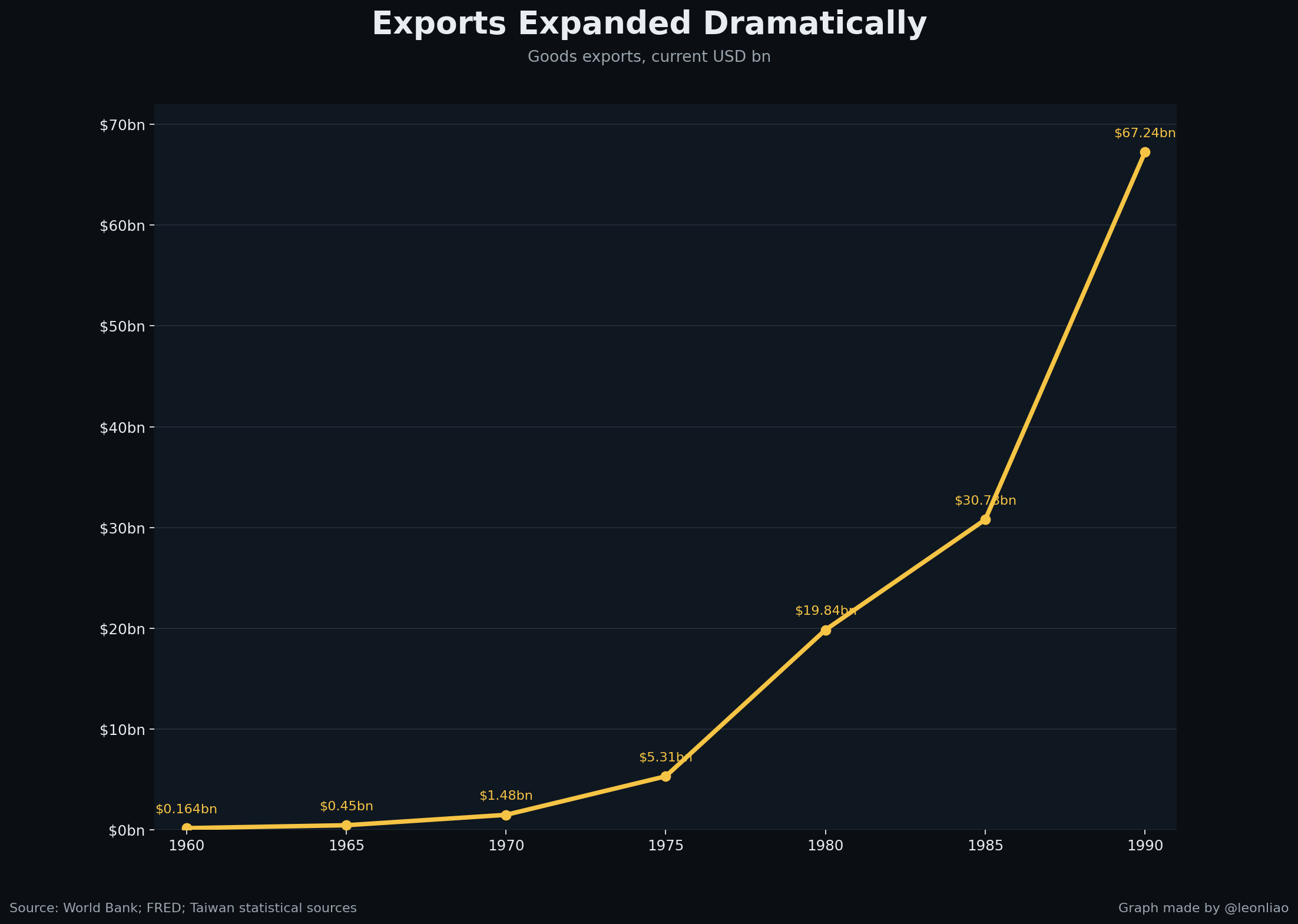
In 1960, Taiwan’s exports were only $0.164 billion, still dominated by processed agricultural products such as sugar and rice. By 1970, exports had exceeded $1.48 billion, with industrial goods accounting for more than 80% of total exports. By 1980, exports were close to $20 billion, with textiles and home appliances as core export products. By 1990, exports had reached $67.24 billion, with electronics, computer components, and machinery becoming the largest export categories. Over three decades, Taiwan’s export value expanded 410 times.
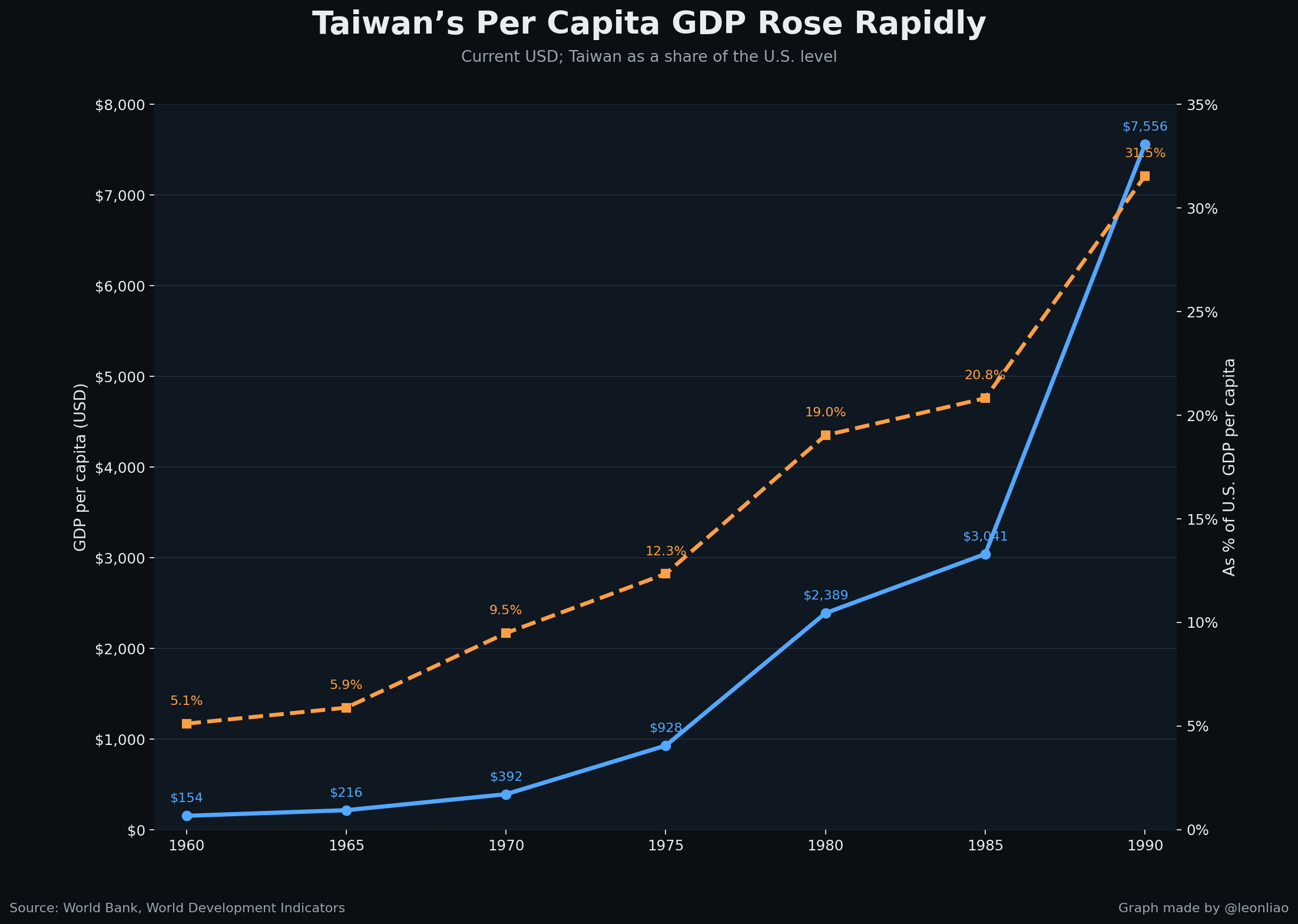
During this process, Taiwan’s GDP per capita caught up rapidly. It moved from a poor region into an upper-middle-income economy. In the 1960s, Taiwan’s per capita income was still only 5%–6% of the U.S. level, relying on U.S. aid and processed agricultural exports to accumulate capital. With the export-oriented industrialization boom of the 1970s, GDP per capita exceeded $2,300 by 1980, reaching 19.03% of the U.S. level. In the 1980s, as Taiwan’s global share in electronics, home appliances, and computer components rose quickly, currency appreciation combined with industrial upgrading. By 1990, Taiwan’s GDP per capita had reached 31.54% of the U.S. level.
Taiwan’s real democratization came only after the lifting of martial law in 1987. The first direct presidential election in 1996 marked Taiwan’s entry into a more complete stage of modern mass democracy. By then, Taiwan already had a highly export-oriented manufacturing sector, an electronics industrial base, technology institutions, and a semiconductor strategy.
Today, Taiwan is often seen as a successful case of democratization in the Chinese-speaking world. That does not change the historical sequence: Taiwan industrialized before it democratized.
Taiwan was not a case of liberal democracy first creating industrialization. It was a case of industrial takeoff under an authoritarian system, followed by gradual democratization.
3. Singapore: A Developed Economy and a Non-Typical Liberal Democracy
Singapore is even more direct.
Today, Singapore is a high-income society, a global financial center, a shipping and aviation hub, a precision-manufacturing base, an electronics and petrochemical center, and a global city-state. It has a highly legalized business environment, elections, a parliament, an efficient administrative system, and world-class public housing, education, ports, airports, and infrastructure.
But Singapore has never been a typical competitive liberal democracy in the Western textbook sense.
The PAP has dominated politics for decades. Opposition parties exist, but the ruling party’s advantage is extremely strong. Trade unions, media, public expression, social organizations, and the space for political competition have all long operated under a highly managed system. This regime cannot be simply equated with a traditional military dictatorship, but it also cannot be packaged as an Anglo-American liberal democracy. It is closer to an authoritarian state under long-term dominant-party rule.
Singapore industrialized inside this political structure.
The Economic Development Board was established in 1961, and from the 1960s onward Singapore began pushing industrialization and attracting foreign capital. Jurong Industrial Estate, public housing, ports, airports, the education system, labor-force management, and multinational corporate investment together formed the foundation for Singapore’s upgrade from an entrepôt port into an industrial and service economy.
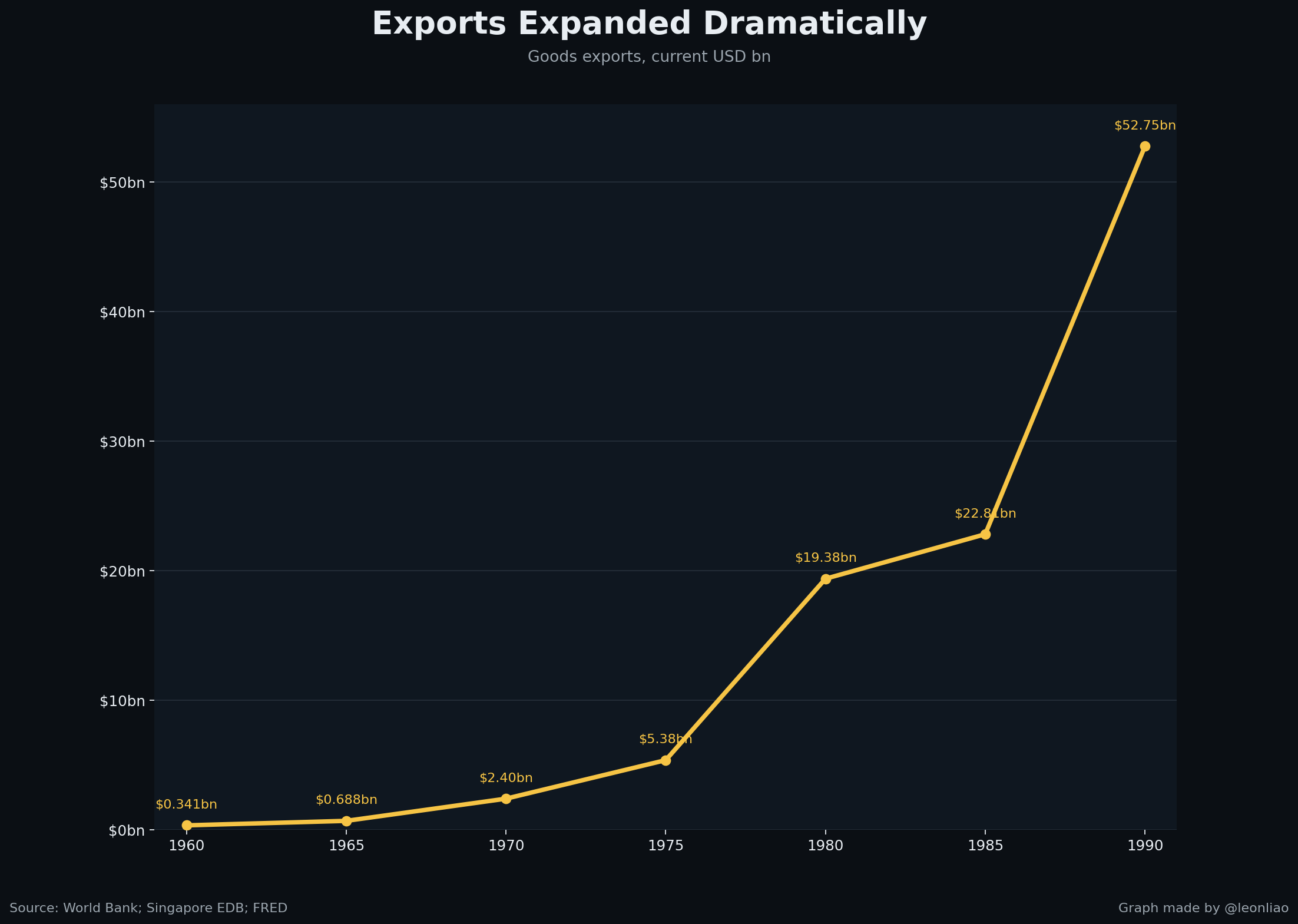
In 1960, Singapore’s exports were only $0.341 billion, mainly primary-product re-exports such as rubber and tin. By 1970, exports had reached $2.4 billion, with industrial goods accounting for more than 75% of total exports. By 1980, exports were close to $19.4 billion, centered on refining, ships, and home appliances. By 1990, exports had reached $52.75 billion, with electronic components and hard disk drives becoming the leading export categories. In three decades, Singapore’s exports expanded 154 times.
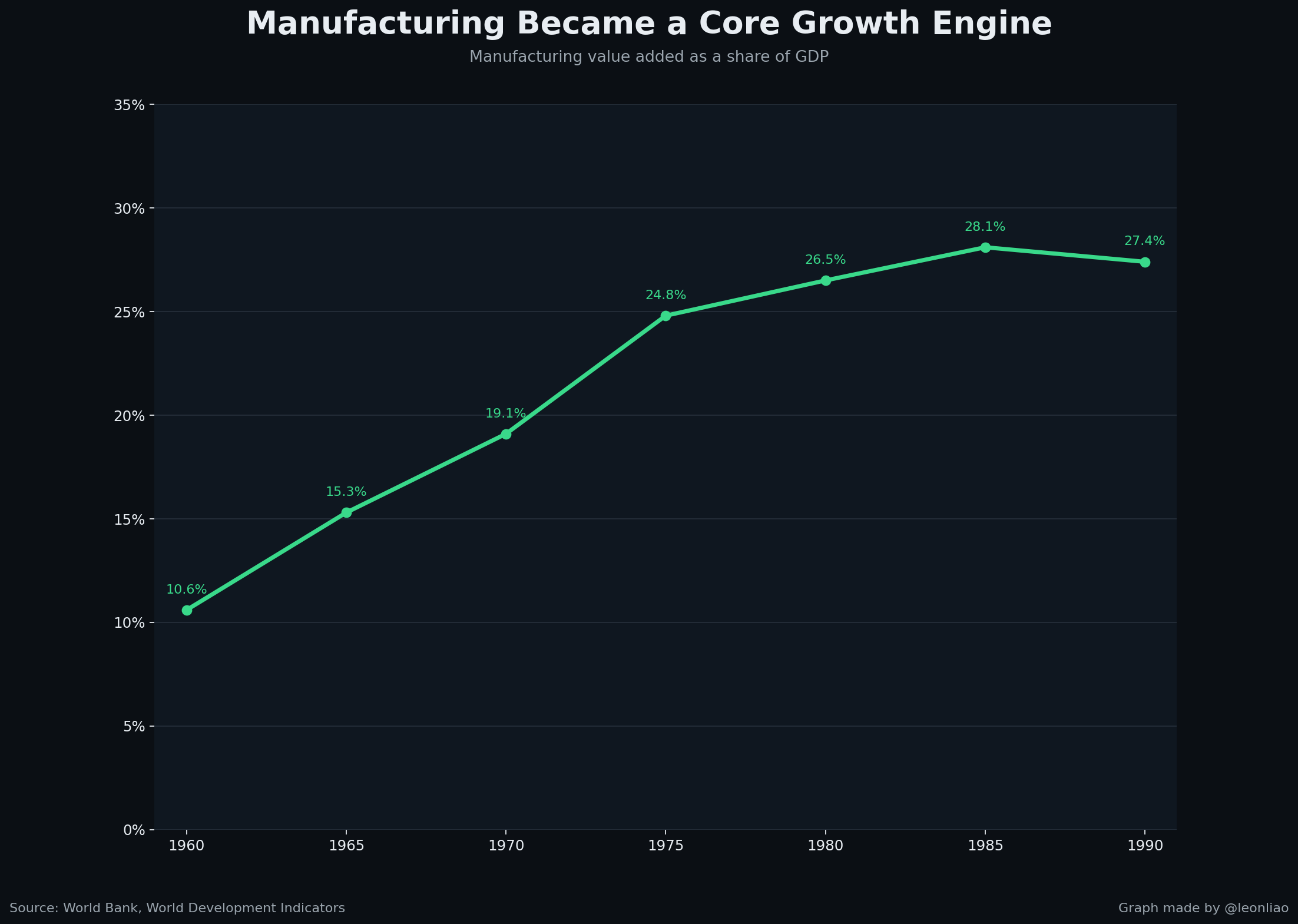
From 1960 to 1970, Singapore’s manufacturing share rose from 10.6% to 19.1% of GDP, as it moved beyond a single entrepôt-trade model and used foreign-invested factories to build an industrial base. From 1970 to 1985, refining, shipbuilding, and electronics assembly drove manufacturing’s continued rise, reaching a peak of 28.1% of GDP in 1985. From 1985 to 1990, traditional low-end manufacturing began moving outward, while higher-value manufacturing such as semiconductors, storage devices, and pharmaceuticals became more important. Manufacturing’s share edged down slightly, but value added rose sharply.
In 1960, Singapore’s GDP per capita was 14.23% of the U.S. level. Income rose quickly on the basis of port re-exports and foreign-invested light industry. In the 1970s, the industrialization dividend was fully released. By 1975, GDP per capita had exceeded $2,700, reaching 36.14% of the U.S. level. In the 1980s, Singapore upgraded into electronics, precision manufacturing, and petrochemicals. By 1985, GDP per capita had reached 50% of the U.S. level. By 1990, it had risen further to 53.27%.
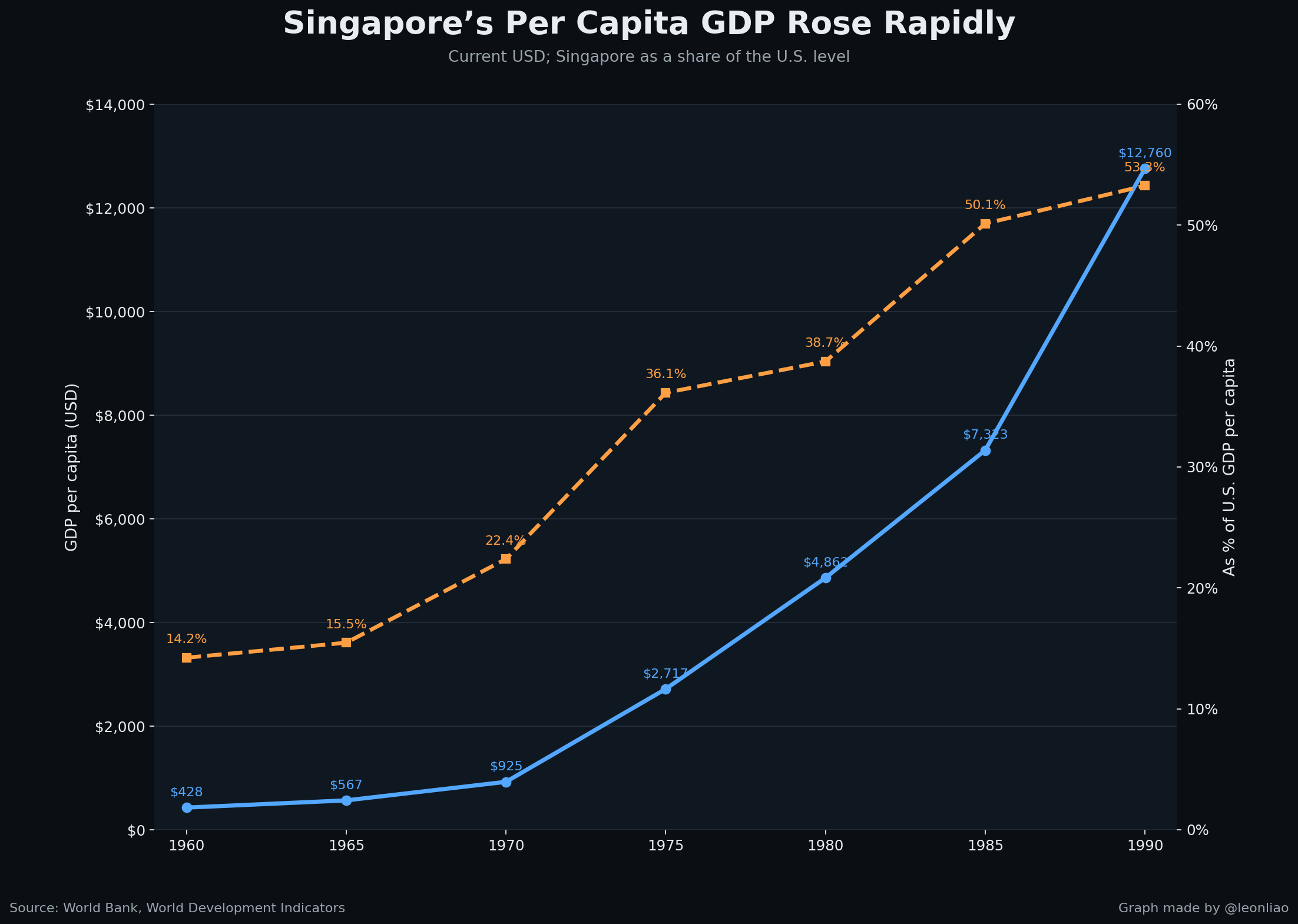
Singapore had no natural resources, no large domestic market, and no agricultural hinterland. It became a high-income economy because a highly centralized administrative state organized openness, foreign capital, land, housing, labor, and infrastructure into one development machine.
Singapore shows that a high-income modern economy does not necessarily begin with competitive liberal democracy. A country can complete industrialization, urbanization, and high-income transformation under a non-typical liberal-democratic political structure.
4. Japan: The Industrial State Came Before Postwar Democracy
Japan is often placed inside the narrative of postwar liberal-democratic success. That narrative covers only the second half of Japan’s political history, and obscures the real starting point of Japanese industrialization.
Japan’s first industrialization did not take place under the postwar liberal-democratic system. It took place after the Meiji Restoration of 1868–1873, under an oligarchic state, an emperor-centered state, an imperial bureaucratic state, and later an expanding military order.
After the Meiji Restoration, Japan’s political core was jointly supported by domain oligarchs, bureaucrats, the military, and the legitimacy of the emperor system. The Meiji Constitution of 1889 established the Imperial Diet, but sovereignty belonged to the emperor. The cabinet was not responsible to parliament. The military held a special position. Genrō elder statesmen and bureaucrats long controlled the direction of the state. Party politics gradually developed, but for a long time it could not dominate the state apparatus.
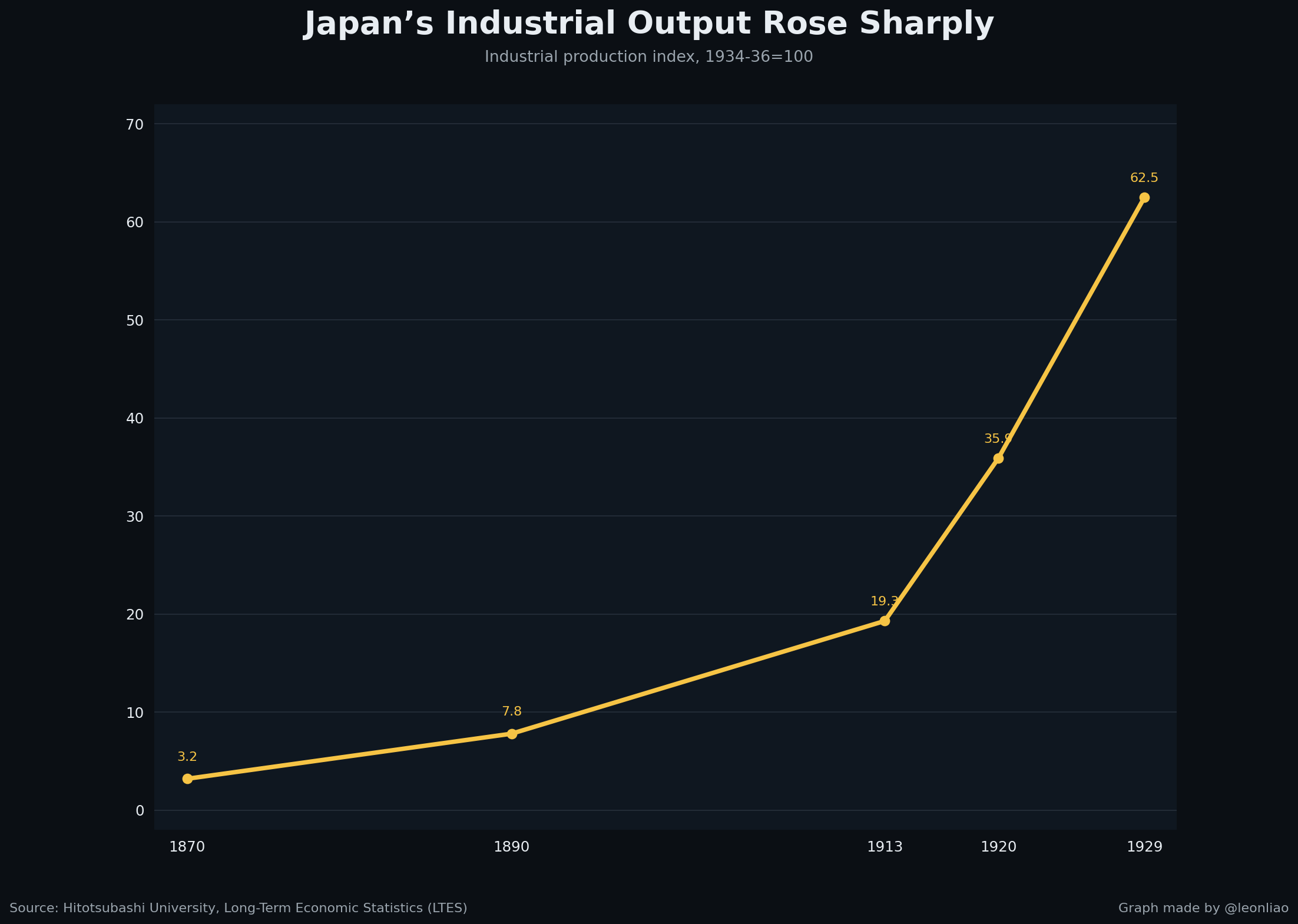
From the Meiji period onward, Japan pushed land-tax reform, compulsory education, conscription, railways, telegraphs, postal services, state-run model factories, military industry, mining, shipbuilding, and later heavy and chemical industries. From 1870 to 1930, Japan’s real industrial output expanded by nearly 20 times. From 1913 to 1920, during the nine years around World War I, industrial output almost doubled, making it the fastest expansion phase of Japan’s modern industrialization. After 1920, global trade weakness slowed the pace. The steel industry, a representative heavy-and-chemical sector, experienced explosive growth during this period: wartime demand from military production and shipbuilding pushed steel output up tenfold in ten years. By 1930, crude steel output had exceeded 2 million tons, reaching roughly 30% of Britain’s level.
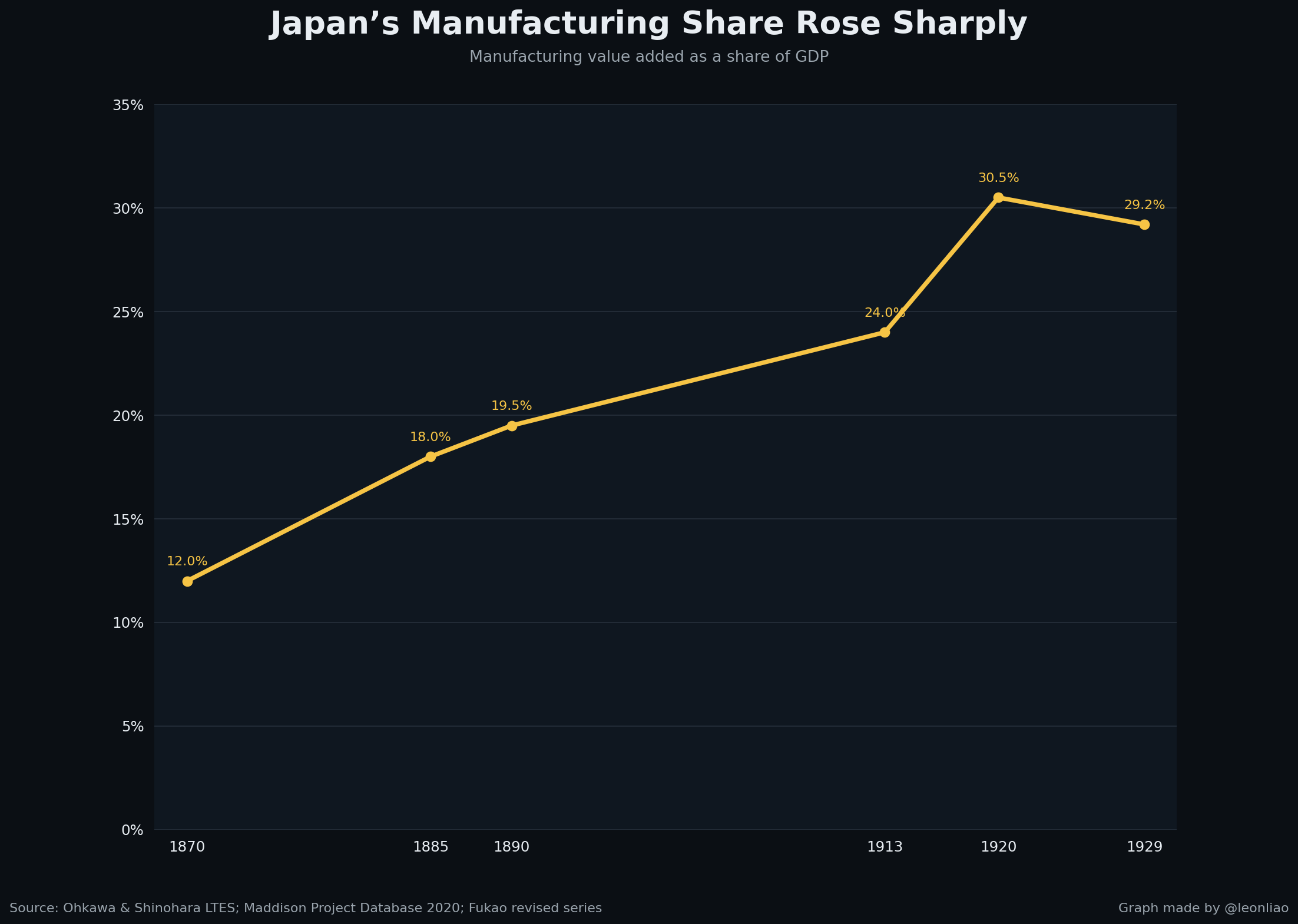
From 1870 to 1890, during the light-industrial takeoff phase, Japan’s manufacturing share of GDP rose from 12% to 19.5%. This stage was dominated by raw silk and cotton spinning. Heavy industry was absent. Japan’s total industrial scale was still only a small fraction of Britain’s, and the country relied on processed agricultural exports to accumulate capital. From 1890 to 1913, during the heavy-industrial foundation phase, Japan used the indemnities from the Sino-Japanese War and Russo-Japanese War to complete primitive capital accumulation. Yawata Steel Works, shipbuilding, and machinery industries took root. Manufacturing’s share rose to 24%, marking Japan’s transition from handicraft production to modern machine industry. From 1913 to 1930, Japan benefited from the supply vacuum created by World War I, as European industry retreated from Asian markets and Japanese industrial goods dominated East Asian exports. In 1920, manufacturing reached a historical peak of 30.5% of GDP. After 1920, global demand contracted, the Great Kantō Earthquake hit, and the yen appreciated. By 1930, manufacturing’s share had fallen back to 28.7%, and industrial growth slowed sharply.
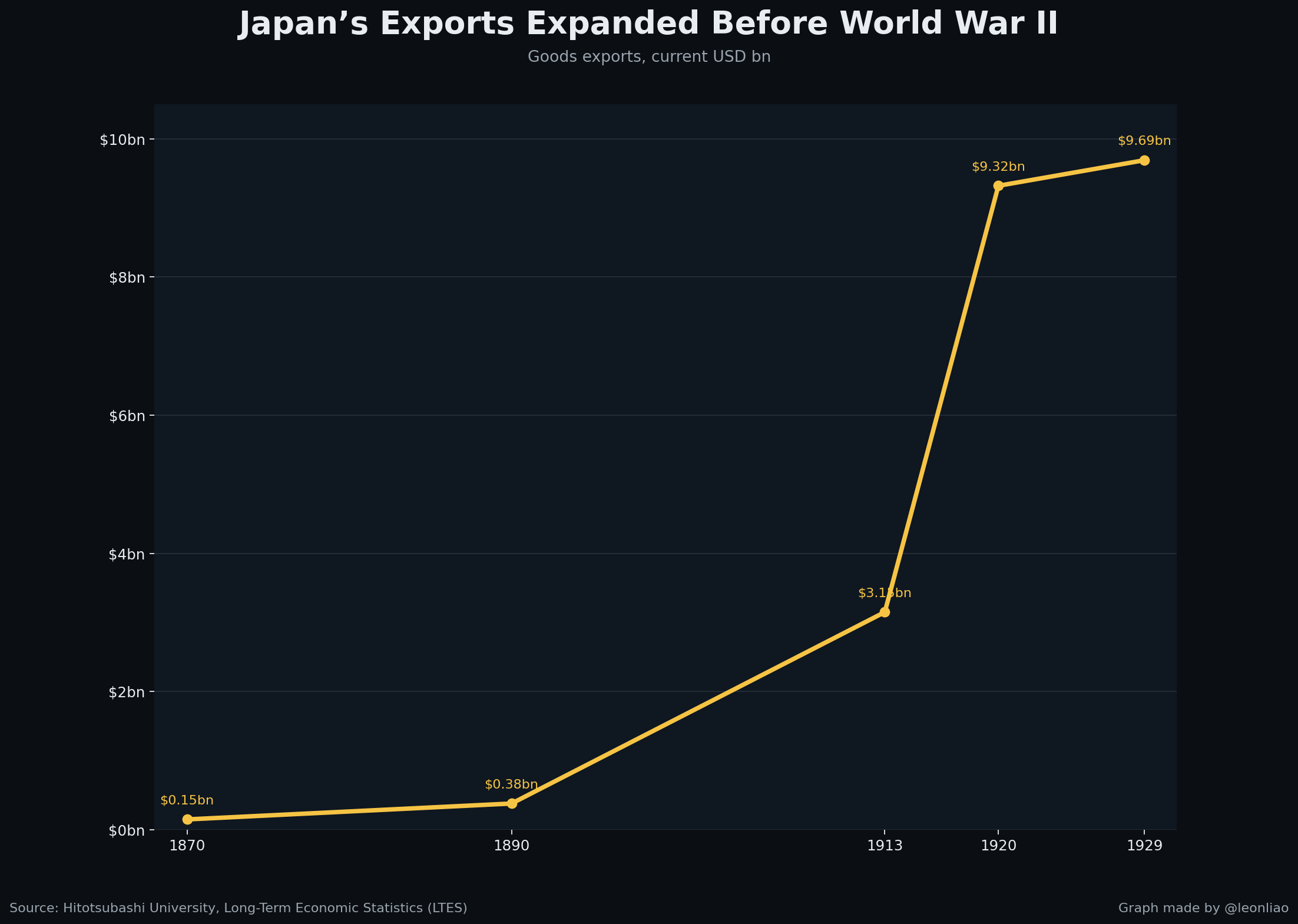
From 1870 to 1930, Japan’s export scale grew unevenly alongside industrialization. In the early Meiji period from 1870 to 1890, Japan exported through treaty ports. In 1870, exports were only $0.15 billion, dominated by primary products such as raw silk, tea, and coal. Manufactured exports were almost nonexistent. Over those twenty years, exports grew only 2.5 times, and foreign trade remained highly dependent on European and American markets. From 1890 to 1913, the indemnity from the Sino-Japanese War helped Japan establish the gold standard in 1897, while the expansion of cotton spinning revived foreign trade. By 1913, exports had risen to $3.15 billion, with raw silk and cotton textiles as the core export goods. From 1914 to 1920, during World War I, European civilian industry cut production, and Japan seized overseas markets for industrial goods. In seven years, exports tripled, reaching $9.32 billion in 1920. Trade surpluses helped Japan accumulate gold reserves, and heavy-industrial exports began to emerge. From 1920 to 1930, postwar demand weakened, Japan’s exports stagnated and fluctuated, and the 1929 Great Depression added another shock. Exports fell from $9.69 billion to $8.75 billion in 1930. The key pillar industry, raw silk, was hit hard, forcing Japan to accelerate domestic heavy-and-chemical industrial upgrading.
Alongside trade expansion, Japan’s export structure became steadily more industrialized. In 1870, primary products accounted for 92% of total exports, while manufactured goods accounted for only 8%. By 1913, manufactured goods had risen to 61% of exports, with raw silk accounting for 45% and cotton textiles 16%. By 1929, the export structure had improved further. Raw silk’s share fell to 32%, cotton and rayon textiles accounted for 28%, and higher-value industrial goods such as machinery, ships, and chemicals accounted for 12%. Manufactured goods as a whole exceeded 70% of exports. Japan had completed its transformation from a primary-commodity exporter into an industrial-goods exporter.
By the 1930s, Japan had become Asia’s strongest industrial state and military-industrial power. This process was closely tied to imperial expansion and military politics, and eventually pushed Japan into the catastrophe of war.
After 1945, under the U.S. occupation reforms, Japan established a new constitution, universal suffrage, parliamentary politics, and more complete civil rights. Postwar Japan did become a constitutional democracy. But this democratic state did not inherit a still-unindustrialized agrarian society. It inherited a country that had already completed its first industrialization, with a heavy-industrial base, an engineering education system, corporate organizations, state bureaucracy, and technological capabilities.
Even in the postwar period, Japan was long not a typical two-party alternation liberal democracy. After 1955, the Liberal Democratic Party dominated politics for decades, forming the so-called 1955 system. During the core decades of postwar high growth, Japan had a constitution, elections, opposition parties, press space, and parliamentary politics. But the actual power structure was stabilized for a long time by the LDP, the bureaucracy, industry, and local interest networks. It was closer to a constitutional democracy under a one-party-advantage system than to an Anglo-American model of competitive party alternation.
So Japan’s industrialization came long before a liberal-democratic system. The Meiji-imperial state completed Japan’s first industrialization. Postwar constitutional democracy was rebuilt on an already industrialized society. The high-growth era then unfolded under the long dominance of the LDP’s one-party-advantage system.
5. Hong Kong: High-Income Transformation Under Colonial Rule
After World War II, Hong Kong gradually developed from an entrepôt port, a refugee society, and a light-industrial base into a high-income industrial and service economy. From the 1950s to the 1970s, textiles, garments, plastics, toys, electronics, and re-export trade drove rapid economic expansion.
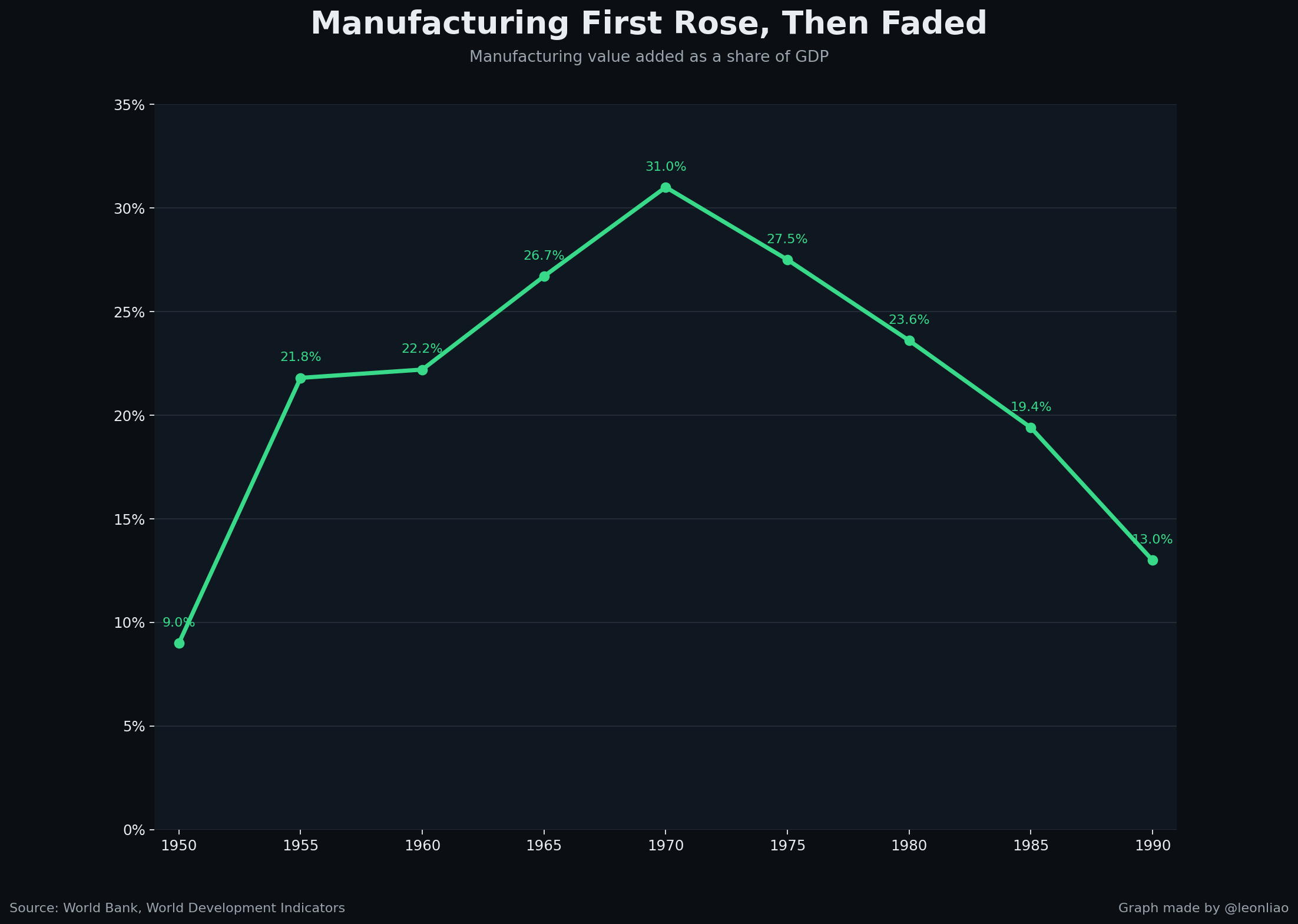
From 1950 to 1970, Hong Kong’s manufacturing share kept rising, from 9% of GDP to a peak of 31% in 1970. After China’s reform and opening began in 1978, labor-intensive factories moved on a large scale into the Pearl River Delta. Manufacturing’s share then entered a long one-way decline, falling to only 13% of GDP by 1990 — far below South Korea’s 28.8%, Taiwan’s 28.5%, and Singapore’s 27.4% in the same year. Hong Kong deindustrialized earlier and shifted toward trade, finance, and services. After the 1980s, Hong Kong increasingly relied on finance, shipping, real estate, professional services, and its connection with mainland China to become a global city.
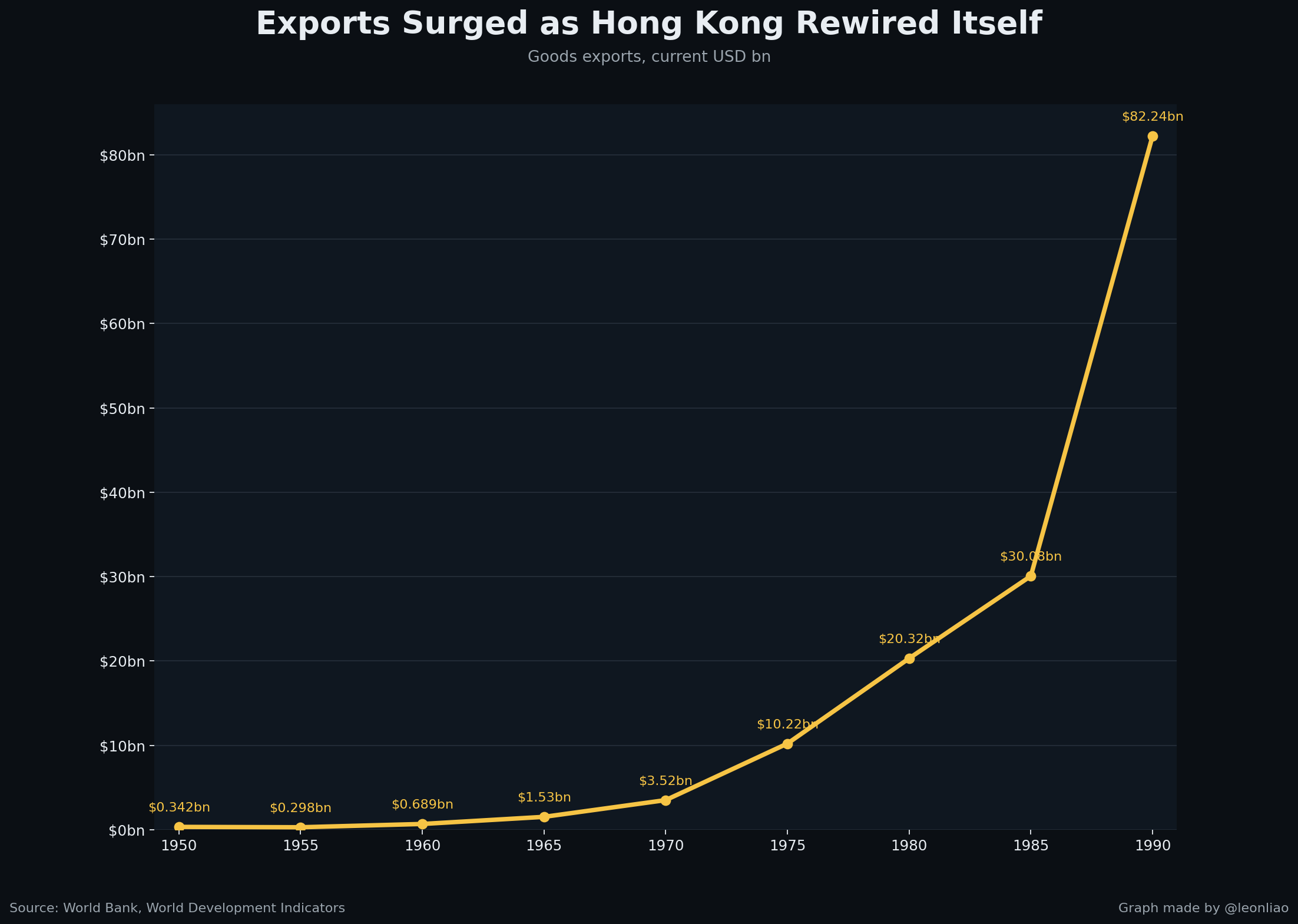
In 1960, Hong Kong’s exports were only $0.689 billion, mainly local light-industrial exports. By 1980, exports had exceeded $20 billion. After that, re-export trade linked to mainland China pushed Hong Kong’s exports sharply higher, reaching $82.24 billion in 1990. In three decades, Hong Kong’s exports expanded 119 times.
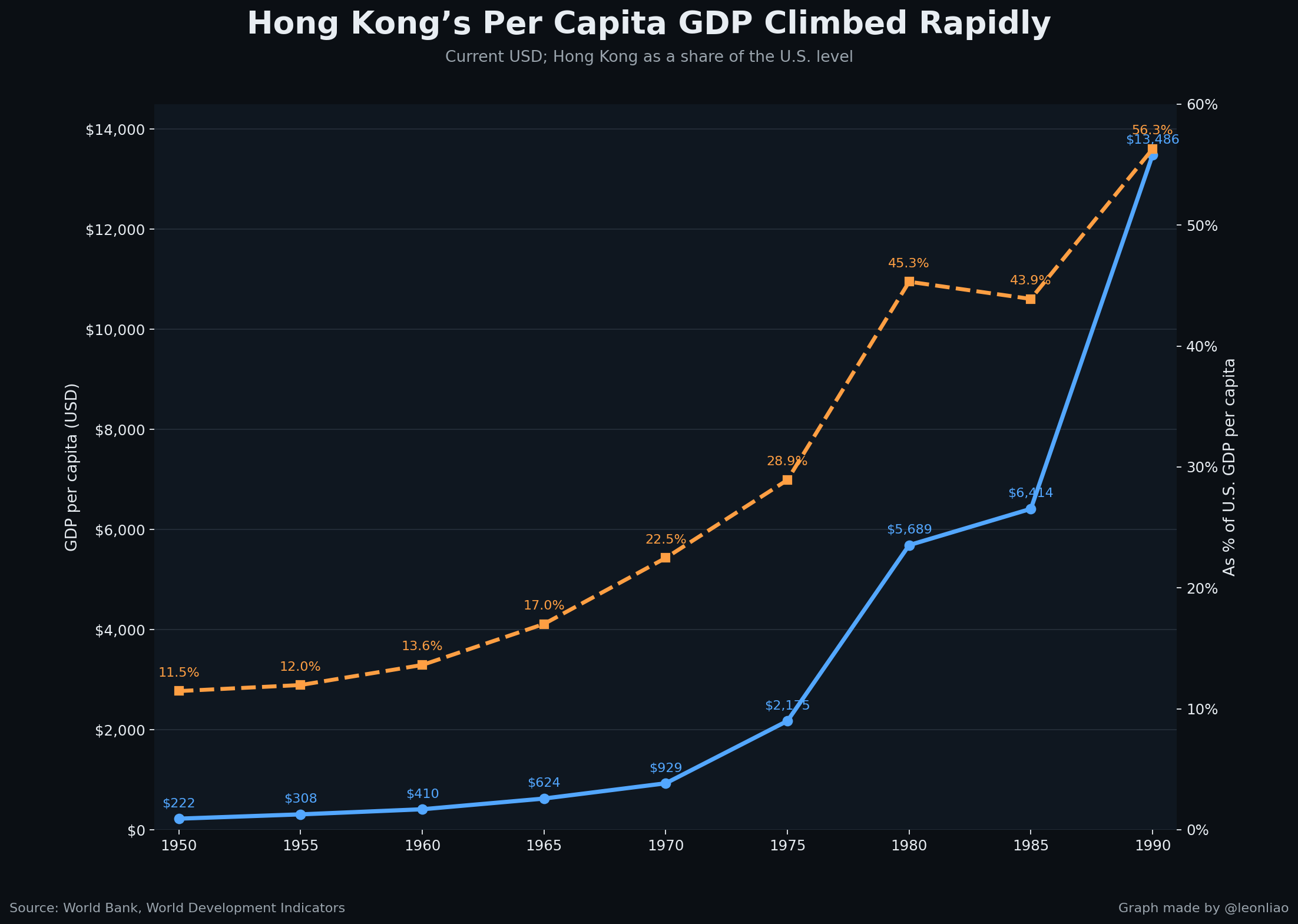
In 1960, Hong Kong’s GDP per capita was $410, only 10.5% of the U.S. level. In the 1970s, the light-industrial dividend drove income upward rapidly. By 1980, GDP per capita had reached 45.32% of the U.S. level. In 1985, it pulled back slightly amid global recession. By 1990, it had exceeded $13,000, reaching 56.30% of the U.S. level, the highest income level among the Four Asian Tigers.
But Hong Kong’s industrial takeoff and high-income transformation did not take place under a liberal-democratic system. It took place under British colonial rule. Hong Kong had common law, the Independent Commission Against Corruption, administrative efficiency, an open economy, and commercial freedom, but it did not have a democratic government in the sovereign sense. The governor was appointed by London. The administrative system was dominated by the colonial government. Political participation remained limited for a long period.
Hong Kong shows that free markets, rule of law, an open economy, and high-income transformation can coexist under a non-democratic colonial system. It is not a full sovereign-state case, but it directly challenges the simple narrative that liberal democracy is the precondition for high-income development.
Of course, Hong Kong’s experience should not be overextended. It depended on special geography, colonial institutions, mainland connectivity, and city-scale advantages. But as a supplementary case, it is extremely powerful: a modern high-income economy does not necessarily require democratic politics to arrive first.
Asia’s most successful industrialization stories were not cases of liberal democracy first creating industrialization. Taken together, South Korea, Taiwan, Singapore, Japan, and Hong Kong show that rapid industrialization took place under authoritarian or non-liberal political structures; democracy, quasi-democracy, or more open political orders emerged only later, after these new industrial societies had already been built.
If we looked only at Asia, this conclusion would already be strong enough. But the myth that most needs to be dismantled lies in Europe. The liberal-democratic narrative often presents continental Europe as the original source of industrialization created by free institutions. The next essay will test that timeline.
If this framework helps you understand China, industrial power, state capacity, capital, technology, and global order beyond the usual headlines, please consider subscribing to China as a System.
A like, restack, comment, or share also helps this work reach more readers.
For a full guide to the publication and its main research series, start here: China as a System: Publication Map.
