
Inside China’s Humanoid Robot Race
China’s humanoid robot race is moving from spectacle to factories, homes, data systems, and embodied AI infrastructure.

China’s real humanoid robot race is no longer about whether machines can run, jump, or flip like humans. It is about whether China can connect AI models, industrial supply chains, real-world scenarios, and labor processes into a new physical intelligence system.
This essay is part of What China’s Industry Media Is Really Talking About.
Executive Summary
China’s humanoid robot industry is moving from capability display to work-capability validation. Robot half-marathons, scenic-area deployments, home-service pilots, supermarket shelf-management tests, and industrial scenarios all show that the industry’s evaluation standard is shifting from whether robots can run, jump, or flip to whether they can complete real tasks reliably.
The core bottleneck of embodied AI is shifting from the robot body to the robot “brain.” Motion control and mechanical design have crossed the first threshold; the next stage of competition will focus on task understanding, spatial perception, VLA models, world models, layered big-brain/small-brain architectures, edge computing, and real-world generalization.
Real-world scenarios are becoming China’s main industrial validation mechanism for embodied AI. Hangzhou’s scenario application competition, Shanghai’s industry summit, scenic-area deployment, and home-service pilots show that China is using local governments, companies, testing institutions, investors, and media to organize scenarios and move robots from laboratories into factories, supermarkets, homes, industrial parks, and public-service spaces.
Data infrastructure will determine whether embodied AI can keep improving. Robots do not need only demonstration videos; they need high-quality, synchronized, well-annotated, transferable action data. The companies that can turn messy physical-world data into trainable robotic experience may control the next-stage industrial entrance.
China’s advantage is not only the number of robotics startups, but its manufacturing and supply-chain system. New-energy vehicles, consumer electronics, industrial automation, sensors, precision machining, lithium batteries, industrial software, and supply-chain management capabilities are all beginning to feed into humanoid robotics and embodied AI.
There is still a bubble in humanoid robotics, but real industrial validation is emerging behind it. The key question is not whether robots can replace human labor at scale today, but whether China can connect AI models, industrial supply chains, real-world scenarios, data systems, and labor processes into a new physical intelligence system.
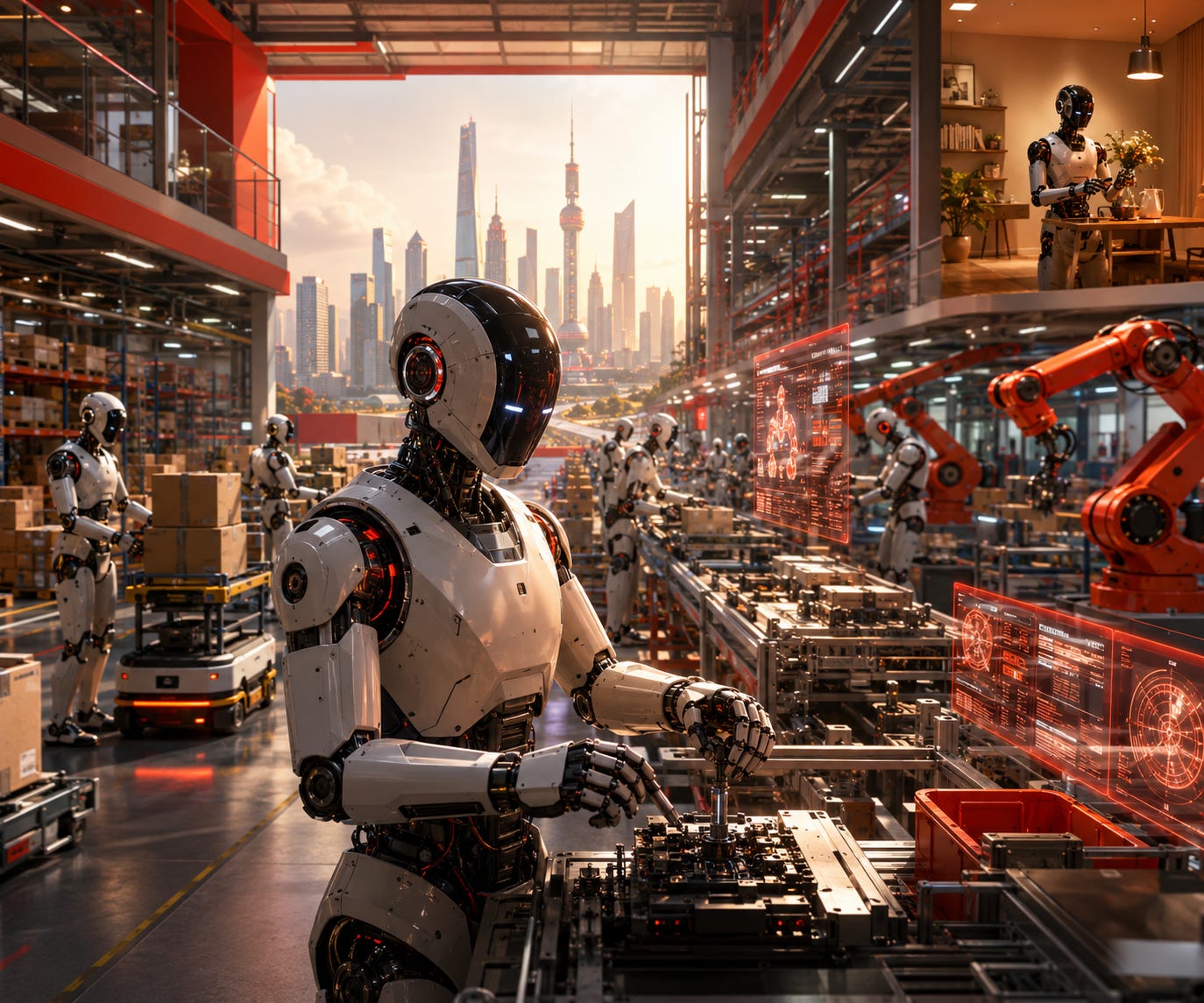
Robots Have Finally Started Running, but the Real Race Has Only Just Begun
On April 19, 2026, the Beijing E-Town Half Marathon and Humanoid Robot Half Marathon concluded. Xinhua reported that “Lightning,” a robot from Shenzhen-based Glory Wisdom Technology’s Qitian Dasheng team, won the humanoid robot race with a net time of 50 minutes and 26 seconds over the 21.0975-kilometer course. It was an unusually visible moment: robots and human runners appeared on the same half-marathon route, separated by barriers, completing the race together. For the general public, it was easy to read this as a visual event about “robots outrunning humans.”
But what Chinese industry media really captured was not just a humanoid robot half-marathon champion. It was a change in the measurement of competition in humanoid robotics. Over the past two years, the most memorable scenes for humanoid robots have come from Spring Festival Gala appearances, trade shows, product launches, parkour videos, dancing demonstrations, and backflips. These performances proved that motion control, joint capability, balance, and body engineering had crossed the first threshold. Now the question is changing: can robots operate stably for longer periods, across more complex paths and more open environments? Can they navigate autonomously? Can they move from the racetrack into factories, shopping malls, homes, scenic areas, and real jobs?
This is the most important common signal in Chinese media coverage of humanoid robots and embodied AI over the past month: China’s humanoid robot industry is moving from the stage of “can it move?” to the stage of “can it work?” This shift sounds simple, but it means the entire industry evaluation system is being reset. Pure motion capability is becoming a basic requirement. What will really determine company value is beginning to shift toward real-world scenarios, data loops, commercial delivery, supply-chain stability, and the generalization capacity of the robot “brain.”
This is different from ordinary AI foundation models. Large models can demonstrate capability in linguistic space. They can quickly gain user feedback through chat, coding, images, and video. Embodied AI has to enter the physical world. It does not face pure text. It faces ground friction, changing light, stairs, glass doors, shelves, tools, clothing, unpredictable human movement, different home layouts, complex factory rhythms, and safety boundaries. A robot dancing on a stage and a robot helping clean a real home, assembling precision components in a server workshop, or identifying and arranging products in a supermarket are entirely different industrial problems.
So the real signal from the half marathon was not that “robots have surpassed humans.” It was that China’s humanoid robotics industry is pushing capability validation from the exhibition booth into open environments. The racetrack is only the first layer of testing. What the industry really cares about lies beyond the racetrack: factories, homes, commercial services, and industrial workflows.
Chinese Robots Are Looking for “Jobs”
A recent TMTPost/Bohu Finance article titled “Chinese Robots Dream of Becoming Workers” captured the shift in the industry narrative very precisely. The report noted that Zhiyuan Robotics’ new A3 humanoid robot will be delivered through the “Qingtian Lease” platform and deployed in batches at scenic areas. ZiBianLiang Robotics announced a partnership with 58.com to provide home services, with robots entering real homes and working alongside cleaning staff. The report’s core observation was direct: over the past two years, appearing on the Spring Festival Gala and joining competitions were important stages for demonstrating robot capability. Now, entering factories, homes, and real-world scenarios to solve actual problems has become the real test.
The phrase “worker” sounds slightly humorous, but it is closer to the core of embodied AI commercialization than many grand technology concepts. If humanoid robots cannot enter labor processes, they will remain demonstration devices, educational devices, exhibition devices, or capital-market concepts. Real industrialization has to answer a set of very plain questions: Can the robot replace part of repetitive labor? Can it collaborate with human workers? Can it remain safe in unstable environments? Can it reduce enterprise costs? Can it form a replicable deployment model? Can it generate new data while working and feed that data back into models and control systems?
This is also the biggest difference between humanoid robots and traditional industrial robots. Traditional industrial robots usually work in structured environments, with clear task boundaries, fixed motion paths, and specially designed workstations. Humanoid robots attract attention because, in theory, they can enter spaces designed for humans without requiring every environment to be rebuilt for machines. They can climb stairs, open doors, carry items, inspect facilities, provide explanations, serve customers, organize objects, and move across factories, shopping malls, homes, scenic areas, hospitals, and warehouses.
But this vision only works if robots can handle the unstructured world. Scenic-area reception and home cleaning may not sound like the most advanced applications, but they may become among the earliest stress tests for embodied AI. Scenic areas involve crowds, paths, questions, unexpected situations, and service interaction. Homes contain furniture, clutter, different floor materials, pets, children, clothing, and complex spatial layouts. When robots enter these environments, they must integrate motion control, semantic understanding, spatial perception, human-machine interaction, and safety constraints.
Recent Chinese media coverage has not stopped at “robots are cool.” It has started asking where robots will actually work. That is the sign that the industry is entering its next stage. Every new technology sector, from concept to industry, goes through a brutal change in evaluation. At first, people look at technical demonstrations. Later, orders speak. Then scene retention, unit economics, maintenance costs, data feedback, and scaled deployment decide company fate. Humanoid robots are now reaching that transition point.
The Robot “Brain” Is Becoming the Main Battlefield
If the most visible competition in humanoid robots over the past two years was in the body, the real competition ahead will increasingly concentrate on the “brain.” TMTPost summarized several current technical routes in embodied AI: VLA end-to-end models, world models, layered “big brain/small brain” architectures, and combinations of these approaches. The article noted that VLA models directly generate actions by integrating multimodal perception signals such as vision with language instructions, but they can run into problems in complex scenarios. World models seek to understand physical rules and environmental evolution, but they require higher data and training costs. The layered big-brain/small-brain approach uses large models to understand tasks and plan objectives, while action models or control systems handle fine execution.
This technical discussion matters. It shows that China’s embodied AI industry is no longer competing only over whether robotic limbs are flexible. It is thinking about how AI enters the physical world. The robot body is the body: motors, reducers, sensors, joints, structural components, and batteries determine whether it can move, move stably, and move for long enough. But beyond the body, a robot must understand tasks, identify objects, judge spatial relationships, predict the consequences of actions, communicate with humans, handle unexpected conditions, and learn from failure.
This is where the concept of embodied AI truly differs from ordinary robotics. It does not mean adding a voice assistant to a traditional robot. It does not mean stuffing a large model into a hardware shell. It requires AI systems to interact with the physical world through a body and form a closed loop among perception, action, feedback, correction, and relearning. When a robot hears “take the blue cup on the table to the kitchen,” it must understand the semantics of “table,” “blue cup,” and “kitchen.” It must locate the object, plan a path, avoid obstacles, control its arm, maintain grip strength, and confirm task completion. If any link in this chain fails, intelligence turns from demonstration into accident.
Signals from the Shanghai International Embodied AI Robotics Industry Innovation Summit point in the same direction. Knews reported that compared with previous years, the 2026 Shanghai summit showed an obvious shift. Demonstration-style performances such as robots writing calligraphy or dancing were much less prominent. Industry participants and visitors focused instead on whether robots could truly solve problems. Taking the place of robot bodies in the spotlight were upstream sectors such as chips and sensors. Some visitors even said they did not see many robots at the venue, but saw many upstream robot-related products.
This is the detail of real industry change. Chinese media was not seeing a simple change in exhibition style. It was seeing the center of gravity in the embodied AI industrial chain move upstream. For robots to truly enter real scenarios, they must solve localization of the “brain,” perception accuracy, edge computing, low-latency decision-making, force control, and system reliability. Performance actions can be carefully choreographed. Real tasks require robots to keep making correct judgments in uncontrolled environments.
The next-stage core question for the humanoid robot industry will therefore move from “whose robot looks most human?” to “who can make robots accumulate experience in the real world?” This is also the new form of Chinese AI competition after AI enters the physical world. Model capability will no longer be reflected only in parameters, leaderboards, or chat experience. It will be reflected in whether robots can turn real tasks into learnable, reusable, and scalable data assets.
Scenario Competition Is Becoming the Industrial Validation Mechanism
The Hangzhou International Embodied Robot Scenario Application Competition is another important signal. Hangzhou municipal media reported that the 2026 competition will be held from May 15 to 16 at Yunqi Town in Hangzhou’s West Lake District. The event will move robots from stages and racetracks into real scenarios such as firefighting, supermarkets, and factories, with some competitions requiring autonomous perception and decision-making. As of the report, the organizing committee had received applications from 90 entities across 15 provinces, municipalities, and autonomous regions.
CCTV previously reported that the competition, themed “Intelligence Opens the Future, Scenarios Without Boundaries,” will include professional testing, application-scenario challenges, entrepreneurship and investment competitions, and interactive exhibitions. It will release embodied robot scenario lists and organize scenario matchmaking, with the goal of accelerating the transition of embodied AI technology from laboratory R&D to industrial application. The report also stated clearly that the embodied AI industry represented by humanoid robots is now at a critical stage of transition from technological breakthrough to commercial validation. The main battlefield of industrial competition has moved from basic motion capability to scenario-based application elimination.
This kind of event is not just another robotics competition. Its meaning is not only to select winners. It puts scenarios, enterprises, local governments, evaluation institutions, investors, and potential customers onto the same industrial platform. For embodied AI, real-world scenarios themselves are scarce resources. Without real tasks, there is no real data. Without real data, there is no model iteration. Without scenario matching, there are no orders. Without orders, there is no scaled production. Without scaled production, there is no cost decline or supply-chain maturation.
China’s way of promoting embodied AI is beginning to show a familiar industrial organization path: local governments provide scenarios and platforms; companies bring products and solutions; evaluation institutions define standards and rules; media convert progress into visible signals; investors reprice companies based on commercial validation. This process will not be perfect. It will include bubbles, duplicated construction, and showcase projects. But it does provide a form of organizational capacity for pushing new technologies from laboratories into industrial sites.
This point is crucial. Commercialization of embodied AI will not come from one company making a single-point breakthrough. It requires factories to open test lines, supermarkets to provide shelf and product data, property managers and industrial parks to provide inspection scenarios, home-service platforms to design collaborative workflows, and local governments to coordinate safety, space, liability, and standards. The closer robots get to real labor, the more they require systemic organization.
From this perspective, the Hangzhou competition, the Beijing E-Town half marathon, and the Shanghai summit are not isolated events. Together, they show that China is turning embodied AI from a technology showcase into an industrial testing ground. The racetrack tests motion capability. The summit tests supply-chain coordination. Scenario competitions test task implementation. Enterprise partnerships test commercial closed loops. These nodes together form the real site of China’s humanoid robot industry.
Data Is the Dirtiest, Heaviest, and Most Critical Infrastructure of Embodied AI
Jazzyear’s report “The Dirtiest Work in Embodied AI Has Become a Hundred-Million-Yuan Business” moved the focus away from robot bodies and toward the deeper data problem. The article noted that data is a critical bottleneck for the embodied AI industry. Many players are building data collection centers, and some companies plan to release million-hour-scale datasets. But truly usable data for training embodied models remains scarce. Much of the data suffers from timestamp misalignment, asynchronous modalities, incomplete annotation, and inconsistent data structures.
This type of reporting is valuable because it avoids the most easily circulated surface images of humanoid robots and goes directly into the hardest part of the industry. What embodied AI really needs is not a few beautiful demonstration videos. It needs large volumes of high-quality action data that are synchronized, annotated, reusable, and transferable. Every grasp, turn, obstacle avoidance, door opening, object handoff, fall, and correction involves vision, language, touch, force, position, velocity, joint angles, and environmental state. Turning these signals into training data is itself a complex engineering task.
The data for ordinary internet AI comes from text, images, webpages, code, videos, and user interactions. Cleaning it is expensive, but at least the data already exists in the digital world. Embodied AI data comes from the physical world. It must be obtained through sensors, robot operations, teleoperation, simulation platforms, real-world scene collection, and human annotation. It is not only costly, but messy. When an action fails, was the error caused by visual recognition, grip force, path planning, joint control, or an environmental change outside the training distribution? These problems cannot be solved by simply increasing data volume.
Therefore, data compilation, simulation training, and real-world feedback will become the least glamorous but most important infrastructure of the embodied AI industry. Whoever can turn messy physical-world data into trainable robotic experience may control the next-stage industrial entrance. On the surface, the robotics industry sells hardware. At a deeper level, the competition increasingly looks like an “experience production system”: real scenarios generate experience; data systems organize experience; models absorb experience; robots then return to scenarios to validate that experience.
This also explains why the commercialization of embodied AI has a natural connection with China’s manufacturing system. China has vast numbers of factories, warehouses, supermarkets, industrial parks, logistics sites, service settings, and infrastructure scenarios. If these scenarios are systematically organized, they are not only robot sales markets, but robot training environments. China’s advantage is not simply that it has many robotics companies. It also has dense, diverse, and high-frequency physical-world application scenarios that can keep pulling AI back into the real world.
The Competition Between Zhiyuan and Unitree Reflects the Industry’s Route Divergence
36Kr/DingjiaoOne’s reporting on Zhiyuan and Unitree provides an important window into the competitive structure of China’s humanoid robot companies. The article noted that Zhiyuan and Unitree together sold more than 70% of the world’s humanoid robots over the past year. Unitree is known for body capability and stage visibility, having gone viral with backflips, spinning movements, and parkour on the Spring Festival Gala stage. Zhiyuan, by contrast, held a partner conference, released products and models, and talked about ecosystem and applications. The report also noted that at Zhiyuan’s APC2026 partner conference on April 17, 2026, founder and president Peng Zhihui said Unitree is mainly body-focused, while Zhiyuan is pursuing full-stack deployment and wants to use its platform in real scenarios to bring actual productivity to customers.
This is not just corporate rivalry. It reflects two capability systems in the humanoid robot industry. One capability is body engineering: making robots more stable, lighter, cheaper, more flexible, and more durable. The other is full-stack system capability: moving the body, motion control, models, brain, small brain, data, scenarios, ecosystem, and customer delivery forward together. The former determines whether robots can enter the market quickly. The latter determines whether robots can be embedded into production and service workflows over the long term.
36Kr also reported that Zhiyuan released four robot bodies and six AI models at its partner conference, and disclosed 2025 revenue of RMB 1.05 billion, up sharply from RMB 60 million in 2024. Zhiyuan also proposed an XYZ curve for the embodied AI industry, calling 2022 to 2025 the development and trial period, 2026 to 2030 the deployment growth period, and the years after 2030 the deployment popularization period.
These numbers and concepts show that the humanoid robot industry is entering a stage closer to real business operation. Financing, product launches, and demonstrations remain important. But revenue, delivery, customers, scenarios, and ecosystem are becoming just as important. Robotics companies can no longer only prove to investors that “the future market is huge.” They also need to prove to customers that the product can be used today, expanded tomorrow, maintained when problems arise, and made cheaper over time.
This is why the phrase “deployment growth period” matters. For embodied AI, deployment is not simply handing over a machine. It means continuously adapting to scenarios, maintaining systems, collecting data, optimizing models, reducing failure rates, training operators, and building after-sales networks. The companies that can turn robots into deployable products, not demonstration prototypes, are the companies that truly enter industrial competition.
Homes, Factories, and Services Are the Three Early Exam Rooms for Embodied AI
Economic Information Daily’s reporting on embodied AI moving toward the “ultimate exam room” of the home placed the household scenario in an important position. The report cited a 2026 embodied AI industry development report from 36Kr Research Institute, which argued that the core breakthrough point for humanoid robot development lies in the evolution of the robot brain. The home is important because it is more open, chaotic, and difficult to standardize than many factory scenarios.
The home is one of the hardest scenarios. Factories can redesign environments. Warehouses can standardize shelves. Supermarkets can fix product categories and workflows. But homes have almost no unified format. Every home differs in layout, furniture, clutter, flooring, lighting, elderly people, children, pets, and living habits. If a robot can safely, stably, and cheaply complete tasks in the home, its generalization capability will be more convincing than in a single workstation.
But the home may not be the earliest large-scale commercial scenario. Industrial, commercial, and public-service settings may land first. Enterprise customers are more willing to pay for efficiency, and they can more easily design workflows, modify environments, centralize maintenance, and calculate investment returns. Scenic-area guidance, supermarket shelf management, industrial-park inspection, warehouse handling, factory loading and unloading, simple assembly, security patrols, hospital delivery, and eldercare assistance may all become early testing grounds.
These three directions correspond to three different industrial logics. Factory scenarios emphasize stability, rhythm, cost, and safety. Commercial-service scenarios emphasize human-machine interaction, brand display, and workflow coordination. Home scenarios emphasize generalization, low cost, safety, and user experience. Recent Chinese media coverage has placed these scenarios together, showing that the industry is no longer only discussing “what robots can do,” but comparing the commercialization sequence of different scenarios.
This will decide company fate. Body-focused companies may first expand shipments through education, research, exhibition, and developer markets. Full-stack companies may prioritize industrial and commercial-service scenarios. Companies with platform partnership capabilities may seek scaled deployment through home services, scenic areas, property management, and logistics. Companies that control data and simulation infrastructure may become foundational suppliers for the whole industry.
Supply-Chain Competition Will Decide Whether Robots Become a Real Industry
Humanoid robots are easily treated as AI products, but they are ultimately complex manufactured goods. They require motors, reducers, lead screws, bearings, sensors, batteries, wiring harnesses, structural components, controllers, chips, operating systems, simulation platforms, models, and whole-machine integration capability. Every link affects cost, reliability, and scaling speed.
The Shanghai summit’s focus on upstream components such as chips and sensors shows that the industry has realized the bottleneck is not only algorithms, but supply chains. Knews reported that chips and sensors had replaced robot bodies as a focus at the exhibition. This shift is itself a sign of industrial maturation. When an industry moves from watching whole-machine performances to examining upstream materials, core components, control systems, and localization capacity, it usually means it is preparing for larger-scale production and deployment.
This is also the distinctive feature of China’s humanoid robot competition. China has not only AI model companies and robotics startups, but also one of the world’s most complete manufacturing systems. New-energy vehicles, consumer electronics, industrial automation, drones, lithium batteries, sensors, precision machining, industrial software, and supply-chain management capabilities can all migrate into embodied AI. The robot body looks like a new product, but behind it lies the possible recombination of many existing industrial capabilities.
The automotive supply chain is especially important. Autonomous driving has accumulated experience in perception, positioning, planning, control, sensor fusion, and automotive-grade hardware. Cars and humanoid robots are not the same product, but both need to perceive, judge, and act in the physical world. The software and hardware capabilities accumulated by automakers and auto suppliers over the past decade in intelligent driving may become one of the industrial foundations of embodied AI.
If the U.S. embodied AI competition depends more on top AI labs, capital markets, and robotics startup ecosystems, China’s advantage may lie more in supply-chain density, manufacturing cost, scenario organization, and iteration speed. China may not lead every foundation-model metric, but it has strong system capability in rapidly combining hardware, scenarios, supply chains, and engineering teams.
This is also what external observers often underestimate when looking at China’s humanoid robot industry. Many reports focus on what robot a company released, or whether a particular demo was real. But the more important questions are: Does the industry have sufficiently low-cost components? Enough engineers? Dense enough suppliers? Enough real scenarios? Local governments and enterprise customers willing to open testing grounds? Media, capital, and industrial organizations constantly making progress visible? These factors together determine the long-term competitiveness of China’s embodied AI.
There Will Be Bubbles, but the Bubble Is Not the Whole Story
Humanoid robots and embodied AI clearly contain bubble elements. Financing is hot. Product launches are frequent. Concepts are abundant. Demonstration videos are everywhere. Many companies will overestimate the maturity of their technology. Many scenarios will not generate stable returns in the short term. Many products remain far from truly replacing human labor. Robot cost, maintenance, safety, battery life, generalization, failure rates, and liability boundaries are still unresolved.
But reducing the entire industry to a bubble would miss the more important change. Bubbles often accompany the early expansion of new industries. The question is whether real technological progress, real supply-chain accumulation, and real scenario demand exist behind the bubble. Chinese media coverage of humanoid robots and embodied AI over the past month shows precisely that the industry is moving from the most superficial concept heat toward more concrete industrial validation.
The robot half marathon validates motion capability and stability. Scenic-area deployment and home services validate commercial scenarios. The Hangzhou competition validates real tasks and evaluation systems. The Shanghai summit validates upstream supply chains and “brain” localization. Jazzyear focused on data infrastructure. 36Kr focused on the route competition between Zhiyuan and Unitree. Put together, these reports reveal a more complete industrial cross-section.
The real question is not whether humanoid robots can replace human labor at scale today. In the short term, of course they cannot. The real question is whether China is building an industrial system that can keep pushing robots from demonstration toward deployment. If that system can continuously reduce hardware costs, accumulate scenario data, improve model capability, train supply chains, establish evaluation standards, and generate customer demand, then humanoid robots will not remain a short-term concept.
The Core of China’s Embodied AI Is Not Whether Machines Look Human, but Whether AI Can Enter Real Production Systems
The easiest way to misread humanoid robots is to focus on appearance. People see robots walking, running, and dancing like humans, so they naturally focus on whether they “look human.” But the real importance of embodied AI is not anthropomorphic form. It is whether AI can enter real production and life systems through a body.
The next stage of China’s humanoid robot industry will not be decided by one half-marathon champion or one product launch. It will be decided by a series of more concrete questions: Can robots work stably for eight hours in factories? Can they identify products and manage shelves in supermarkets? Can they move safely in homes and complete simple chores? Can they collaborate with humans in scenic areas, hospitals, industrial parks, and warehouses? Can every failure become data, every deployment become model iteration, and every scenario become a replicable solution?
This is the real value Chinese industry media has provided over the past month. It has not only discussed technology visions or company valuations. It has placed robot half marathons, scenic-area deployment, home services, scenario competitions, the Shanghai summit, data infrastructure, and the Zhiyuan-Unitree rivalry into the same industrial field. That field shows that China’s embodied AI is moving from the “robot performance era” toward the “robot work era.”
China’s real humanoid robot race is no longer about whether machines can run, jump, or flip like humans. It is about whether China can connect AI models, industrial supply chains, real-world scenarios, and labor processes into a new physical intelligence system. Once this system forms, humanoid robots will no longer be just a technology consumer product or a capital-market theme. They will become a new interface through which China’s manufacturing, services, and artificial intelligence industries evolve together.
Source note: This essay is based on recent Chinese media reporting from Xinhua, TMTPost/Bohu Finance, 36Kr/DingjiaoOne, Knews, Hangzhou municipal media, CCTV, Economic Information Daily, and Jazzyear. All translations of short quoted phrases are my own.
What stands out to me is not just the OEM race but the system-level buildout behind it. Once local testing bases, component clusters, integrators, and factory demand start compounding together, the investable signal often appears in suppliers before it appears in the robot brands themselves.
a very granular and helpful look into the next emerging tech sector China is poised to dominate. Just like LLMs, humanoids will develop most rapidly if they are diffused most broadly. the size of China's population and industry offer the prime opportunity for humanoids to learn and iterate.
also China's EV sector will directly benefit its humanoid sector as both share largely identical supply chains. this is just like China's EV industry has benefited from its dominant smartphone and battery industries. All these verticals share foundational components that form a self-perpetuating flywheel.