
Inside China’s Transformer Export Boom
Global AI, aging power grids, and the energy transition are pushing China’s power equipment factories into the center of a new infrastructure race

China’s transformer export boom is not a normal foreign-trade story. It shows that China’s manufacturing system is moving into the foundational infrastructure layer of global AI, grid modernization, and the energy transition.
This essay is part of What China’s Industry Media Is Really Talking About.
Executive Summary
China’s transformer export boom reflects a deeper global infrastructure bottleneck created by AI data centers, aging grids, renewable integration, and emerging-market electrification.
Transformers have moved from a low-profile industrial product to a critical constraint in the physical infrastructure of the AI and energy-transition era.
China’s advantage comes from delivery speed, supply-chain density, engineering responsiveness, and industrial-cluster coordination, not simply from low-cost manufacturing.
Chinese power equipment exports are shifting from product shipment toward broader system capability, including grid equipment, project delivery, engineering services, and eventually standards influence.
The export boom still faces serious barriers, including North American certification systems, trade restrictions, local supply-chain protection, high-end technology gaps, and the need for overseas service networks.
The larger signal is that China’s manufacturing system is moving from the role of “world factory” toward the role of global infrastructure capability supplier for AI, electricity, and energy-transition systems.
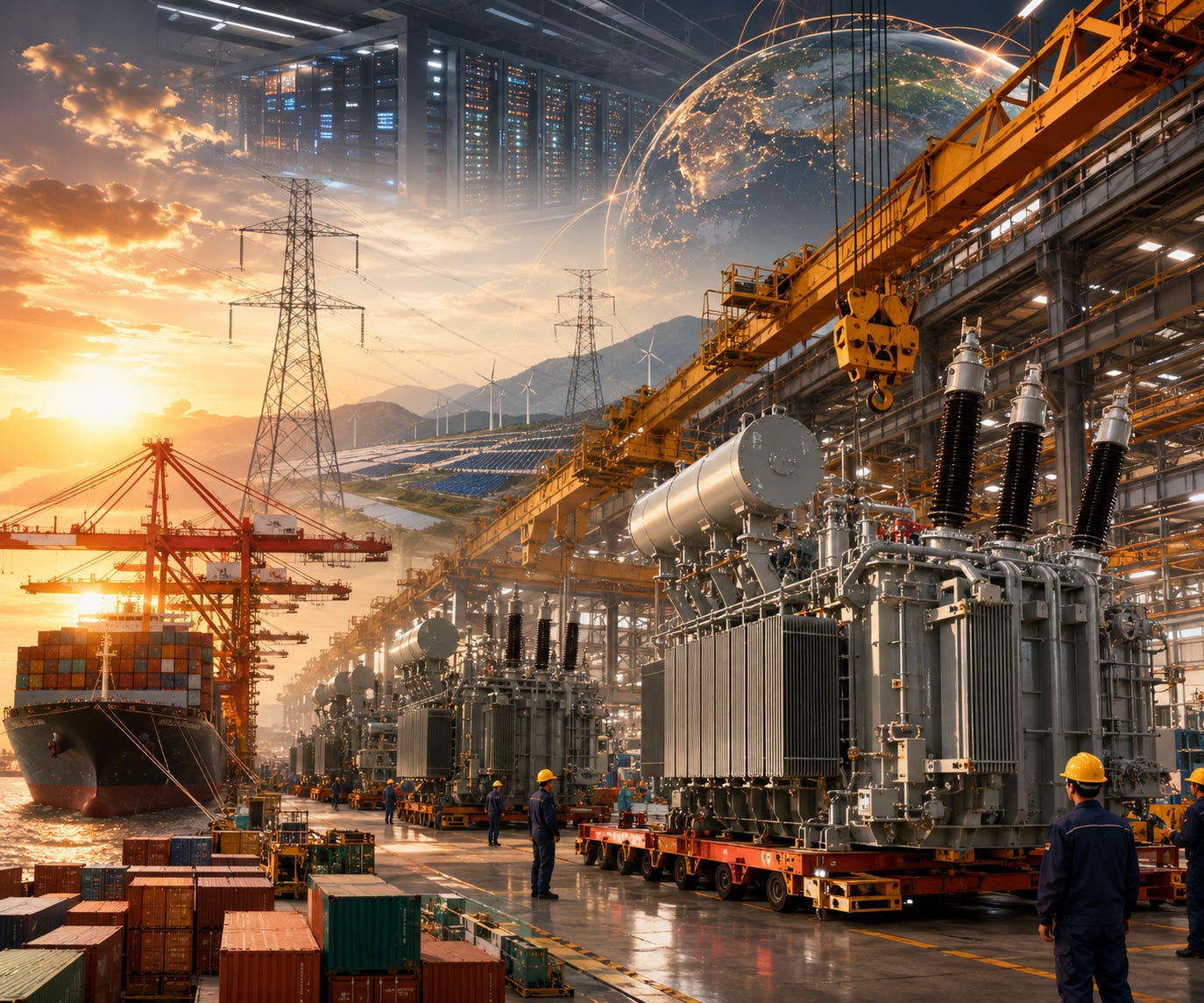
A quiet industrial product has suddenly moved to the front line of global infrastructure shortages
China’s power equipment exports are entering an unusual period of intensity. Over the past few years, when global markets discussed Chinese exports, the most frequently mentioned categories were electric vehicles, lithium batteries, solar modules, construction machinery, and consumer electronics. But over the past month, Chinese industry media have begun paying close attention to a deeper and less visible export category: transformers and power equipment.
Xinghai Intelligence, a vertical media outlet under 36Kr, used a striking headline in one recent report: “Chinese transformers are being snatched up by the whole world.” The phrasing is internet-style, but the underlying issue is real: a global supply bottleneck in electrical infrastructure. The report described foreign buyers entering transformer factories in Liyang, Changzhou, Jiangsu Province, to conduct factory acceptance inspections and even lock in future production capacity in advance. Some European customers were willing to pay higher prices to secure delivery. Transformer factories in Jiangxi and Henan were also running at full capacity, with order backlogs stretching further into the future.
The value of these reports lies in the way they bring an industrial product that rarely enters public discussion back into the larger story of global infrastructure rebuilding. A transformer is not a product that naturally generates public imagination. It does not have the brand story of an electric vehicle, the technological aura of robots or large language models, or the visible energy-transition symbolism of solar panels. But inside the real energy system, the transformer is a critical node connecting power generation, transmission, transformation, distribution, and final electricity use. Without transformers, electricity cannot be converted across voltage levels, and data centers, factories, urban grids, renewable power stations, and charging infrastructure cannot be smoothly connected to the power system.
This is the most important signal in recent Chinese industry-media coverage: global infrastructure shortages are moving from the question of “whether there is enough electricity” to the question of “whether electricity can be delivered to the right place.” AI data centers require large-scale, stable, high-density power supply. Aging grids in the United States and Europe require modernization. Renewable generation needs grid connection. Emerging markets need new power infrastructure. All these demands ultimately converge on a group of industrial products that look traditional but are extremely important: transformers, high-voltage switches, distribution cabinets, cables, meters, energy storage systems, and grid automation equipment.
The core of this wave of Chinese power equipment exports is not that Chinese companies have suddenly discovered a new export category. It is that global energy systems and digital infrastructure expansion have simultaneously run into a bottleneck in power equipment supply. The on-the-ground details provided by Chinese industry media show that Chinese companies are not merely taking orders in a normal business cycle. They are providing delivery capacity at a moment of global grid equipment shortage.
Why transformers have suddenly become a globally contested product
The rising demand for transformer exports looks on the surface like order growth. At a deeper level, it reflects three simultaneous pressures on the global power system.
The first pressure comes from the modernization of aging power grids in the United States and Europe. A large share of grid assets in the U.S. and Europe was built decades ago. Investment has been insufficient for years, and many transformers, transmission lines, and distribution assets are approaching or exceeding their designed service lives. In normal times, aging grids can continue operating through maintenance and partial replacement. But when renewable integration, EV charging, data center expansion, and industrial load reshoring happen at the same time, the redundancy of the old system is quickly consumed. Chinese media reports noted that delivery lead times for some transformers in the U.S. market have lengthened significantly, with certain products stretching from dozens of weeks to much longer time frames. This detail matters because it shows that transformer shortages are not merely a short-term inventory problem. They reflect a structural mismatch among domestic manufacturing capacity, certification systems, supply-chain organization, and new demand in the U.S. and Europe.
The second pressure comes from renewable grid connection. Wind and solar power do not become stable power-system capacity simply because equipment is installed. Renewable power stations require voltage step-up, grid connection, transmission, dispatching, and energy-storage coordination. Behind these processes sit large quantities of transformers, switching equipment, cables, and grid automation systems. Over the past few years, global renewable installations have expanded rapidly, but grid investment in many countries has not kept pace. As a result, renewable generation capacity has increased, while grid connection and absorption have become new bottlenecks. China’s expansion in solar, wind, and energy-storage supply chains has therefore also driven the overseas expansion of power equipment, because more foreign renewable projects now need not only modules and batteries, but an entire set of power-connection capabilities.
The third pressure comes from AI data centers. Caixin’s recent reporting on data centers and power equipment exports elevated this issue to a higher level: global data centers are entering a historic expansion cycle, while power-supply architectures and electrical system designs for data centers are changing rapidly. This is directly activating opportunities for Chinese power equipment exports. AI is usually understood as a competition in chips, models, compute, and software ecosystems. But as the training and inference needs of large models continue to grow, AI competition is moving closer and closer to power infrastructure competition. Data centers are not abstract clouds. They are high-density power-consuming facilities that require stable grid access, voltage transformation, power distribution, backup power, energy storage, and cooling systems. Whether the power system can be connected quickly is becoming a major constraint on data center construction timelines.
36Kr cited International Energy Agency-related forecasts suggesting that global data center electricity demand could reach close to 945 TWh by 2030. Yicai also cited similar expectations in its coverage of the grid equipment sector, noting that AI demand, aging infrastructure replacement, and renewable energy development are jointly pushing up transformer demand. Whatever the precise future number turns out to be, the direction is already clear: the infrastructure bottleneck of the AI era will not stop at GPUs; power equipment is becoming another harder and more physical constraint.
This is why transformers have suddenly become important. Chips determine compute density. Models determine intelligence. Capital expenditure determines the scale of data center construction. But the power system determines whether these investments can actually run. Even if a large data center project has land, chips, and servers, its progress can still be delayed if it cannot obtain fast and stable grid access. The transformer has therefore moved from being a backstage device to a front-stage bottleneck.
Chinese companies’ advantage comes from delivery cycles, not just low prices
The rapid expansion of Chinese transformer and power equipment exports cannot be reduced to low prices. Cost advantage certainly exists, but the keyword that repeatedly appears in recent Chinese industry-media reports is delivery cycle.
Reports reposted by Xinhua and Economic Daily focused on the Changzhou industrial cluster in Jiangsu Province. They noted that some local companies’ products have been exported to more than 100 countries and regions, and that foreign buyers have entered factories to inspect products and lock in production capacity in advance. The delivery cycle for similar transformers overseas can reach 24 months, while some companies in Changzhou can compress delivery into just a few months. Customized design cycles abroad often take several months, while Chinese companies can sharply shorten the design process. Changzhou has more than 70 transformer export companies, and local transformer exports rose by more than 60% year on year in the first quarter.
These figures explain more than simple export growth. They show that Chinese companies are not offering an isolated product, but a complete form of industrial organization capacity. A transformer may be a traditional industrial product, but it is not a simple standardized component. Grid standards, use cases, capacity requirements, climate conditions, safety certifications, and customer engineering requirements differ across countries and regions. Companies need to respond quickly to customized design needs. They need stable access to core components such as cores, copper, insulating materials, tanks, bushings, switches, and control systems. They also need to organize production, testing, logistics, and customs clearance. China’s advantage comes from the simultaneous presence of all these links, and from the fact that they are physically close enough to one another.
The Changzhou case is worth writing about because it shows an often-overlooked side of China’s manufacturing system. China is not relying only on a few national champions to compete globally. It has many regional industrial clusters that provide the ability to design quickly, source quickly, produce quickly, and deliver quickly. The Yangtze River Delta has dense supply chains, complete industrial support, and relatively smooth coordination among local governments, customs authorities, ports, logistics providers, and companies. For foreign customers, the most direct experience is simple: when domestic suppliers require long production queues, Chinese companies can provide solutions faster, organize production faster, and complete delivery faster.
This is the core competitiveness of Chinese power equipment exports: not that a single device is cheaper, but that the entire industrial system responds faster.
During a period of global infrastructure shortage, delivery speed itself becomes a strategic capability. If the United States and Europe lacked only a single product, imports could solve the problem. But if they lack supply-chain coordination, engineering design speed, and large-scale manufacturing organization, then rebuilding the supply chain becomes far harder. China’s export strength in transformers is the result of steel, nonferrous metals, electrical materials, machining, automation equipment, logistics ports, testing and certification, engineering talent, and industrial clusters working together.
This is highly similar to the export logic of electric vehicles, solar panels, and energy storage. Chinese companies do not expand overseas simply because a terminal product is cheap. They expand because the Chinese manufacturing system can compress upstream materials, midstream components, equipment manufacturing, engineering design, and large-scale delivery into a dense industrial network. Transformers are the latest expression of this system capability in the power equipment sector.
Global power equipment shortages are revaluing China’s industrial system
The growth of Chinese power equipment exports is no longer only an industry story. It is beginning to enter capital-market and industrial-strategy discussions. A recent Shanghai Securities News report noted that performance across power equipment subsectors is diverging, but overseas expansion and ultra-high-voltage investment may become the industry’s “dual growth engines.” The report said that in the first quarter of 2026, China’s cumulative power equipment exports reached RMB 24.805 billion, up 35.99% year on year. Transformer exports continued to grow at a high rate, with particularly strong performance in Africa and Europe, while the North American market remained stable.
This data has two implications. First, power equipment exports are not being driven by a single market. Europe needs grid modernization and renewable integration. North America needs to respond to data centers, grid upgrades, and manufacturing reshoring. Emerging markets need to build basic power systems. Africa, the Middle East, Southeast Asia, and Latin America all have larger room for power infrastructure expansion. Chinese power equipment companies are not facing a regional export opportunity. They are facing a global power-system rebuilding cycle.
Second, power equipment exports are moving from product exports toward more complex capability exports. Shanghai Securities News noted that Chinese power equipment exports are shifting from product output to brand and technology output, and then toward solution and standard output. This judgment is critical. External observers often understand Chinese exports as manufactured goods sold overseas. But power equipment is different from ordinary consumer products. It is embedded in grids, factories, data centers, renewable power stations, and urban infrastructure. Once companies can participate in overseas project design, equipment integration, operations and maintenance, and long-term supply, they are exporting not only a product, but part of a power-system organizational capability.
This also marks a change in Chinese companies’ position in the global energy transition. In the past, Chinese manufacturing was more often viewed as a supplier of renewable end equipment, such as solar modules, batteries, and inverters. Now, Chinese companies are moving deeper into the power system itself: transmission, transformation, distribution, energy storage, smart grids, ultra-high voltage, and data center power supply. This position is more foundational than simply selling modules, and it is also harder to replace.
Power equipment exports are also mutually reinforced by China’s domestic ultra-high-voltage construction. China has one of the world’s largest grid systems, and its experience in ultra-high voltage, cross-regional transmission, renewable absorption, grid dispatching, and large-scale infrastructure construction provides companies with a massive domestic engineering environment. Shanghai Securities News reported that State Grid completed more than RMB 129 billion in grid fixed-asset investment in the first quarter, up 37.0% year on year. Such domestic investment brings orders, but it also allows companies to accumulate engineering experience, iterate products, and build system integration capabilities. Chinese companies can supply power equipment overseas not only because they have factories, but because China’s domestic market has long provided high-intensity grid construction and equipment iteration scenarios.
This is how the industrial field supports technological capability. Transformers, switching equipment, cables, meters, and automation systems do not improve in laboratories alone. They are repeatedly tested, improved, and scaled in countless grid projects, renewable energy projects, industrial parks, data centers, and urban distribution systems. The more complex China’s domestic market becomes, the more engineering experience companies accumulate. The more complete the domestic supply chain becomes, the easier it is to compress delivery cycles. The more sustained domestic grid investment remains, the easier it is for companies to maintain capacity, talent, and technology iteration.
The real background of China’s power equipment exports is the spillover of industrial capability built through a large-scale domestic power system.
AI infrastructure competition is entering the power layer
Over the past year, public discussion of global AI competition has concentrated heavily on chips, models, and data center capital expenditure. U.S. technology giants have continuously expanded capex. Nvidia GPUs have become the world’s most important compute bottleneck. Chinese companies have tried to find breakthroughs in domestic chips, inference optimization, model distillation, application scenarios, and industrial deployment. But if AI is understood as a complete industrial system, the power layer will become increasingly important.
The construction speed of AI data centers ultimately requires the cooperation of the power system. Servers need electricity. Cooling systems need electricity. Networking and storage equipment need electricity. Backup power and uninterruptible power systems require supporting infrastructure. Large data centers also need transformers, distribution cabinets, high- and low-voltage switches, busways, cables, energy storage systems, and grid-connection engineering. The larger the AI models become, the more inference calls increase, the more compute demand rises, and the denser data centers become, the more important power equipment becomes.
This gives China’s power equipment exports a new strategic meaning. Chinese companies are not only selling traditional grid equipment. They are helping global AI infrastructure acquire physical operability. If overseas data centers want to expand quickly, they need power equipment supply. If U.S. and European domestic manufacturing capacity cannot fill the gap quickly, they will become more dependent on global supply chains. If Chinese companies can maintain advantages in delivery cycles, cost, customization, and large-scale supply, they will become hidden suppliers of global AI infrastructure expansion.
This is why the transformer export boom should not be viewed only through a foreign-trade lens. It is connected simultaneously to the AI industry, energy systems, data center construction, grid investment, and global industrial competition. A country or region may have advanced models, but that does not automatically mean it has enough data center expansion capacity. It may have data center capital expenditure, but that does not automatically mean it can quickly obtain grid access. It may have power generation capacity, but that does not automatically mean it has enough transformation, transmission, and distribution equipment. The competition of the AI era will gradually expose these infrastructure weaknesses.
China’s advantage is that it has long treated power infrastructure as the foundational system of industrialization and urbanization. China has large-scale grid investment, cross-regional transmission experience, ultra-high-voltage engineering capabilities, renewable grid-connection pressure, industrial park distribution demand, and the world’s largest manufacturing electricity-use environment. These scenarios have shaped the engineering capabilities and supply-chain organization capabilities of Chinese power equipment companies. What the outside world sees is rising Chinese transformer exports. What is really operating behind them is China’s long-accumulated power infrastructure industrial system.
If the last round of globalization made China the supply center for consumer electronics and industrial manufactured goods, AI and the energy transition are now turning part of China’s power equipment industry into a solver of global infrastructure bottlenecks.
Overseas expansion does not mean a world without barriers
The momentum behind Chinese power equipment exports is strong, but that does not mean the global market is fully open. A recent People’s Daily client report on Chinese transformers offered an important sober perspective. The report acknowledged that China is the world’s largest transformer producer, with about 60% of global capacity, clear export growth, and shorter delivery cycles than European and American manufacturers. But it also pointed out that the North American market still has certification, standards, trade barriers, and local supply-chain protection issues, while multinational electrical giants such as Siemens, ABB, and Schneider Electric still retain long-standing advantages in high-end markets and North American channels.
This matters. Transformers and power equipment are not ordinary low-barrier commodities. They involve grid security, long-term reliability, engineering standards, certification systems, insurance liabilities, and project financing. Overseas customers do not look only at price and delivery speed. They also care about operating life, failure rates, service networks, certification qualifications, and local compliance. For Chinese companies to truly move from an “export order boom” to long-term systematic overseas expansion, they must continue crossing these thresholds.
There are also still gaps in high-end technology segments. The People’s Daily client report noted that China still needs breakthroughs in areas such as wood pulp for insulation pressboard used in ultra-high-voltage grades, high-end ultra-high-voltage equipment, special transformers, and solid-state transformers. This reminder makes the story more complete. China’s power equipment industry is strong, but strength does not mean every link is already leading. The next stage of industry competition may shift from capacity and delivery speed toward high-end materials, reliability verification, frontier technologies, overseas certification, global service networks, and localized manufacturing.
Trade friction is also a real variable. Once transformers become a bottleneck in global infrastructure, they are no longer ordinary industrial goods. North America and Europe may pay greater attention to supply-chain security, grid security, and critical infrastructure autonomy. In the future, Chinese companies may face stricter reviews, higher tariffs, more complex certification requirements, and localization demands in some markets. For Chinese companies, the next stage of overseas expansion may involve not only selling products abroad, but also building overseas service systems, channel systems, certification capabilities, and partial local manufacturing capacity.
This is also where Chinese power equipment exports resemble the overseas expansion of electric vehicles, solar, and energy storage. The first stage uses product competitiveness to open the market. The second stage encounters trade friction and localization pressure. The third stage requires overseas operating systems. If Chinese companies want to turn a short-term export boom into a long-term position as global infrastructure suppliers, they need to upgrade from factory delivery capability to global project capability.
Capital markets have begun to reprice grid equipment
Industry momentum is entering the capital market. A recent Yicai report observed that the grid equipment sector has risen sharply over the past period, and the market is now debating whether the prosperity of grid equipment can support higher valuations. The report cited institutional views that China’s transformer exports are expected to continue growing in 2026, driven by aging infrastructure replacement, renewable energy development, and surging AI demand.
This shows that a change has already happened: power equipment is no longer being priced merely as a cyclical manufacturing subsector. It is beginning to be priced within the combined logic of AI infrastructure, grid modernization, and the energy transition. In the past, the valuation of grid equipment companies depended more on domestic grid investment cycles, raw material costs, order recognition, and industry competition. Now, overseas orders, data center demand, U.S. and European grid bottlenecks, and global energy transition dynamics are all entering the valuation narrative.
But this also brings risk. Yicai noted that valuations in the grid equipment sector were already at a relatively high percentile. Real industry momentum does not mean every company’s valuation can expand indefinitely. Transformer export growth may bring revenue and profit elasticity, but differences among companies are large. Some companies have overseas certifications, customer resources, and high-end product capabilities. Others rely more on low-end capacity. Some can enter data center, high-voltage equipment, and system integration segments. Others remain ordinary manufacturers. Some have brands and channels. Others are still dependent on contract manufacturing and project-based orders.
This is the boundary that must be maintained when analyzing China’s power equipment exports. A strong industry trend does not mean every company is strong. High export growth does not guarantee sustained margin expansion. Full order books do not mean there will be no price competition after capacity expansion. A common path in Chinese manufacturing is that once demand becomes strong in a certain direction, many companies quickly enter, capacity expands rapidly, and internal industry competition intensifies. Power equipment has higher technical and certification barriers, and capacity expansion is not as easy as in ordinary consumer goods, but overheated investment and price competition can still emerge.
A more accurate judgment is therefore this: China’s power equipment overseas expansion is a real industrial trend, but capital markets have already begun to price it in advance. The future beneficiaries will be companies that combine delivery capability with high-end products, overseas certification, engineering services, and global customer structures.
This is not a single export story. It is China’s industrial system moving into the global power infrastructure layer
The most important meaning of China’s transformer export boom is not how much export value grows in a single year. It is that China’s industrial system is moving into a deeper position inside global infrastructure.
Global AI competition will bring more data centers. Data centers will bring more electricity demand. Electricity demand will drive grid connection, transformation, and distribution upgrades. The energy transition will drive transmission and grid-connection investment. Aging-grid replacement will bring a long-term equipment replacement cycle. Industrialization and urbanization in emerging markets will continue expanding demand for power infrastructure. All these trends ultimately point toward power equipment.
China’s advantage in this position was not formed by accident. It comes from decades of industrialization, urbanization, grid investment, renewable buildout, and manufacturing supply-chain accumulation. Chinese companies can organize transformers, cables, switching equipment, energy storage, inverters, meters, distribution systems, and engineering services. Behind them stands a massive industrial system. The core of this system is not only low cost, but scale, speed, supplier density, engineering experience, and continuous iteration.
The outside world often understands Chinese manufacturing through the language of “overcapacity,” but the transformer export boom offers the opposite perspective. In many cases, what the world truly lacks is not abstract demand, but deliverable industrial capability. When AI, grids, and the energy transition simultaneously pull equipment demand forward, whoever has a manufacturing system that can respond quickly gains a new global position. What China’s power equipment industry is showing is exactly this form of deliverable industrial capability.
This is also why What China’s Industry Media Is Really Talking About is worth tracking continuously. The value of Chinese industry media lies not only in company news and export data, but in the early signals from the industrial field. Foreign buyers entering factories for inspection, Changzhou factories compressing delivery cycles, overseas orders extending years into the future, European customers paying premiums, and data centers forcing grid upgrades — when these details are placed together, they form a larger judgment: China’s manufacturing system is moving beyond the role of “world factory” and further into the position of “global infrastructure capability supplier.”
The AI era will not belong only to countries that write code, train models, and manufacture chips. It will also belong to those that can build grids, organize power equipment, expand data centers, stabilize energy systems, and deploy industrial capability quickly into the real world. This is where the significance of China’s power equipment exports lies.
Chinese transformers being snatched up by the world is not an accidental foreign-trade hit. It is a signal that after global AI, the energy transition, and grid reconstruction simultaneously exposed infrastructure bottlenecks, China’s industrial system is being seen again.
Source note: This essay is based on recent Chinese media reports and industry coverage from 36Kr / Xinghai Intelligence, Xinhua / Economic Daily, Caixin, People’s Daily client, Shanghai Securities News, and Yicai on China’s transformer exports, power equipment exports, data-center electricity demand, grid equipment demand, and the overseas expansion of China’s electrical equipment industry. All translations of short quoted phrases are my own.
Thanks Leon for this hugely informative essay. Here's a thought...A Russian, a German, and an American walk into a transformer factory. Whoever offers the highest bid gets the transformers. But, whoever wins the bid also needs to pay in Yuan. Now that's what I call win-win cooperation!