
Inside MiniMax’s Global AI Platform Experiment
A Chinese AI company is turning models, agents, video, music, hardware, and overseas users into one platform strategy

MiniMax is revealing a new stage in China’s AI industry: competition is no longer only about model parameters, benchmark rankings, or chatbot interfaces. It is increasingly about whether model capabilities can be converted into global users, developer ecosystems, content production workflows, intelligent hardware supply chains, and sustainable revenue.
This essay is part of the series What China’s Industry Media Is Really Talking About.
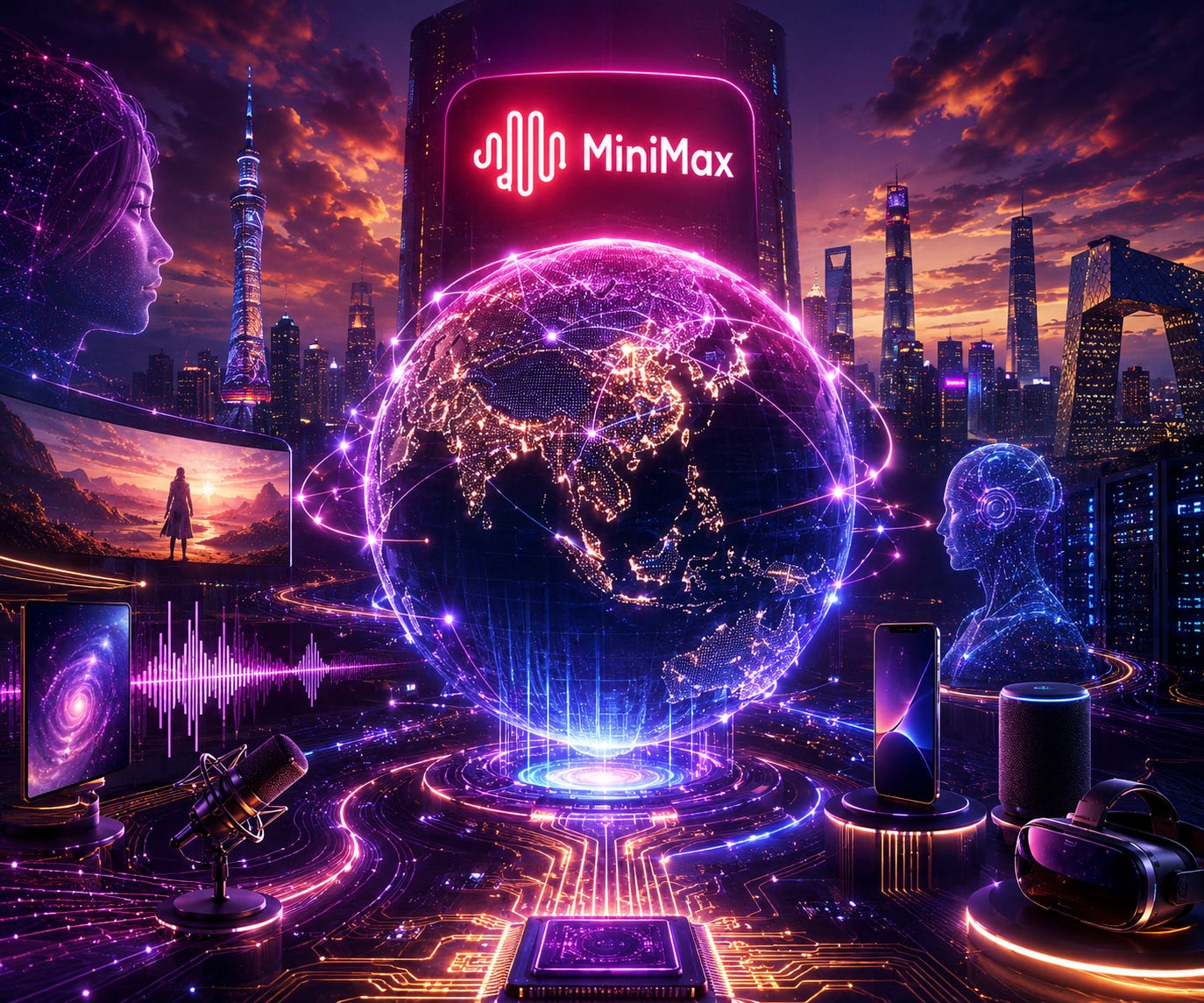
MiniMax Is No Longer Just One of China’s “AI Six Little Dragons”
MiniMax now matters because it sits at the intersection of several shifts inside China’s AI industry. Over the past month, Chinese industry media has not focused on a single MiniMax product launch. The coverage has been scattered across several different fronts: the global open-sourcing of M2.7, compatibility with domestic and overseas chips and inference platforms, Hailuo AI’s appearance at the Cannes World AI Film Festival, the expansion of Music 2.6 in AI music generation, MiniMax’s intelligent hardware push in Guangzhou, its first annual report after listing, growth in open-platform users, and the iteration of agents and multimodal models.
Placed together, these reports reveal something larger than another Chinese AI startup releasing another model. MiniMax is becoming a window into China’s shift from single-point model competition toward platform competition.
China’s AI companies are entering a more complex phase. The first stage was a model capability race: who could produce stronger text, voice, image, video, and coding capabilities. The second stage was a product-interface race: who could turn models into consumer apps, AI companions, video tools, music tools, office tools, and productivity assistants. The third stage is a systems-organization race: who can connect models, developers, inference platforms, domestic chips, overseas users, content industries, and hardware supply chains into one operating structure.
MiniMax’s importance lies precisely in this third stage. It is no longer enough to describe Chinese AI companies as model developers or application builders. The more important transition is from “AI model company” to “AI platform company,” and from “cloud application” to “content industry, intelligent hardware, and global distribution.”
Behind M2.7 Open Source Is a Cross-Chip, Cross-Platform, Cross-Ecosystem Adaptation War
The most direct news over the past month was the global open-sourcing of MiniMax M2.7. Securities Times, Shanghai Securities News, Economic Observer, The Paper, and other Chinese outlets all highlighted one crucial detail: after MiniMax M2.7 was officially open-sourced on April 12, Huawei Ascend, Moore Threads, MetaX, Kunlunxin, NVIDIA, Together AI, Fireworks, Ollama, and other domestic and overseas chip companies and inference platforms completed model integration and inference adaptation on the first day.
On the surface, this looks like a model-release story. In reality, it points to the way China’s AI industry is organizing its ecosystem.
In the past, open-source large models were usually interpreted as technical openness, community expansion, or developer marketing. In the case of MiniMax M2.7, open source looks more like a platform strategy. It connects Chinese domestic AI chips, the overseas GPU ecosystem, cloud inference platforms, local deployment tools, and developer communities at the same time.
The presence of Huawei Ascend, Moore Threads, MetaX, and Kunlunxin shows that Chinese model companies are actively adapting to domestic compute alternatives. The presence of NVIDIA, Together AI, Fireworks, and Ollama shows that MiniMax still wants access to global developer ecosystems and overseas inference platforms.
This is one of the most important structural changes in China’s AI industry today. U.S. chip restrictions have not simply pushed Chinese AI companies into a closed domestic system. Instead, they have pushed Chinese model companies to adapt to two ecosystems at once: one based on domestic compute, and another based on global developers and inference platforms. MiniMax M2.7’s open-source release is not just a demonstration of model capability. It is a bid to become a connective layer across chips, inference platforms, and developer ecosystems.
Reports reposted by The Paper also described MiniMax M2.7 as a model that can enable self-evolution and autonomously build complex Agent Harness systems, using Agent Teams, complex Skills, Tool Search, and related capabilities to complete complex productivity tasks.
The key word here is not simply “agent.” The deeper point is that models are being designed as execution systems that can call tools, organize tasks, and embed themselves into workflows. MiniMax’s model strategy is therefore not limited to chatbot performance. It is moving closer to productivity infrastructure.
Chinese AI companies already understand that pure chat products have limited commercial boundaries. The real value lies in whether models can enter software development, office automation, content production, enterprise workflows, intelligent hardware, and developer toolchains. M2.7’s open-source release and ecosystem adaptation are ultimately a fight for the underlying model position inside these future applications.
MiniMax’s Commercialization Sample Matters More Than Another Model Ranking
If one looks only at model announcements, MiniMax can easily be placed alongside DeepSeek, Kimi, Zhipu, StepFun, 01.AI, and other Chinese model companies. But MiniMax has one more distinctive feature: it has begun to expose part of the commercialization picture through public-company financial reporting.
QbitAI reported in early March, based on MiniMax’s annual report, that MiniMax generated total revenue of $79.04 million in 2025, up 158.9% year on year. More than 70% of that revenue came from international markets. By the end of 2025, MiniMax had served more than 236 million users across more than 200 countries and regions. MiniMax’s official website also shows that the company serves more than 214,000 enterprise customers and developers, with products including MiniMax Agent, Hailuo AI, MiniMax Audio, Talkie, and its open platform.
These numbers do not mean that MiniMax has already become a mature, highly profitable AI company. On the contrary, large-model companies are still in a phase of heavy investment, high compute consumption, large R&D expenses, and ongoing business-model validation.
The real point is different: MiniMax offers one of the rare quantifiable commercialization samples among Chinese AI companies. At a time when most large-model companies still rely on funding rounds, product launches, benchmarks, and user buzz to shape their external narrative, MiniMax’s revenue structure, overseas revenue share, user scale, developer-customer base, and ARR allow the outside world to observe an AI platform company’s commercial path in more concrete terms.
Securities Times eCompany and Sina Finance reported that MiniMax founder and CEO Yan Junjie disclosed during the company’s 2025 annual results call that MiniMax’s ARR exceeded $150 million in February 2026. For its open-platform products aimed at enterprise customers and individual developers, new registered users in February 2026 had reached more than four times the level of December 2025. Another report noted that the average daily token consumption of the M2 series text models had grown more than sixfold compared with December 2025.
Three terms matter most here: ARR, open platform, and token consumption. ARR shows that subscription and recurring revenue are becoming important indicators for large-model companies. The open platform shows that MiniMax is not only serving consumer users, but also competing for enterprise customers, developers, and API calls. Token-consumption growth shows that usage intensity is rising.
The core of AI commercialization is not just how many users downloaded an app. It is how many real tasks, real calls, real content generations, and real workflows are consuming tokens.
This is where MiniMax differs from some model companies with louder technical narratives. DeepSeek’s story is closer to model engineering efficiency and open-source disruption. Kimi’s story is closer to long-context capability, super-app potential, and domestic user mindshare. Zhipu leans more toward enterprise services, government-enterprise markets, and B2B infrastructure. MiniMax’s path looks more like a combination of global AI-native products, open platforms, multimodal content tools, and agent-based execution systems. It may not be the strongest in every individual category, but it reveals one possible route toward Chinese AI platformization.
Hailuo AI, Music 2.6, and Cannes Show That MiniMax Has Not Abandoned Content Industrialization
One of MiniMax’s most recognizable early products was Hailuo AI. Over the past year, the AI video generation sector has gone through extremely fast product iteration and competitive reshuffling. Both Chinese and global companies are competing for entry points into short-video generation, advertising production, animation, and AI-assisted film and television workflows. Over the past month, MiniMax’s content-generation route again appeared in Chinese media coverage through the Cannes World AI Film Festival and its collaboration with Stellar Gravity.
Xinhua reported on April 23 that the second World AI Film Festival, WAIFF 2026, was held at the Palais des Festivals in Cannes, France, and that MiniMax appeared as a global partner of the festival and co-initiator of the China special track. The report noted that the Chinese-style animated music video The Most Fleeting Thing in the World, jointly produced by MiniMax and Stellar Gravity, was specially screened in Cannes. The work relied on MiniMax’s multimodal technology and demonstrated stable performance in complex lighting and facial depiction, while integrating ink-wash aesthetics, classical Chinese atmosphere, and Chinese visual symbols into its audiovisual language.
The Paper also covered the same event, emphasizing that the work co-created by MiniMax and Stellar Gravity was screened in Cannes and featured singer Yu Shuxin. Reports reposted by Tencent News added more on-site details: on April 21 local time, Stellar Gravity and MiniMax’s Hailuo AI appeared at the Palais des Festivals in Cannes with their co-created work, with Stellar Gravity’s founder and singer Yu Shuxin participating in related events.
Viewed in isolation, this kind of coverage could look like brand marketing or overseas exposure. But placed inside MiniMax’s broader strategy, it points toward content industrialization. AI video is not merely about generating a short clip, nor is it only a visual spectacle for social media. The more commercially valuable direction is whether AI can enter IP development, concept design, storyboarding, art exploration, virtual production, post-production effects, marketing assets, and derivative content production.
When Chinese film and television companies begin co-producing works with large-model companies, AI is no longer just a toy-like generation tool. It begins to enter the industrial workflow of content production.
MiniMax’s official product system currently places Video, Hailuo, Audio, Talkie, Agent, and API within the same architecture. Its model capabilities cover text, audio, image, video, and music. The launch of MiniMax Music 2.6 shows that the company does not understand multimodality as only a video-generation track. It is laying out voice, music, video, character interaction, and agent capabilities at the same time.
This matters especially for China’s AI industry. China has one of the world’s largest short-video ecosystems, livestream e-commerce ecosystems, gaming ecosystems, film and television IP production systems, and social content platforms. If AI content generation remains at the demo level, it will struggle to create lasting value. But if it enters China’s highly industrialized content-production chains, it could change the cost structure, production rhythm, and organizational form of content supply.
MiniMax’s Hailuo AI and Music route is testing exactly this direction.
The Guangzhou Hardware Push Shows AI Companies Moving Toward the Supply-Chain Floor
Another underappreciated MiniMax signal is intelligent hardware. In late March, 36Kr, Jiemian, and other Chinese outlets noticed that MiniMax had completed the registration of a subsidiary in Guangzhou, positioning the city as its national intelligent hardware manufacturing headquarters and Greater Bay Area headquarters. The business scope reportedly includes self-operated intelligent hardware, intelligent hardware partnerships, and Guangdong regional business. Production, R&D, assembly, and supply-chain layout will be centered on Guangzhou and surrounding areas, covering products such as Hailuo AI, voice, and agents.
This signal matters. It shows that MiniMax is not satisfied with remaining a cloud model, app, or API company. It is trying to bring model capabilities into hardware products, supply-chain coordination, and regional industrial clusters.
Guangzhou and the Greater Bay Area are not just geographic choices. They represent one of China’s most mature ecosystems for consumer electronics, intelligent hardware, components, assembly, foreign trade, and distribution channels. When a Shanghai-based AI model company places its intelligent hardware headquarters in Guangzhou, it is effectively connecting model capabilities to the Pearl River Delta manufacturing system.
This is also where China’s AI industry differs sharply from the U.S. AI industry. U.S. AI companies usually have strengths in foundation models, cloud platforms, chip design, software ecosystems, and capital markets. Chinese AI companies have a different kind of room for expansion: once model capabilities mature, they can be connected more quickly with hardware manufacturing, supply-chain iteration, consumer electronics, robots, in-car terminals, toys, education hardware, companion devices, audio-video terminals, and industrial equipment.
The model does not have to remain inside a chat window on a screen. It can enter real products.
MiniMax’s intelligent hardware layout is still early and should not be overinterpreted. But it already reveals a direction: future competition among Chinese AI companies may not only be about whose model is stronger. It may increasingly be about who can embed models into more manufacturable, deliverable, sellable, and iteratable terminals.
That requires more than algorithm teams. It requires supply chains, industrial design, hardware engineering, channels, after-sales service, cost control, and regional industrial coordination.
This is one of the most important details in Chinese industry-media coverage. Western coverage often observes Chinese AI companies through model capability, funding valuation, regulatory risk, and U.S.-China AI competition. Chinese industry media is more likely to notice which city a company enters, which supply chain it connects with, what kind of industrial-chain capability it combines with, and what hardware scenario it moves toward after building apps.
These seemingly small industrial details often reveal structural change earlier than product launches do.
MiniMax’s Platform Ambition Is a Shift from “Traffic Interface” to “Intelligence Paradigm”
Wallstreetcn’s summary of MiniMax’s earnings call noted that Yan Junjie laid out three major expectations for 2026. First, software development will see an intelligence leap toward L4 to L5 levels, with AI evolving from a tool into a colleague-like collaborator. Second, workplace productivity scenarios will replicate the rapid penetration path already seen in programming. Third, multimodal content creation will move into the direct generation of medium- and long-form production-grade content. He also expected these trends to drive platform token demand up by one to two orders of magnitude.
This statement deserves to be unpacked carefully. L4 to L5 intelligence means that AI moves from being an assisting tool to becoming a work partner capable of taking on more complete tasks. Workplace scenarios replicating the programming field’s penetration path means that agents will no longer serve only programmers, but will enter broader knowledge work. Multimodal content creation entering medium- and long-form production-grade generation means that AI content tools must move beyond short clips, short copy, and short videos into deliverable commercial content production.
More importantly, Yan’s definition of a “platform company” no longer follows the traffic-interface logic of the internet era. According to Wallstreetcn’s report, he defined an AI-era platform company as one that can define and push forward a new intelligence paradigm, while continuously capturing the commercial value created by that paradigm shift. This differs from the internet-era platform model centered on traffic entrances.
This may be MiniMax’s core self-definition. Internet platforms were built on traffic, user time, advertising, transactions, and network effects. AI platforms are built more on model capability, token consumption, task completion, workflow embedding, multimodal generation, developer calls, and agent collaboration.
MiniMax is not trying only to compete for a traditional app entrance. It is trying to compete for the foundational layer of task execution and content generation in the AI era.
This is why it has to do several things that may look scattered from the outside. It is open-sourcing models while building agents. It is developing Hailuo AI and Music while running an open platform. It is serving global consumer users while serving enterprise customers and developers. It is keeping cloud products while entering intelligent hardware supply chains.
Each individual line has competitors. Taken together, they form a platform experiment.
MiniMax’s Real Signal: Globalization, Contentization, Hardware Integration, and Platformization Are Happening at the Same Time
MiniMax is not the easiest company to explain in China’s AI industry. It cannot be written as neatly as DeepSeek, whose story is about extreme engineering efficiency and open-source model disruption. It cannot be described as simply as Kimi, whose story is about long-context capability, domestic user mindshare, and the search for a super-app entrance. It is also unlike Alibaba, ByteDance, or Tencent, which can be placed directly inside large-platform AI strategies.
MiniMax is more complex because it stands across several tracks at once: models, agents, video, music, AI companionship, open platforms, overseas markets, intelligent hardware, and capital markets.
But this complexity is exactly what makes it an important industry signal. MiniMax does not represent a single-line breakthrough. It represents an emerging compound path for Chinese AI companies: using model capability to support applications, using applications to acquire global users, using open platforms to attract developers and enterprise customers, using open-source adaptation to connect chips and inference ecosystems, using content tools to enter film and creative industries, and using intelligent hardware to connect manufacturing supply chains.
This path has not yet been proven. MiniMax still faces high compute costs, intense model competition, overseas regulatory and platform-distribution risks, uncertainty around content-generation commercialization, the difficulty of hardware execution, and pressure from larger companies with stronger resources, traffic, and cloud infrastructure.
But Chinese industry-media coverage over the past month already shows that MiniMax is moving from an AI application company toward a platform-style company trying to organize multimodal models, agents, content production, developer ecosystems, and global markets.
MiniMax’s real value is not that it has already become the final winner in Chinese AI. Its real value is that it reveals the new shape of Chinese AI competition. Chinese AI companies are becoming systems organizers, not just model publishers. They need to understand algorithms, compute, products, content, developers, hardware, supply chains, overseas markets, and capital markets at the same time.
That is why MiniMax matters: it is not an isolated large-model company. It is an early sample of China’s AI industry moving from model competition to platform competition, from cloud tools to industrial systems, and from domestic applications to global distribution.
Source note: This essay is based on recent Chinese industry-media and financial-media coverage of MiniMax, including reports from Securities Times, Shanghai Securities News, The Paper, Xinhua, QbitAI, Wallstreetcn, Economic Observer, 36Kr, Jiemian, and related reposts. All translations and interpretations of Chinese industry-media language are my own.
Thank you for your insight; could AI answer in a logistical manner if it's possible to manage an alternative, low-consumption, possibly renewable energy based economic model of development and, if so, without drastic measures such as de-population?