

The China Squeeze does not measure exports taken from developing countries. It redefines the market share created by Chinese industrial competitiveness as an excessive claim on global development space.
This essay is part I of The Myth of the China Squeeze, in the series of Rethinking the China Debates.

刘国松《距离的构成之六》The Composition of Distance No. 6, 1970
I’ve long been paying close attention to various kinds of Western narratives about China. While these narratives are not entirely devoid of factual grounding, they are all too often riddled with distortions and biases. After observing them over an extended period, I have also identified certain recurring patterns. Most recently, I’ve noticed a new narrative being fabricated.
Over the past three decades, each new stage of China’s industrial rise has produced a new explanation in Washington for why Chinese competitiveness should be regarded as abnormal.
When export growth was driven by labour-intensive manufacturing, the argument centred on wage suppression, weak labour standards and cheap workers. After China joined the World Trade Organization and its trade surplus widened, the focus shifted to an undervalued renminbi and “currency manipulation”. As Chinese companies moved into machinery, electronics, telecommunications equipment and more advanced manufacturing, government subsidies, state capital, forced technology transfer and intellectual property became the dominant themes. More recently, China’s scale in electric vehicles, batteries, solar power, shipbuilding and industrial equipment has brought “overcapacity” and China Shock 2.0 to the centre of the debate.
Very few of these explanations disappear. They accumulate. The result is an ever-expanding framework in which sustained Chinese industrial competitiveness is assumed to require some force outside the normal workings of the market.
The latest version is called the China Squeeze.
The original China Shock was mainly a story about Detroit, the American Midwest and Europe’s industrial regions. It described how Chinese imports weakened manufacturing employment across the West. China Shock 2.0 moved higher up the value chain, focusing on electric vehicles, batteries, solar power and advanced manufacturing—and on the possibility that a new wave of Chinese exports could erode the high-end industries the West still retains.
The China Squeeze takes the argument into the Global South.
Its imagined victims are workers in Dhaka, Addis Ababa, Lagos, Phnom Penh and India’s textile cities. The claim also carries greater moral weight. China continues to make garments, footwear, furniture and electronics while using robots, artificial intelligence and integrated supply chains to become more efficient. It has therefore failed, the argument runs, to follow the traditional path of industrial development by leaving labour-intensive industries to poorer countries.
The old accusation was:
China took our factories.
The new one is:
China is keeping poor countries poor.
Industrial competition with China has been recast from a Western economic anxiety into a development problem for the Global South.
From a policy argument to a global narrative
The idea moved quickly from policy commentary to economic modelling and then into the wider international debate.
On March 24, 2026, Foreign Affairs published China Is Squeezing Southeast Asia. The article portrayed China’s industrial upgrading, automation and export expansion as a constraint on Southeast Asia’s industrial space. Robots and artificial intelligence, it argued, had reduced China’s dependence on low-cost labour, allowing production that might once have migrated to neighbouring economies to remain at home.
In May, the Peterson Institute for International Economics published China’s Mercantilist Squeeze on Developing Countries, a working paper by Shoumitro Chatterjee and Arvind Subramanian that gave the argument a formal economic structure.
The paper identified three channels of pressure. China continued to dominate global labour-intensive exports. Chinese goods entered developing markets and narrowed the room available to local manufacturers. At the same time, China imported relatively few garments, shoes and other low-skill manufactures from poorer economies.
The authors’ central claim was simple enough. China had moved into electric vehicles, batteries and advanced manufacturing without relinquishing its competitiveness in textiles, garments, leather, footwear and electronics assembly. Europe, America and the earlier East Asian industrialisers had gradually withdrawn from parts of labour-intensive manufacturing as their incomes rose. China had not followed the same path. By remaining in those industries, it was supposedly compressing the space available to later developers.
On May 19, PIIE translated the paper into a more marketable podcast:
How China’s Trade Is Holding Back Developing Countries.
A month later, Foreign Affairs published another article by the same authors:
China Is Pulling Up the Ladder Behind It.
The subtitle made the moral claim explicit:
How Beijing’s Export Strategy Will Keep Poor Countries Poor.
How $365bn in “excess exports” was created
The most widely cited number in the PIIE paper is the estimate that China generated roughly $110bn of “excess exports” in textiles, garments, leather and footwear. Extend the same method across all low-skill manufacturing and the figure rises to $365bn.
Those numbers are easy to read as export income already lost by the Global South.
That is not what they measure.
PIIE begins with a population benchmark. In labour-intensive industries, it assumes that a country’s share of exports should broadly correspond to its share of the low-skilled labour force. According to the paper, China accounted for roughly 28 per cent of the working-age population in low- and middle-income economies by 2022, but 64 per cent of their value-added exports in garments, textiles, leather and footwear.
The difference was 36 percentage points.
PIIE classifies that gap as China’s “excess exports”. It then multiplies the 36-point difference by total value-added exports in those industries to arrive at roughly $110bn. Applying the same method to all low-skill manufacturing produces the $365bn estimate.
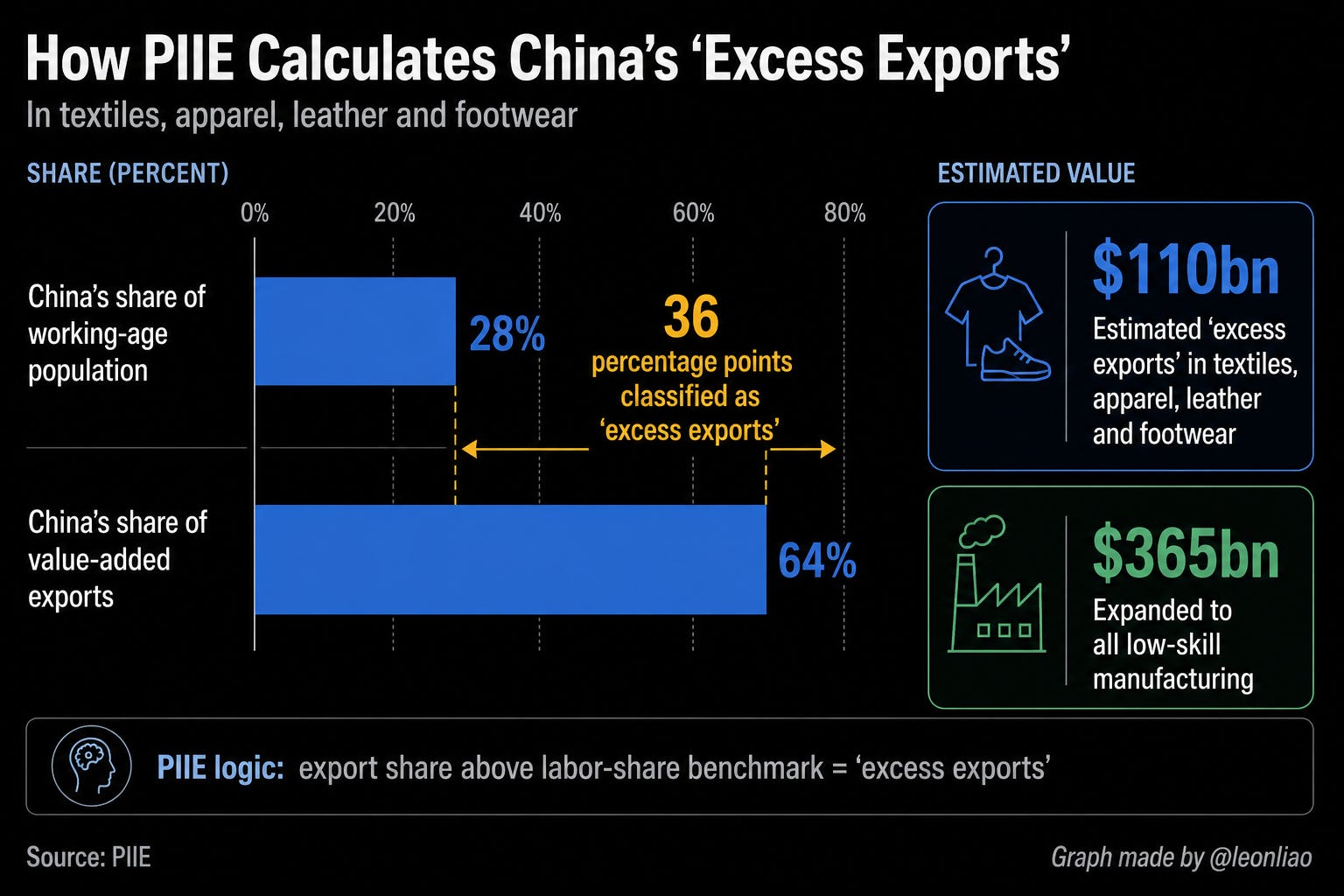
The calculation rests on a demanding assumption. As the paper acknowledges in a footnote, export shares would correspond to labour-force shares only if countries had similar levels of value added per person and similar propensities to export.
The real world is defined by precisely the differences this benchmark sets aside.
Electricity supply, port efficiency, capital stock, industrial clustering, worker skills, productivity, access to finance, logistics, organisational capability, economies of scale and connections to global markets vary enormously across countries. Much of the industrial strength China has accumulated over the past four decades reflects the long-term development of those capabilities.
Yet the PIIE calculation places export advantages created by productivity, scale, capital and supply-chain efficiency into the same result as exchange rates, subsidies and policy distortions. Everything above the population benchmark is then treated as “excess”.
International trade has never been allocated according to population. A country’s population gives it no natural claim to an equivalent share of global exports.
Apply the same benchmark elsewhere and many of the world’s most successful industries begin to look suspicious.
Germany accounts for only about 1 per cent of the world’s population, yet German carmakers produced roughly 13.6mn passenger vehicles in 2024, around 18 per cent of global output.
South Korea has about 0.63 per cent of the world’s population but accounted for roughly 27 per cent of global shipbuilding deliveries.
The Netherlands represents just 0.22 per cent of the global population, while ASML controls more than 80 per cent of the lithography-equipment market and remains the world’s only producer of extreme-ultraviolet lithography systems.
The United States has roughly 4.2 per cent of the world’s population, yet Nvidia alone controls around 80 per cent of the AI-chip market, and American companies remain overwhelmingly dominant in commercial AI accelerators.
Would these positions also count as German, Korean, Dutch or American “excess exports”? Of course not.
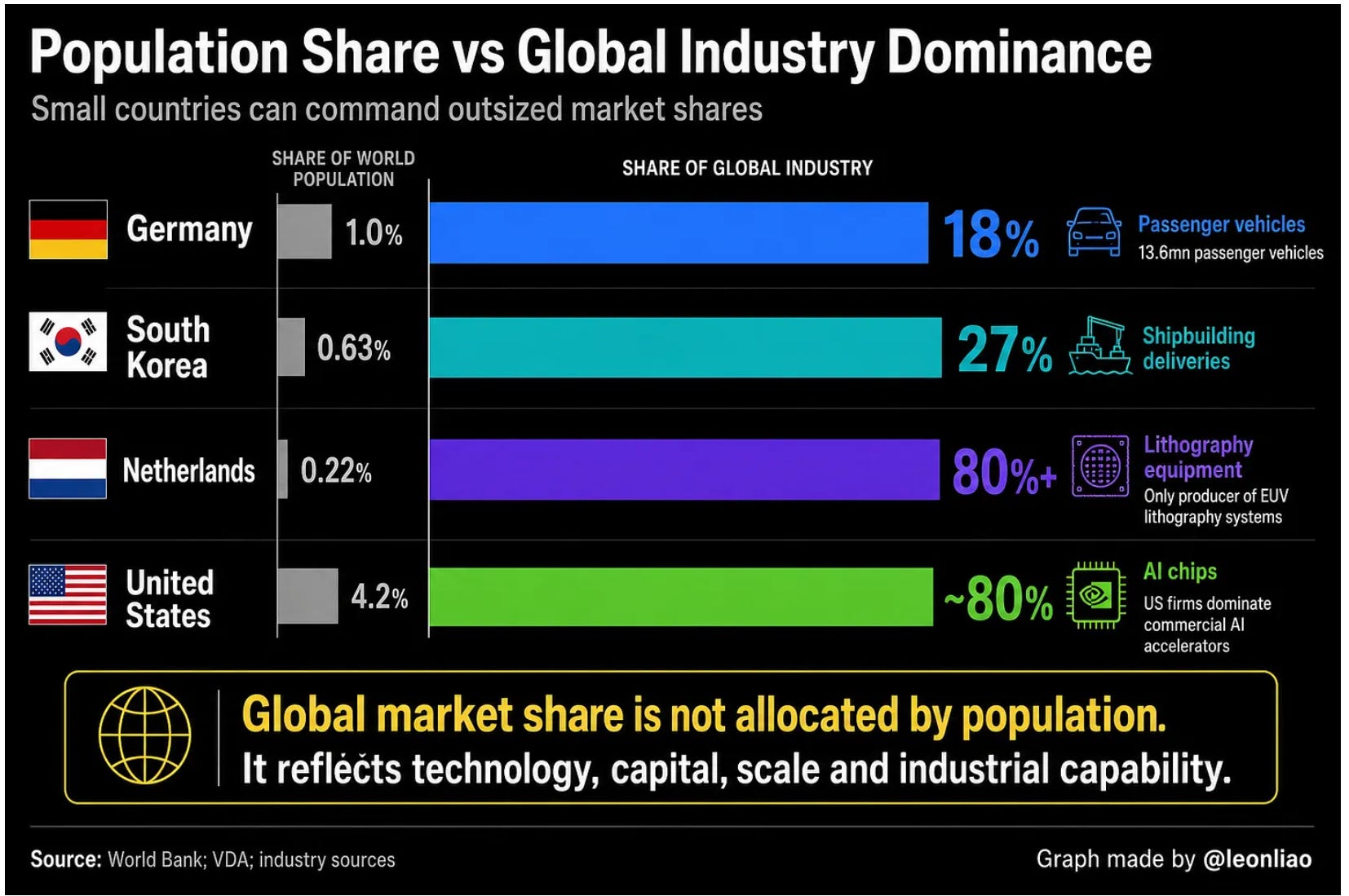
The global distribution of automobile production, shipbuilding, lithography equipment and AI chips reflects decades of accumulated technology, capital, industrial clustering, talent, scale and organisational capability. China’s large export shares in textiles, garments, machinery and electronics cannot be treated as an occupation of industrial space that naturally belongs to others merely because those shares exceed China’s population weight.
Taken to its logical conclusion, the PIIE method turns exceptional industrial performance into a claim on somebody else’s development space. Competitiveness itself begins to carry a moral liability.
Who receives the dollar China no longer exports?
The model also leaves out a more difficult question.
If China exports one dollar less, who gets that dollar?
Orders may move to Vietnam, Bangladesh, Mexico or Turkey. They may shift to highly automated producers elsewhere. Some production may return to advanced economies. Some demand may simply disappear as costs rise and prices increase.
Those outcomes have very different implications for low-income countries.
The useful counterfactual is therefore much more demanding. Which countries are actually capable of absorbing production displaced from China? How much investment, value added, employment and export income could they gain? How long would it take to build the local supply chains required to sustain that production?
PIIE does not construct such a country-level counterfactual.
Instead, exports above China’s population benchmark are treated as potential exports belonging to other countries. Those hypothetical exports are then converted into lost value added and foregone employment. China’s existing production becomes the industrialisation the Global South failed to achieve.
The difficulty is obvious: market space does not automatically become productive capacity.
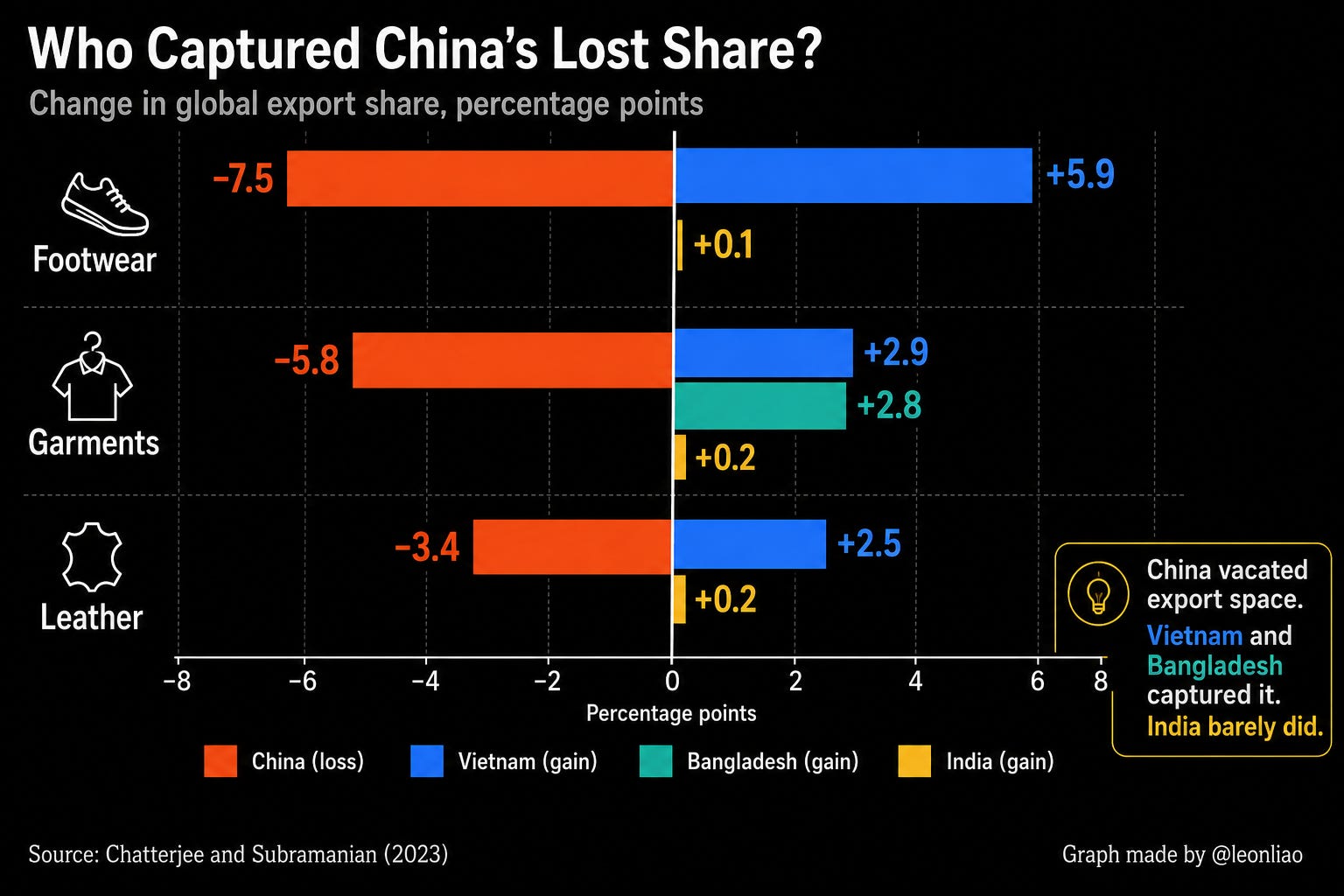
As recently as 2023, the same two authors argued that China was rapidly vacating export space in garments, footwear and leather, while India’s weakness reflected protectionism and limited participation in global value chains. Their own figures showed that Vietnam and Bangladesh captured most of the market share released by China, while India gained almost nothing.
Their table showed a clear pattern.
In footwear, China’s global share fell by 7.5 percentage points. Vietnam gained 5.9 points; India gained only 0.1.
In garments, China lost 5.8 points. Vietnam gained 2.9 and Bangladesh 2.8. India gained only 0.2.
In leather, China lost 3.4 points. Vietnam gained 2.5; India again gained only 0.2.
Three years later, the same development problem has acquired a different explanation: China has not vacated enough space.
Factories require electricity, land, ports, roads, finance, workers, suppliers, policy stability and companies capable of organising production. China’s withdrawal from an industry creates none of these conditions by itself. Orders are not redistributed according to population.
Between potential market space and achievable industrial capacity lies the whole field of development economics.
The morality of vacating the ladder
The China Squeeze rests on a deeper premise: once an economy reaches a certain income level, it should gradually withdraw from low-skill manufacturing and leave industrial space to later developers.
The paper presents post-war industrialisation as a relay race. Europe and America withdrew from parts of labour-intensive manufacturing. Japan and the East Asian economies moved in. China later became the largest successor. China should now retreat in turn and pass the baton to poorer countries.
The flying-geese model does capture part of East Asia’s industrial history. It does not establish a general obligation for successful economies to abandon industries that remain competitive.
The United States did not withdraw from agriculture, energy, aerospace or advanced manufacturing after becoming rich. It remains one of the world’s largest agricultural exporters.
Germany did not abandon automobiles, machinery or chemicals. It is still one of the world’s largest exporters of chemical products.
Japan and South Korea continue to retain major positions in steel, shipbuilding, automobiles, advanced materials and industrial equipment. Japan remains the world’s second-largest automobile producer. South Korea remains the second-largest shipbuilder.
Higher incomes usually bring capital deepening, automation, stronger brands and restructuring within industries. They do not necessarily cause entire production chains to disappear.
Some activities move abroad; others remain. Labour-intensive stages may migrate while upstream materials, equipment, design, research and automated production stay in the original industrial centre. Global demand also expands, allowing more than one economy to increase exports within the same sector.
PIIE’s own initial historical comparison found that, at comparable income levels, China’s current share of low-skill manufacturing exports was not obviously higher than the shares once held by advanced economies. Only after adjusting for the larger scale of global markets and the greater tradability of modern production did the paper conclude that China occupied an unusually large amount of export space.
The evidence appears to have been adjusted until it produced the intended conclusion.
There is no historical formula for how much industry China “should” abandon. The answer depends on the benchmark chosen and on how a researcher defines a country’s supposedly fair share of world exports.
From competition to development rights
China unquestionably competes with other developing economies.
Chinese goods place pressure on some local manufacturers. China’s continued strength in garments, footwear, furniture and consumer electronics may reduce the number of orders available to other producers. Any economy with enormous industrial scale will affect global prices, investment flows and the geography of production.
The China Squeeze makes a broader claim. It turns industrial competition into an occupation of development space.
Exports above China’s population benchmark become “excess exports”. Continuing to operate competitive industries becomes “pulling up the ladder”. The failure of some countries to build manufacturing capacity is then folded into the consequences of China’s industrial rise.
The China Squeeze does not measure how many exports China has taken from developing countries. It defines the market share created by Chinese industrial competitiveness as an excessive claim on global development space.
That framing has obvious political value.
The China Shock supplied a domestic justification for American tariffs and industrial protection. The China Squeeze offers a way to internationalise the same policies. Restricting Chinese exports can be presented as protecting industrialisation in poorer countries. Weakening Chinese supply chains can be sold as putting the ladder back down for the Global South.
The ambition goes well beyond another debate about closed factories in the American Midwest. It seeks to persuade developing countries that China’s success has become an obstacle to their own.
The theory’s most persuasive claim, however, remains to be tested.
China now operates the world’s largest industrial-robot system. Artificial intelligence and automation are reducing the dependence of some manufacturing industries on low-cost labour. Has this allowed China to hold on indefinitely to labour-intensive industries that might once have moved abroad? Have robots blocked the next wave of industrialisation?
Bangladesh, Vietnam and Ethiopia have already provided the answer.
That is the subject of the next essay in this series.
Read more:


The value chain is a very ambiguous term
Often this includes
Exploiting a rising mark up
In commercial space
As the newly entered
product markets
move from commodity like products to
Highly differentiated
Often tech frontier products
Ie exploiting uniquely produced
Features
Much
Like firms attempt to find and exploit markets for rare deposits
The exploitation of
Dynamic market Lacunae
Border induced price differentials
The fence gates to local markets
Create patterns of opportunity and exclusion
What the state can do is play a long game a siege strategy
Till compradore elements open the gates of Troy
Privateer Corporate earth
Likes to maintain certain image fabrications. One is really brutal
Free markets
Filled with finite capital players
Free ranging
Produces
the optimal industrial development foundation
"History"
must be fabricated
to support this narrative
Peoples china is a big fat counter example
With no intention to disguise itself