
The Second Reusable Rocket Revolution
China's Long March 10B demonstrated the world's first offshore net-capture recovery, opening a second engineering pathway beyond SpaceX's Falcon 9 architecture.

For the first time since Falcon 9, the world is witnessing a fundamentally different reusable rocket architecture—not a copy of SpaceX, but an alternative engineering philosophy.
This essay is part of China Frontier Hard Tech Series.
A historic milestone. For the first time, the world is beginning to see a reusable launch vehicle architecture that could genuinely compete with SpaceX.
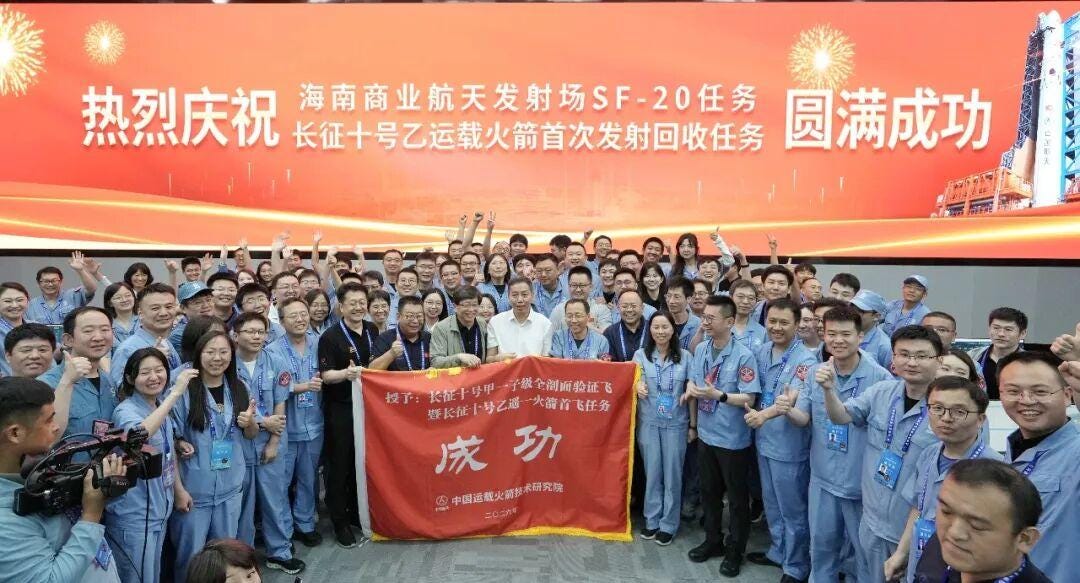
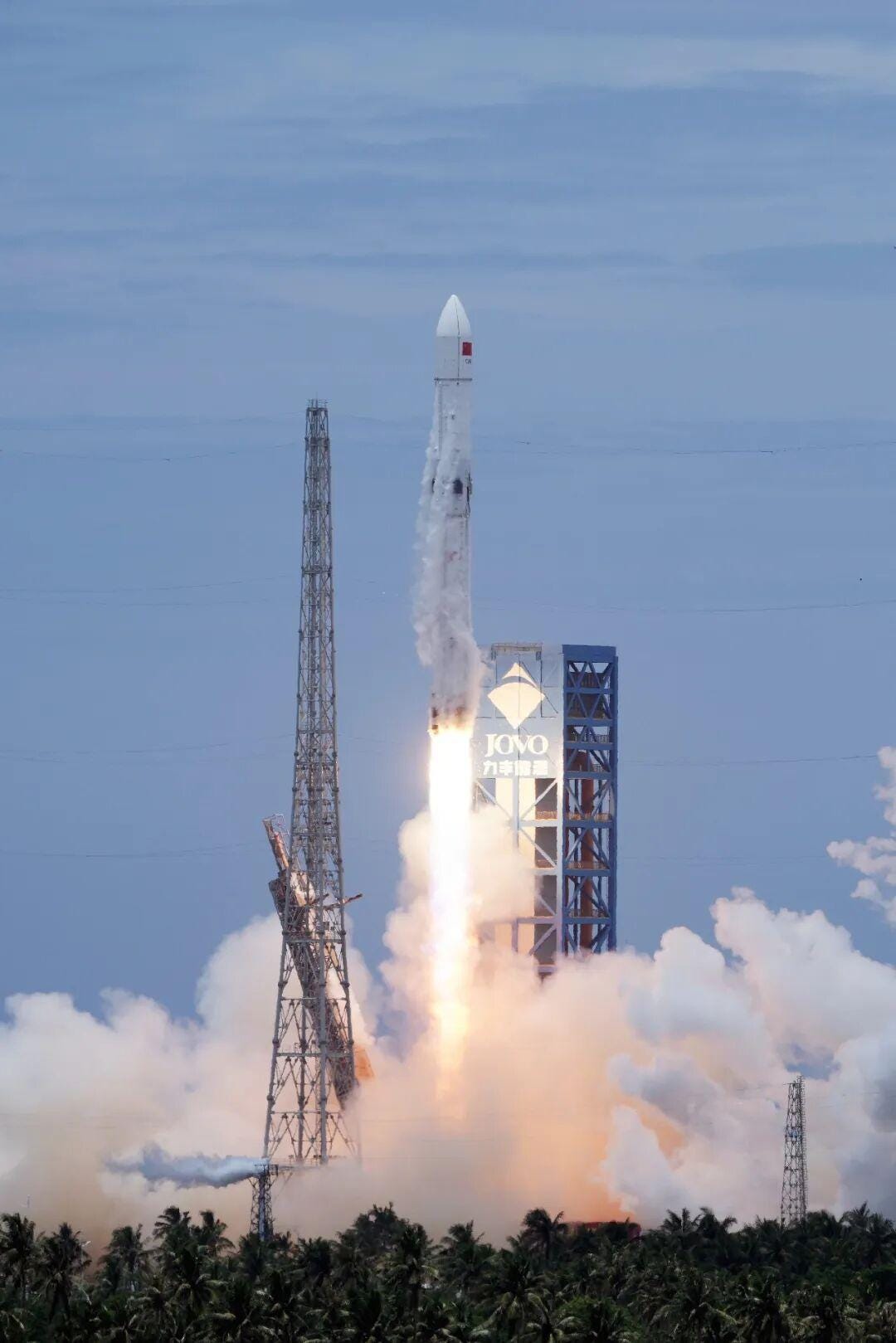
Today, China’s Long March 10B successfully completed its maiden launch and recovered its first stage on an offshore recovery platform. This marks China’s first successful controlled recovery of an orbital-class launch vehicle first stage and the first real-world demonstration of the world’s first offshore net-capture recovery system.
In terms of performance, the Long March 10B now falls into the same class as SpaceX’s Falcon 9. Both offer roughly 16 tonnes of payload to low Earth orbit (LEO) in reusable configuration, enabling missions such as large-scale satellite constellation deployment, space station cargo delivery, and heavy satellite launches.
Unlike Falcon 9’s propulsive vertical landing on landing legs, the Long March 10B adopts a fundamentally different approach: offshore flexible net capture.
If this technology proves reliable at scale, it would represent the second flight-proven architecture for reusable orbital rockets, ending more than a decade in which virtually every reusable launch vehicle around the world has followed the engineering path pioneered by SpaceX.
The breakthrough is also expected to dramatically reduce China’s launch costs. Industry projections suggest that the cost of launching payloads to low Earth orbit could fall from today’s US$6,000–10,000 per kilogram to below US$2,000 per kilogram, approaching SpaceX’s cost structure.
The most important difference lies in the underlying engineering philosophy.
For more than a decade, nearly every reusable rocket has carried the complexity onboard. Falcon 9 flies with landing legs, deployment mechanisms, hydraulic systems, and associated structures throughout the mission.
The Long March 10B takes a different approach: move as much complexity as possible from the rocket to the ground.
The traditional philosophy is straightforward:
The rocket performs every step of the landing itself.
The net-capture philosophy is different:
The rocket only needs to fly back. The final capture is completed by the recovery system.
Eliminating landing legs alone removes several tonnes of dead weight. For future heavy-lift launch vehicles, those savings become increasingly valuable, translating into higher payload capacity, greater structural margins, or additional propellant.
If ground infrastructure can be reused thousands of times, concentrating complexity on the recovery platform rather than on every individual rocket becomes an increasingly attractive systems-engineering solution.
This approach also has the potential to shorten refurbishment cycles, reduce maintenance costs, increase payload capability, and improve overall reliability—advantages that could prove particularly valuable as China enters the era of high-frequency launches for massive low-Earth-orbit satellite constellations.
Related Reads:


