
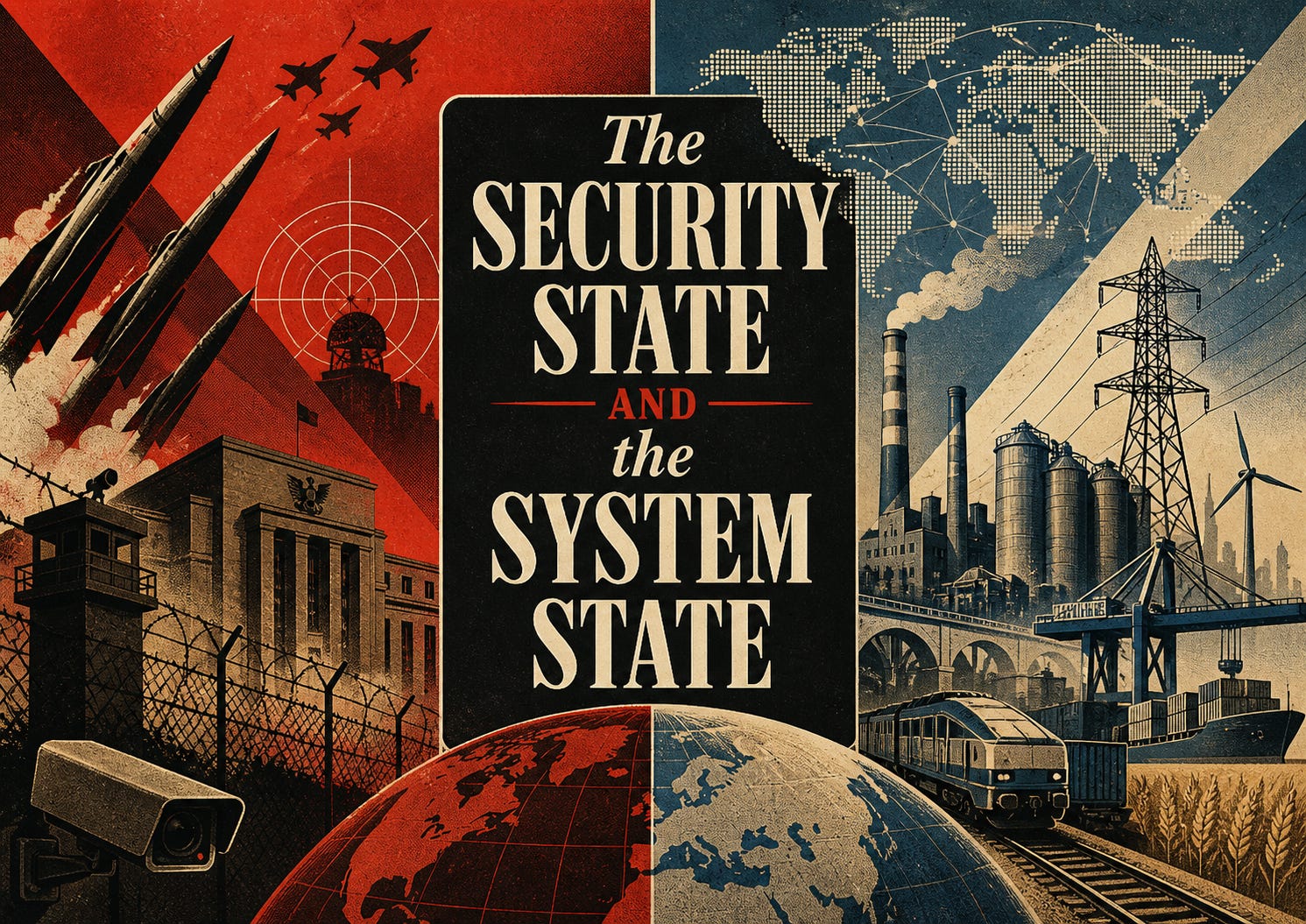
The Security State and the System State
The real challenge for every major power is to build a system in which security, development, openness, innovation, and social vitality can reinforce rather than destroy one another

America’s danger is that the security state devours the developmental state. China’s danger is that a whole-system security framework can absorb too much of economic, scientific, cultural, and social life into the logic of political security.
This is part of the State Governance Series.
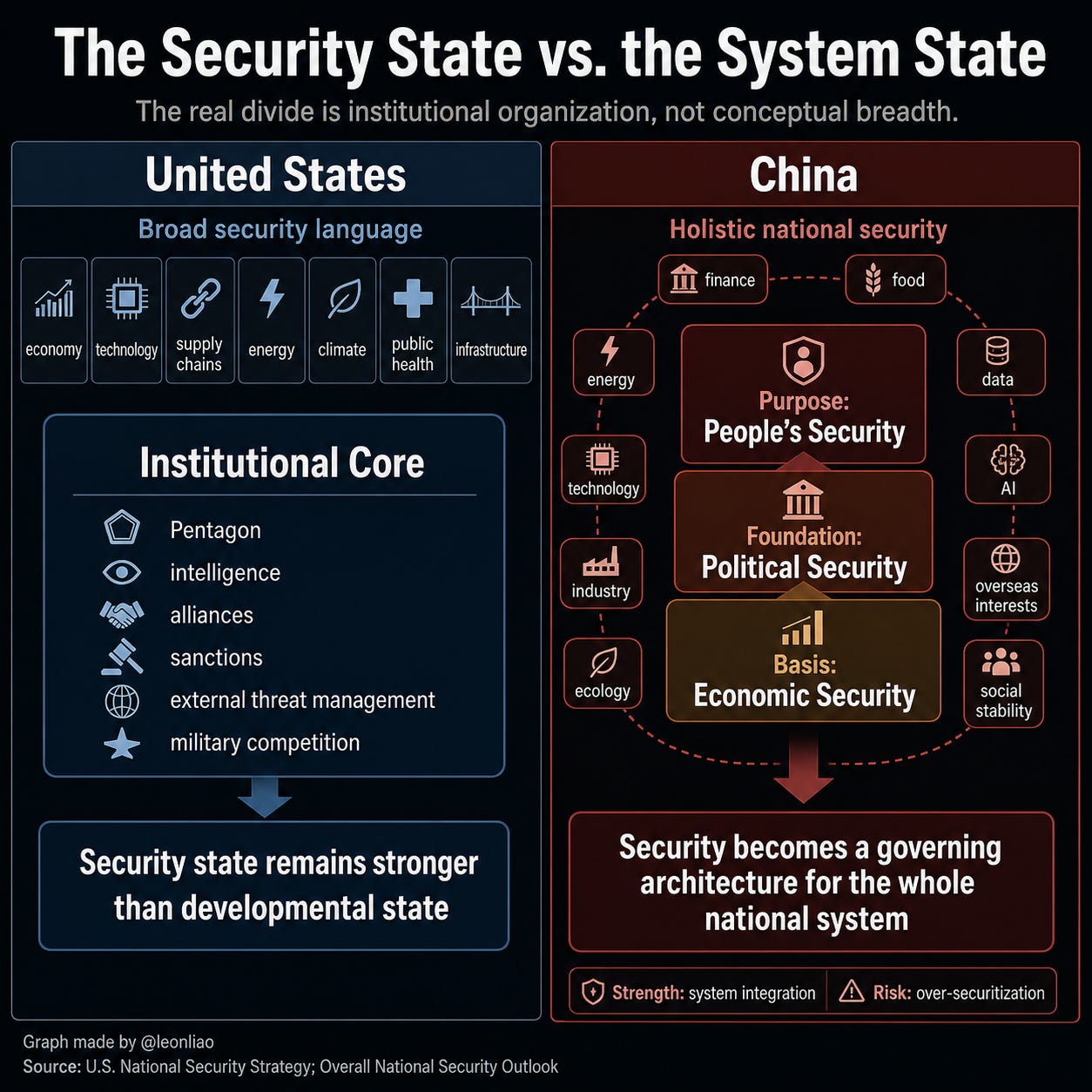
America has already expanded the language of national security. China has turned national security into a whole-of-system governing framework. The real divide is not conceptual breadth, but institutional organization.
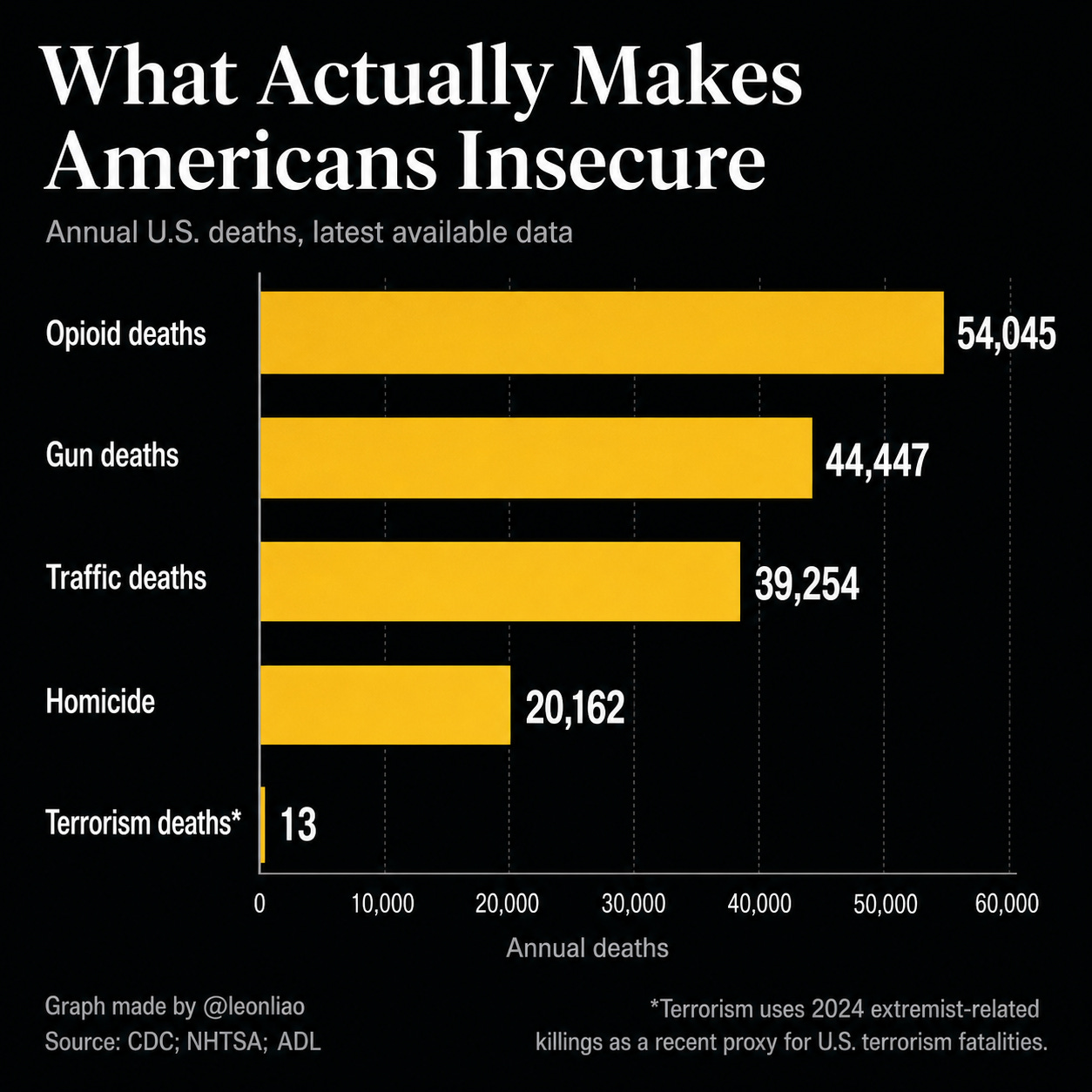
Rajan Menon’s recent substack essay on what American “national security” gets wrong is valuable because it points to a contradiction at the center of the American state. The United States speaks constantly in the language of security, but the people who most need security often receive the least of it. Menon’s argument is not simply that America spends too much on defense. It is that the American national security establishment has become extraordinarily good at protecting threat narratives, military budgets, alliances, sanctions, and external commitments, while many of the insecurities that actually shape ordinary American life come from domestic sources: unstable employment, inadequate wages, medical costs, housing stress, educational inequality, decaying infrastructure, opioids, gun violence, climate disasters, and weakened public services.
His subtitle captures the problem with brutal clarity: America First, except for the Americans who need it most.
But this argument needs one important refinement. It would be too simple to say that America has a narrow concept of national security while China has a broad one. American official strategy documents have already expanded national security far beyond armies, borders, wars, and enemies. The 2017 U.S. National Security Strategy explicitly placed economic strength, manufacturing, energy, technology, data, and sovereignty inside the national security frame. The 2022 Biden strategy went further, arguing that domestic and foreign policy can no longer be separated, and that national resilience, industrial capacity, supply chains, climate, technology, public health, and democratic strength are part of America’s competitive position. The 2025 National Security Strategy also states that economic security is fundamental to national security, while trying to refocus national security around core American interests.
So the real difference between the United States and China is not that one country understands security narrowly and the other understands it broadly. The real difference is institutional. America keeps widening the language of national security, but its security state still orbits external threats, military power, alliances, sanctions, and geopolitical competition. China’s holistic national security concept turns security into a governing architecture for the whole national system. That gives China stronger system-level integration. It also creates a different danger: the boundary of security can expand so far that more and more economic, social, scientific, cultural, and intellectual life is absorbed into the logic of political security.
1. The real divide is not width, but organization
The first mistake in comparing American and Chinese national security thinking is to treat the contrast as a simple opposition between narrow and broad. That is not accurate. American national security language has been widening for decades. The Cold War placed military deterrence, alliances, nuclear strategy, intelligence, and ideological competition at the center of American security. After 9/11, terrorism, homeland security, surveillance, counterinsurgency, and military intervention moved to the center. But especially after the 2008 financial crisis, the rise of China, the supply-chain shocks of the pandemic, and the return of industrial policy, Washington increasingly recognized that national security also depends on production capacity, technology, infrastructure, energy, public health, and economic resilience.
Trump’s 2017 National Security Strategy was important because it made the phrase “economic security is national security” a central strategic idea. Its four pillars were protecting the American people and homeland, promoting American prosperity, preserving peace through strength, and advancing American influence. This was not a purely military document. It treated borders, immigration, trade, manufacturing, energy, innovation, cyber systems, data, and economic power as security questions.
Biden’s 2022 National Security Strategy pushed this logic further. It explicitly said the administration had broken down the dividing line between domestic and foreign policy because American strength at home and abroad are linked. Its national security framework included industrial investment, infrastructure, semiconductor capacity, clean energy, supply-chain resilience, democracy, technology, climate, public health, and strategic competition with China and Russia.
The second Trump administration’s 2025 National Security Strategy is more skeptical of an infinitely expandable national security agenda, but it still places economic security inside national security. It emphasizes balanced trade, industrial strength, technological leadership, and economic competitiveness as foundations of American power.
This means America’s problem is not conceptual ignorance. Washington understands that security is more than military power.
The deeper problem is that the American state does not organize these domains with equal institutional force.
The Department of Defense, intelligence agencies, sanctions bureaucracy, foreign-policy establishment, military alliances, defense contractors, and strategic threat narratives have deep budgets, powerful constituencies, and long institutional memory. By contrast, the developmental functions of the American state, including infrastructure, industrial upgrading, public health, housing, workforce training, energy transmission, and social resilience, are fragmented across agencies, contested by partisan politics, constrained by federalism, and often treated as discretionary or temporary.
This is why Menon’s critique lands so strongly. The United States can talk about economic security, technological security, supply-chain security, climate security, and public-health security. But when security is translated into money, institutions, political urgency, and bureaucratic power, the military and external-threat apparatus still moves faster and more reliably than the domestic investment state. America has expanded the vocabulary of national security. It has not built an equally strong developmental state to match that vocabulary.
2. America’s security state remains stronger than its developmental state
The core American contradiction is that the United States has one of the most powerful security states in history, but its domestic public capacity often looks fragile, slow, and politically exhausted.
This is not because America lacks money, talent, technology, universities, corporations, or capital markets. It has all of them. The problem is organizational. American institutions are extremely effective at mobilizing around external threats and military commitments, but far less effective at sustaining long-term domestic system-building.
Menon’s essay captures the opportunity cost of this structure.
On the surface, American national security claims to protect the nation. In practice, it often protects the external-threat narrative, the military budget, and the security bureaucracy. Yet the forces that make millions of Americans feel insecure are far more domestic than foreign: poverty, unstable employment, inadequate wages, educational inequality, healthcare costs, housing shortages, decaying infrastructure, climate risks, gun violence, drugs, and cuts to public services.
The budget numbers make this asymmetry visible. In fiscal year 2025, total U.S. discretionary outlays were about $1.9 trillion, and defense still accounted for nearly half of the discretionary budget, even as nondefense discretionary programs covered a huge range of domestic functions, including education, housing, public health, transportation, environmental protection, scientific research, workforce programs, and social services. CBO notes that nondefense discretionary outlays were slightly more than half of total discretionary outlays in FY2025, while the Peter G. Peterson Foundation summarizes the same structure by noting that defense accounts for nearly half of discretionary spending.
The direction of policy is even more revealing. The Trump administration’s FY2026 discretionary budget request proposed increasing defense spending by 13% to $1.01 trillion, while pairing that with deep cuts to nondefense agencies and programs.
For FY2027, the White House budget proposed a 10% cut to nondefense spending compared with 2026 levels, while pushing total defense-related spending to just over $1.5 trillion through $1.15 trillion in base defense discretionary programs plus $350 billion in mandatory funds. The same proposed budget framework included a 19% cut to the Department of Agriculture, a 13% cut to Housing and Urban Development, and roughly a 12% cut to Health and Human Services, including reductions affecting low-income heating assistance.
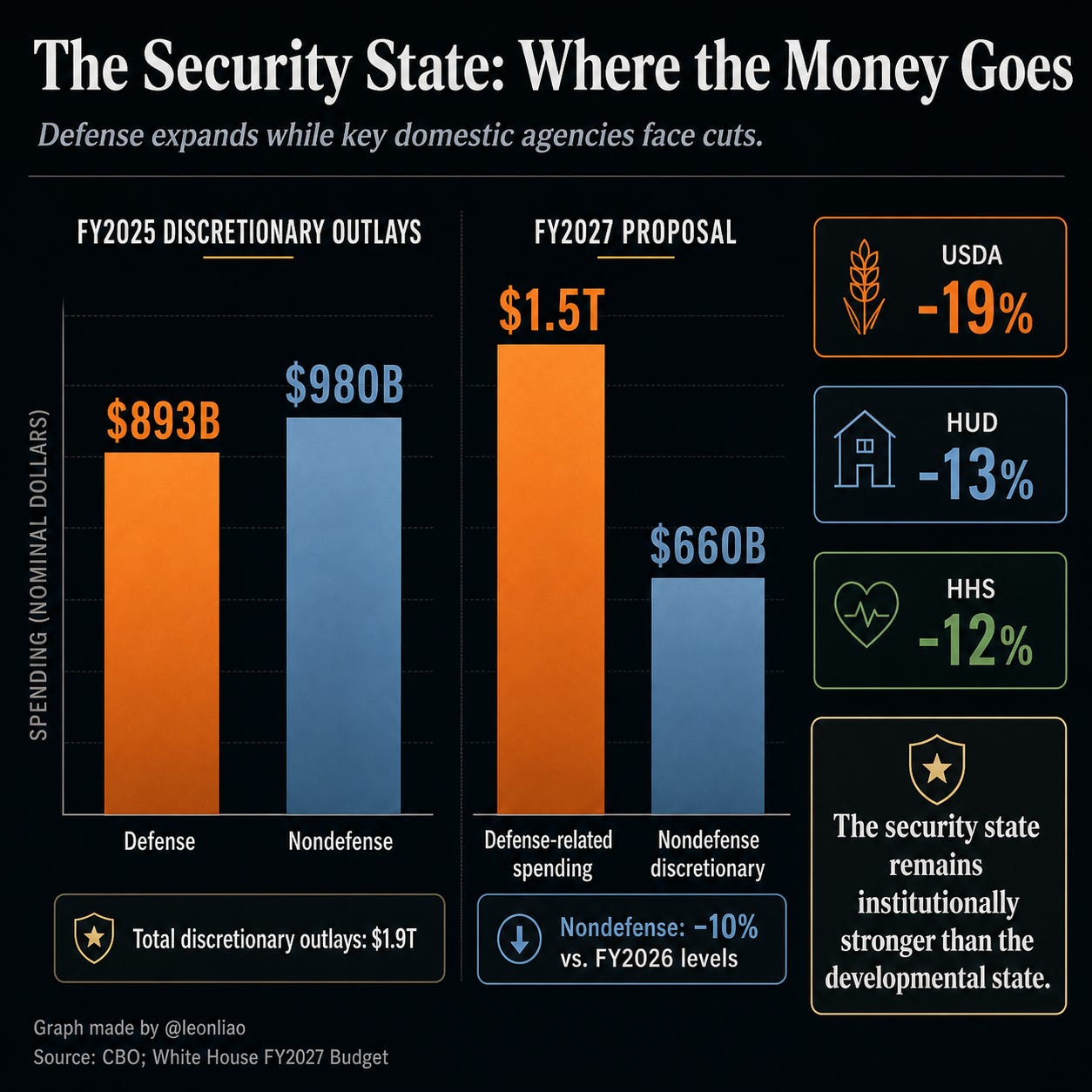
This is not just an accounting issue. It is a theory of the state expressed through the budget. The United States can debate national renewal, industrial resilience, public health, infrastructure, housing, education, and social mobility, but when the budget becomes the real test of priority, military power and external security still receive a much stronger institutional claim. The security state does not merely consume money. It consumes urgency, legitimacy, and governing attention.
The result is a strange asymmetry: the United States can spend immense sums on distant conflicts, weapons modernization, global deployments, intelligence infrastructure, sanctions enforcement, and alliance management, but basic domestic insecurities remain politically underfunded or administratively fragmented.
This is why the phrase “security state” matters. It does not simply mean a state with armed forces. Every serious country needs defense capability, intelligence capacity, border control, and emergency planning. The problem emerges when the institutions built for external security become so dominant that they crowd out the institutions needed for national development.
America’s problem is not that it lacks a national security state. It is that the security state is institutionally stronger than the developmental state.
The American system can produce world-leading defense contractors, globally dominant intelligence agencies, advanced sanctions tools, and a military presence across the world. It can build alliances and coordinate export controls. It can freeze assets, restrict technologies, enforce financial rules, and project power across oceans. But when it comes to building high-speed rail, upgrading the grid, reforming healthcare costs, rebuilding manufacturing ecosystems, coordinating permitting, sustaining vocational training, or reducing the social damage from drugs, guns, housing costs, and infrastructure decline, the state becomes slower, more fragmented, and more internally contested.
This is the deeper meaning of Menon’s critique. It is not only a moral argument about misplaced priorities. It is a structural argument about state capacity. A country can have an enormous military budget and still suffer from strategic weakness if it cannot maintain the social, industrial, educational, fiscal, and infrastructural base beneath that military power. Military strength without developmental capacity becomes a form of strategic imbalance. It protects the perimeter while the domestic foundations weaken.
This is also why the United States increasingly tries to translate domestic weaknesses into national security language. Semiconductors become national security. Supply chains become national security. Clean energy becomes national security. Public health becomes national security. Infrastructure becomes national security. In one sense, this is analytically correct. These are all security issues in the 21st century. But the fact that domestic investment must be justified through national security language also reveals a political weakness. The United States often finds it easier to fund development when it can be framed as competition with China, military readiness, or geopolitical necessity.
That is a sign of the security state’s dominance. Even the developmental agenda must borrow legitimacy from national security.
3. China’s holistic national security concept turns security into a system framework
China’s “holistic national security concept,” first articulated by Xi Jinping on April 15, 2014, represents a different institutional logic. It does not define national security primarily through armies, borders, enemies, and wars. It treats security as a whole-of-system problem. Official formulations describe it as a systematic, holistic, logical, and integrated framework for responding to risks and challenges in the new era.
The most important feature is the ordering. The framework takes people’s security as its purpose, political security as its foundation, economic security as its basis, military, cultural, and social security as safeguards, and international security as external support. This ordering matters. Military security is not placed first. Economic security is treated as a foundation. Political security is placed at the root. People’s security is presented as the purpose.
This structure makes clear that China’s framework is not a liberal theory of individual security. It is a state-centered and party-led framework of overall national security. It emphasizes the people, but it also places political security, institutional security, and regime security at the center. That is its political core. But analytically, the framework is important because it treats modern security as the security of the operating system of the state.
Under this logic, national security includes a wide range of questions.
Can the financial system remain stable? Can the country secure its food supply? Can energy channels be protected? Can critical technologies avoid foreign choke points? Can industrial chains survive sanctions and disruption? Can society remain stable during shocks? Can data, algorithms, and artificial intelligence create new sovereignty risks? Can overseas interests be defended? Can ecological constraints damage long-term development? Can outer space, the deep sea, and polar regions become new fields of strategic competition?
These questions were once treated mainly as development questions, industrial questions, or technical questions. In China’s holistic national security concept, they are reorganized into a unified security architecture. Food, energy, finance, technology, data, AI, ecology, overseas interests, space, deep sea, and polar affairs become parts of national security. The point is not only that the definition of security is broad. The point is that the Chinese system tries to convert this broad definition into planning, regulation, party-state coordination, industrial policy, infrastructure investment, and risk management.
This is the meaning of the system state. It is not simply a state that talks about many security domains. It is a state that tries to integrate those domains into a single governing logic. In the American case, national security language has expanded, but institutions remain divided between the military-security state and a weaker developmental state. In the Chinese case, national security is increasingly built into the architecture of development itself.
This gives China one obvious advantage: system-level integration. When energy, finance, industry, technology, infrastructure, food, and social governance are treated as connected parts of national security, the state can more easily coordinate investment, planning, regulation, and mobilization across domains. This is why China’s approach is more naturally compatible with long-term industrial policy, infrastructure buildout, supply-chain resilience, energy security, and technological self-reliance.
But it also creates a serious risk. If every domain becomes national security, the boundary of security can expand endlessly. Economic questions can become political-security questions. Scientific questions can become ideological-security questions. Cultural questions can become regime-security questions. Data questions can become sovereignty-security questions. Business decisions, academic research, social debates, cultural expression, and technological experimentation can all be pulled into the orbit of political security.
The strength of the system state is integration. The danger of the system state is over-securitization.
4. Real national security is system capacity
The 21st century is changing the substance of national security. During the Cold War, national security could be imagined primarily through nuclear deterrence, military alliances, intelligence competition, ideological blocs, and industrial mobilization for defense. Those dimensions still matter. No major power can ignore military capability. But the deeper foundation of power has shifted toward system capacity.
Real national security is not measured only by the size of a military budget. It depends on whether a country can organize energy, food, finance, industry, science, infrastructure, education, population, and social governance into a stable, adaptive, and shock-resistant system.
Energy security is not only about oil reserves or naval protection of sea lanes. It is about power generation, grid flexibility, transmission lines, storage, nuclear capacity, renewable deployment, industrial electricity prices, fuel substitution, and crisis resilience. A country that cannot build enough electricity capacity for AI, advanced manufacturing, electrification, and household demand will face strategic constraints even if it has a powerful military.
Technology security is not only about export controls or chip bans. It is about basic research, engineering talent, manufacturing ecosystems, supplier depth, capital equipment, industrial software, process knowledge, data access, commercialization speed, and the ability to turn laboratory science into deployed systems. A country can win the frontier invention race and still lose the deployment race if it cannot organize production, infrastructure, and market adoption at scale.
Food security is not only about grain inventories. It is about seeds, fertilizers, irrigation, agricultural machinery, logistics, storage, cold chains, land policy, animal protein systems, and the ability to absorb climate shocks. Finance security is not only about currency strength. It is about banking stability, fiscal room, debt structure, capital markets, household balance sheets, payment systems, and the ability to prevent financial shocks from becoming political shocks. Social security is not only about policing. It is about employment, housing, healthcare, education, mobility, public trust, and whether people believe the system can still reproduce a decent life.
This is why the old distinction between “hard security” and “soft domestic policy” no longer works. A failing grid is a security problem. A hollowed-out industrial base is a security problem. A weak public-health system is a security problem. Housing unaffordability can become a labor-market and social-stability problem. Weak vocational training can become an industrial-capacity problem. Excessive financialization can become a national-resilience problem. Climate disasters can become fiscal, insurance, migration, infrastructure, and political-stability problems.
The American strategic vocabulary now recognizes much of this. The 2022 National Security Strategy explicitly connects domestic investment with America’s ability to compete abroad. But recognition is not the same as organization. The United States still struggles to convert systemic diagnosis into systemic execution. It often knows what must be built, but it moves slowly through permitting fights, agency fragmentation, fiscal conflict, local veto points, private-sector incentives, litigation, lobbying, and partisan cycles.
China’s holistic national security concept, by contrast, is built around the idea that development and security must be integrated. This can produce faster coordination and stronger long-term planning. It can also produce policy overreach when security logic becomes too expansive. The issue, therefore, is not whether security should be broad. In a modern state, it has to be broad. The issue is whether the state can organize broad security without suffocating the openness, competition, experimentation, and social vitality that also generate long-term strength.
5. The two dangers: military capture and security overreach
The United States and China face opposite dangers.
America’s danger is that the security state devours the developmental state. The United States has broadened its national security language, but its strongest institutions still belong to the external-security apparatus. Military spending, intelligence agencies, defense contractors, sanctions enforcement, alliance management, and geopolitical threat narratives have a depth of institutional power that domestic development functions often lack. This means American strategy can identify the right systemic problems while still channeling disproportionate urgency toward military instruments and external competition.
China’s danger is different. The holistic national security concept gives China a more integrated framework for thinking about political, economic, industrial, technological, energy, food, financial, ecological, social, data, and overseas security. That is a serious analytical advantage in an era when great-power competition increasingly depends on whole-of-system resilience. But because the framework is party-led and places political security at the root, it can expand security logic into too many domains of national life. If every uncertainty becomes a security risk, and every security risk becomes a political risk, then innovation, openness, academic autonomy, market competition, cultural life, and social trust can all be narrowed.
This is the deeper comparison. America’s problem is not that it has no broad concept of national security. China’s advantage is not simply that it has a broader one. The real difference lies in the institutional translation of security.
America widens the vocabulary, but the security state remains more powerful than the developmental state. China integrates security into the state system, but must prevent security from becoming so expansive that it constrains the sources of dynamism that make a system strong in the first place.
The strongest state in the 21st century will not be the one that spends the most on defense alone. It will be the one that can maintain the right balance among security, development, openness, innovation, and social resilience. Too little security produces vulnerability. Too much security produces rigidity. Too much military dominance hollows out domestic capacity. Too much political securitization narrows the space for creativity and adaptation.
This is why the central question is no longer whether a country has a strong national security state. The United States already has one. China is building a different one. The more important question is whether a country can build a national system in which security protects development rather than consuming it, and in which development strengthens security rather than becoming subordinate to permanent threat management.
America’s challenge is to rebuild the developmental state beneath the security state. China’s challenge is to ensure that the system state remains adaptive, open, competitive, and innovative enough to sustain the very security it seeks to protect.
That is the real national security question of the 21st century.
many good points and the comparison is certainly helpful. I would further posit that a key difference between the two countries' stance on national security is that the US position is inherently aggressive, reflected in its "forward deployment" of military assets and its extra-territorial application of domestic national security laws while China's position is defensive, reflecting a sort of "fortress" mentality against foreign encroachment.
I disagree with the thesis that China's system approach risks oversecuritization. In fact, there is an argument to be made that its national security deployment is far lower than desired. For example, there are many distances of Chinese nationals being turned to spy for hostile forces and smuggling of rare earth and other controlled critical minerals. There are far fewer such cases on the other side.
the balance of security vs. development and openness depends on the context of the geopolitical competition and right now, the balance should skewer much more towards security and resilience. when the rivalry fades off at some point, the balance can tilt back.
A comprehensive analysis and no doubt valid. But takes time to read. Suggest an exec summary will enable points to be made and the interested reader can be more efficient in determining degree of engagement.