
America Unpacked #11: What Scale Can SpaceX’s Space-Based Compute Reach in Five Years?
Ambition points to terawatts, but within five years the binding constraint is still tons to orbit, and that likely caps space-based AI at low single-digit gigawatts.

Over the past few months, Elon Musk has floated one of the most ambitious industrial visions in the AI era: move compute into orbit, power it with near-continuous solar energy, and scale it through mass launch economics.
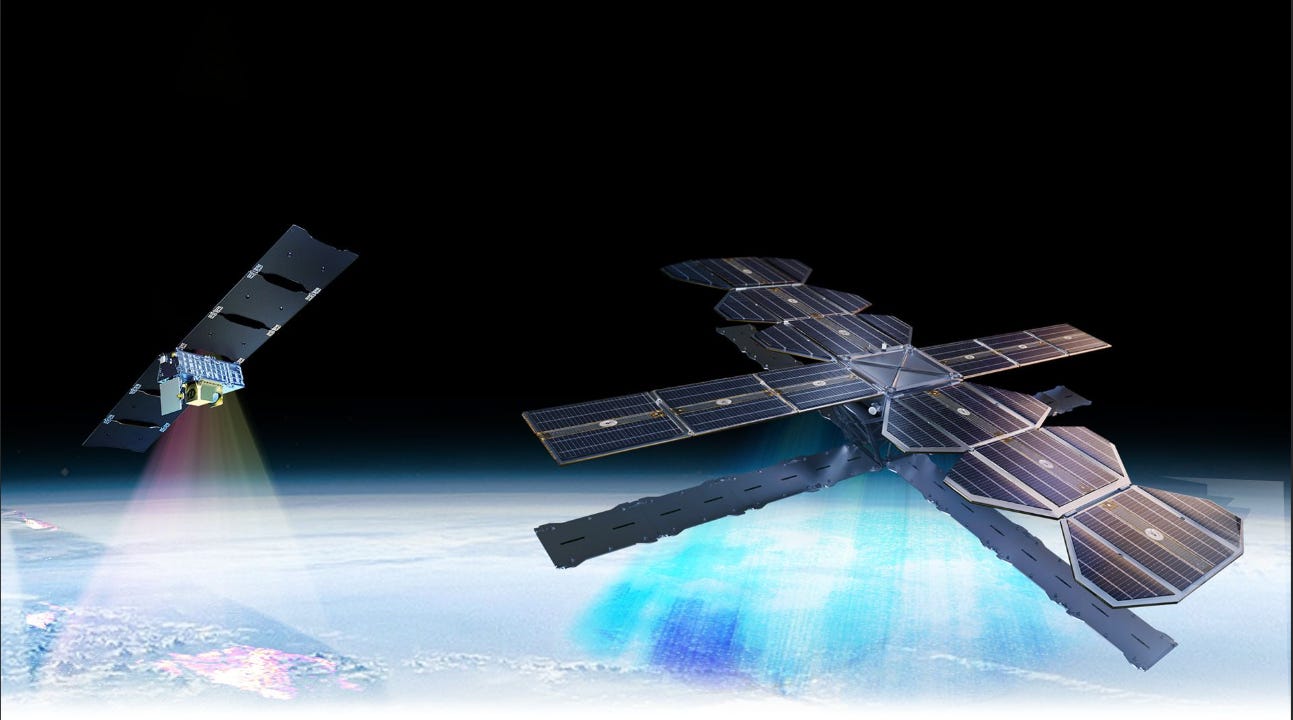
On paper, the arithmetic sounds almost inevitable. If you can put 100 kilowatts of computing power in orbit for every ton you launch, and if you can launch a million tons per year, you are suddenly adding 100 gigawatts of compute annually. Push that logic further, and you are talking about terawatt-scale compute growth.
It is bold. It is elegant. It is also extremely sensitive to one variable: tons to orbit per year.
The real question is not whether space-based AI compute is physically possible. It is whether it can scale meaningfully within the next five years.
The Arithmetic Musk Is Implying
The logic behind the space-compute thesis is straightforward:
Solar energy in space is effectively continuous.
Compute is fundamentally constrained by power.
If launch becomes cheap and frequent, energy can be industrialized in orbit.
Musk has referenced a rough working density of around 100 kW of computing power per ton of payload. Under that assumption:
1,000 tons per year → 100 MW per year
10,000 tons per year → 1 GW per year
1,000,000 tons per year → 100 GW per year
And beyond that, a theoretical path toward terawatt-per-year additions
The scaling function is linear.
But the constraint is brutally non-linear: launch cadence.
What Is Plausible in Five Years?
To answer that, we have to anchor the discussion in industrial reality rather than aspiration.
Let’s assume an optimistic but still grounded scenario for the next 3-5 years:
SpaceX increases annual satellite launches from a few thousand (last year 2300) to roughly 10,000 satellites per year (a level that would likely require sustained Starship operations and regulatory expansion.)
Half of those are dedicated compute platforms
Each compute satellite weighs about 1 ton (The newer V2 Mini generation weighs about 800 kg per satellite, nearly three times heavier, with significantly greater communications capability. And future versions — often referred to as V3 or beyond — are expected to move into the 1.9–2.0 ton range, and in some speculative projections even approach 4 tons or more. Those larger designs would require full Starship-scale deployment rather than Falcon 9. So when we assume ~1 ton per compute satellite, that is not an extreme leap. It sits roughly between today’s V2 Mini class and the projected V3 class).
Power density remains at 100 kW per ton(Musk’s back-of-the-envelope arithmetic often implies a working density around 100 kW per ton of payload. That figure is not a demonstrated spacecraft benchmark, but a forward-looking system assumption combining solar generation, structure, thermal management, and compute hardware.)
Under that scenario:
5,000 compute satellites × 1 ton each = 5,000 tons per year
5,000 tons × 100 kW/ton = 500 MW per year
That is 0.5 GW of new space-based compute annually.
If we stretch assumptions further — say 10,000 tons per year devoted to compute — we reach:
1.0 GW per year
Even under strong execution assumptions, the five-year cumulative outcome looks like:
2.5–5 GW total in orbit
That is meaningful. But it is not system-altering.
Compare That to U.S. Data Center Growth
U.S. data center electricity demand is currently expanding at a pace that would have seemed implausible just a few years ago.
Recent projections suggest:
Annual incremental load growth on the order of 10–20 GW per year
Driven primarily by AI training clusters and hyperscale expansion
Against that backdrop:
If space adds 0.5 GW per year, that is roughly 3–5% of U.S. annual data center load growth.
If space adds 1.0 GW per year, that is perhaps 5–10%.
In other words:
Even in a relatively optimistic five-year scenario, space-based compute likely remains a single-digit percentage contributor to incremental U.S. AI electricity demand.
It would be strategic. It would be technologically symbolic. It would not yet be dominant.
The Real Bottleneck: Tons per Year
The entire equation reduces to one industrial variable:
How many tons can SpaceX put into orbit annually?
To move from 1 GW per year to 10–100 GW per year, you do not need marginal improvement. You need a structural leap.
And the most “fatal” constraint is not the satellite count. It is the launch cadence.
SpaceX’s own public target for Starship is roughly 150 tons to orbit in a fully reusable configuration. If you take Musk’s million-tons-per-year thought experiment at face value, the math becomes immediate. One million tons per year divided by 150 tons per launch is about 6,700 launches per year, which is roughly 18 Starship launches per day, every day, with no breaks.
That is not a five-to-ten-year production plan. That is closer to a long-run physical limit, the kind of number you cite to illustrate what the ceiling might look like if everything works.
To make the million-tons-per-year story feel less absurd, you need two conditions to be true at the same time, and neither is optional.
First, on the vehicle side, Starship has to reach aviation-like turnaround. High reusability is not enough. It needs ultra-high frequency operations, with launch infrastructure, approvals, safety protocols, recovery, refurbishment, and range coordination all industrialized into a repeatable pipeline.
Second, on the payload side, the “compute platform” cannot look like a typical 0.26–0.8 ton communications satellite. If it does, the satellite count explodes into the millions. The only way the arithmetic stays remotely tractable is if these are larger orbital platforms with much higher onboard power handling and power density, meaning fewer units, each carrying far more compute.
And even this back-of-the-envelope ignores the real-world friction that actually decides whether cadence is feasible: pad throughput, regulatory windows, upper-stage reuse cycles, orbital traffic management, commissioning and deployment bottlenecks, and the sheer complexity of orbital assembly at scale.
At that point, you are no longer talking about a satellite business. You are talking about a new industrial layer.
What This Means Strategically
None of this diminishes the long-term ambition.
If launch costs collapse dramatically, and if orbital manufacturing becomes routine, the slope of the curve could change in the 2030s.
But within a five-year horizon:
Space-based compute likely scales to low single-digit gigawatts cumulatively
Annual additions likely remain in the 0.5–1.0 GW range
Contribution to U.S. AI power growth remains single-digit percentage
That makes it best described as:
A strategic pilot layer, not yet a structural energy solution.
The narrative scale is terawatts.
The industrial scale, for now, is gigawatts.
And the distance between those two numbers is measured not in optimism, but in tons to orbit.