
America Unpacked #5: Why “Post-Capitalism” — and Universal High Income — Are Economic Fantasies
As AI makes labor cheaper, scarcity doesn’t disappear—it migrates to capital, energy, compute, and institutions. “Post-capitalism” and “universal high income” often hide the hardest constraints behind

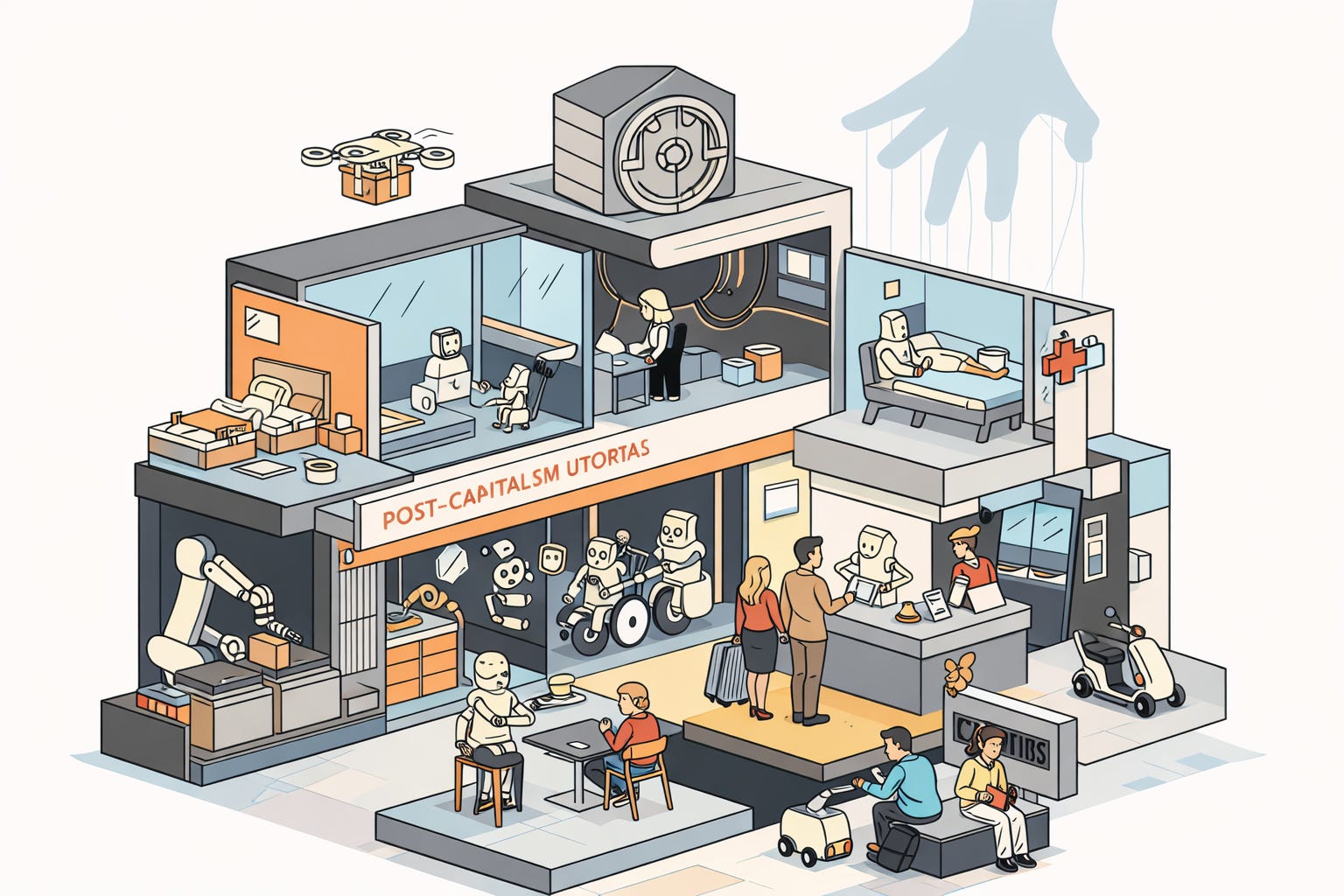
Over the past two years, Elon Musk has kept returning to the phrase “universal high income,” almost as if he’s describing a technological endgame that is simply waiting to arrive: once AI and robots make work optional, wages stop being society’s primary income channel, and people are—more or less—“automatically provided for.”
This week’s most discussed theme in markets—“the 2028 Intelligence Crisis”—projects the same underlying imagination under a different light. It isn’t painting a utopia. It’s sketching a colder trajectory: models rapidly lift white-collar productivity, while wages and aggregate demand fail to keep pace; asset values boom first, the real economy hollows out first, and the final reckoning arrives through finance and politics.
Put these two narratives side by side and they are, in fact, asking the same question: if intelligence truly becomes a scalable, reproducible factor of production, how exactly do income and power get reshuffled across society?
That is also where “post-capitalism” stories most often mislead. They tuck the hardest constraints out of sight, tempting us to believe that once technology becomes powerful enough, institutions will naturally become gentler. This post is an attempt to surface those constraints—layer by layer.
Why “Post-Capitalism” Keeps Returning—and What It Is Really Promising
The reason “post-capitalism” keeps cycling back through Silicon Valley and policy circles isn’t simply techno-optimism. It persists because it satisfies three psychological demands at once. First, it reframes distributional conflict—enduring, structural, and politically hard to resolve—as a technical problem with a technical timeline. Second, it shifts the perceived source of social tension away from “who owns, who decides, who benefits” and toward a seemingly neutral question of “is productivity high enough yet.” Third, it offers elites a softer moral narrative: keep pushing automation, and everyone will be “taken care of” as a byproduct.
Inside this story, AI, robotics, and automation are cast as a welfare-spilling engine. Machines replace labor, the supply of goods and services approaches abundance, wages gradually lose their centrality as an income channel, and the remaining step is simply to issue everyone a “universal high income” so society can step over capitalism’s old structural contradictions. The hinge here is not whether cash transfers exist. The hinge is the stronger, implied conclusion: once machines do most of the work, markets, capital ownership, firm organization, and political conflict all naturally weaken—perhaps even becoming irrelevant.
The problem is that this conclusion lacks a basic economic footing. Technological progress absolutely reshapes relative scarcities, industrial structure, and labor bargaining power; it changes who can organize production more efficiently. But it does not automatically change one underlying constant: how a society decides the use of scarce resources, and who gets to exercise that decision. As long as scarcity persists, coordination persists, and risk-bearing persists, the allocation of returns necessarily maps onto a power structure—and power structures do not evaporate simply because a general-purpose technology arrives.
Historically, every general-purpose technology wave has carried the same fantasy: the old structure will be washed away by the new tool. Steam engines produced the factory system, but they did not disperse capital; they made scale, finance, and organizational capacity more decisive. Electricity enabled finer-grained processes and more complex supply chains, but it did not spontaneously democratize ownership. Computers and the internet lowered information costs and did make some markets more transparent, yet platform organizations gained stronger advantages of concentration. Technology raises productivity, but it often raises the value of decision rights, the premium on ownership, and the returns to organization and governance. The form changes; the constraint remains.
The seduction of “post-capitalism” is that it compresses all of this complexity into a single, simple line: if production becomes automated enough, distribution becomes easy. In practice, the relationship often runs the other way. The more automated production becomes, the more distribution shifts from “how wages rise” to “how assets are owned,” and “who owns the system” matters more for long-run income paths than “who holds a job.” Put differently, automation may reduce scarcity in certain labor tasks, but it sharpens scarcity in capital, organization, compute, data, energy, land, and supply-chain control. And those scarcities are precisely where institutions and power arrangements sit.
Automation Changes the Form of Labor—It Does Not Automatically Cancel Ownership, Coordination, or Institutional Distribution
If you decompose the economic system, the core of “capitalism” is not simply “people work for wages.” It is three deeper structures. First, how ownership over assets and means of production is defined. Second, who coordinates resources, bears uncertainty, and makes investment decisions. Third, how returns are institutionally recognized, measured, distributed, and protected. Automation primarily shocks parts of the system outside the first layer—especially the way labor participates in production—but it offers no automatic replacement for the other two.
Even in an extreme scenario where robots perform the vast majority of productive tasks and humans rarely participate directly in specific labor, the “ownership question” does not dissolve. Robots, factories, models, compute clusters, and supply-chain systems still must be built, financed, maintained, and upgraded. They remain assets—and assets imply exclusivity and control rights. Whoever owns those assets owns claims on future cash flows. Once those claims exist, you necessarily need transactions, contracts, litigation, regulation, taxation, accounting standards, and bankruptcy processes—an entire institutional base. Those institutions are the skeleton of a market economy and a capital system, not optional décor.
Next is coordination and decision-making. Production is not finished simply by assigning “work” to machines. It is a continuously operating complex system: forecasting demand; deciding what to produce, how much, where, and with which technological pathway; managing supply-chain shocks; responding to energy price swings, geopolitical risk, extreme weather, and financial cycles; and making trade-offs under uncertainty. Machines can improve prediction and optimization in specific domains, but they do not automatically answer the question of who sets the objective function. Optimization always requires goals, and goals embed interests. As systems become more automated, the stakes rise on who can set the targets, marshal resources, and exercise final judgment when conflicts appear.
Third is how value is recognized and distributed. Even if marginal production becomes cheaper, society still needs institutional verification of “who contributed what, who bore what risk, and who holds which rights.” Without those confirmations, large-scale cooperation breaks down. Many people treat “markets” as mere venues for exchange, but in modern economies markets function as information and incentive systems: prices aggregate dispersed information, while profits and losses force decision-makers to be accountable for misallocation. Automation can process information faster, but it does not abolish misallocation, and it does not abolish conflict of interest.
That is why the most common outcome of automation is not “the disappearance of power structures,” but their rearrangement. Labor’s relative scarcity falls; capital and organizational capacity become relatively scarcer; returns shift from wages toward asset returns and monopoly rents. Workers may participate less through “jobs” and more through whether they own assets, whether they possess bargaining power, and whether they can access high-return institutional arrangements. The form changes; the constraint does not.
This also clarifies why technological progress has often coincided with stronger concentration. Economies of scale, network effects, data advantages, compute intensity, and capital expenditure thresholds all make it easier for winners to compound. It is tempting to label this “market failure,” but much of it reflects the joint outcome of technological conditions and organizational form. Automation raises system efficiency while also raising entry barriers and increasing the plausibility of concentrated gains. The claim that “technology naturally produces equality” lacks a credible mechanism.
The Mistakes Behind Universal High Income and the “Zero Marginal Cost” Myth—What Actually Matters Is Institutions and Political Economy Constraints
Universal Basic Income—or its upgraded cousin, “universal high income”—is often described as an “exit from capitalism” because it seems to detach personal income from wages, and therefore detach individuals from dependence on employers and capital owners. But in fiscal and political-economy terms it is better understood as a redistribution scheme—one that demands unusually high state capacity and unusually difficult interest coordination. Where does the money come from? How is it collected? How do taxpayers and capital owners respond? How does capital reallocate? Does the tax base leak? What happens to inflation and asset prices? These are not technical questions. They are institutional and power questions.
To sustain “universal high income,” a society must continuously generate a large taxable surplus. That surplus can come from profits, land rents, resource rents, monopoly rents, or taxes on capital returns. But in every case, the essence is the same: a legally enforced claim on certain groups’ output is being institutionally assigned and redistributed. That assignment triggers bargaining, and bargaining requires political authority and enforcement capacity. If enforcement is weak, the scheme tends to become short-term subsidy and long-term balance-sheet stress. If enforcement is strong, the scheme still does not imply “post-capitalism.” It implies a larger state role in distribution, sharper property-right definitions, stronger fiscal extraction capacity, and a more complex social-contract negotiation.
Meanwhile, the “zero marginal cost” argument is often used to claim that markets lose meaning: if copying is nearly free, prices collapse toward zero, goods cease to be scarce, and markets become obsolete. But marginal cost approaching zero does not mean total cost approaches zero, and it does not mean entry barriers approach zero. In the AI era this is especially stark. The marginal cost of inference may fall, but training, data, compute, energy, cooling, chips, data centers, networks, talent, and integration with the real economy remain heavy fixed and ongoing costs. More importantly, these costs scale through capital markets and industrial organization; they are borne by a small set of actors who, in return, obtain stronger ownership and pricing power.
Scarcity does not vanish; it relocates. Yesterday’s scarce input was labor. Today’s scarcer inputs increasingly include access to high-quality data and its lawful use, stable low-cost energy and grid capacity, advanced chips and supply-chain security, distribution channels for models and platforms, user entry points and ecosystem control, and regulatory permissions and compliance capacity. Whoever controls those bottlenecks can translate “near-zero marginal copying cost” into “near-infinite scale returns.” Under that structure, markets do not naturally shrink; they may become even more reliant on asset returns and rents as the organizing logic of distribution.
If one tries to remove market mechanisms—weakening or eliminating price signals—the economy does not transition into a neutral utopia. It typically shifts toward substitute rationing mechanisms. One is administrative rationing, which requires a stronger bureaucracy, better information systems, and tighter execution and accountability—otherwise it tends toward inefficiency and corruption risks. The other is implicit rationing through relationships, status, queues, access barriers, and technical gatekeeping, which is still power allocating scarcity under another name. Markets are not perfect, but they provide a public coordination language. Removing them does not remove conflict; it changes how conflict is expressed.
So treating “post-capitalism” as an economic conclusion is not robust. It functions more as a political aspiration dressed in technological vocabulary. Technology can reshape social structure, but it does not automatically decide how returns are distributed. The questions worth putting on the table are more concrete, harder, and more real: how ownership of machines and platforms is structured; how capital returns are balanced against public welfare; how competition policy responds to concentration; how fiscal systems redistribute without destroying innovation incentives; and how societies maintain stable sources of identity and dignity when employment structures shift rapidly.
As automation penetrates to the core of the economic system, the question societies face is rarely “does capitalism end.” It is “which parts of capitalism get intensified.” Competition in many sectors becomes more dependent on capex and scale; more returns settle on the asset side and platform side; the lived experience of workers becomes more dependent on institutions than on the technology itself. Deferring these questions to an imagined future—where “once the technology is mature, the system will naturally resolve itself”—only postpones distributional conflicts until they erupt in sharper form.
The big problem I usually don’t see addressed is what to do about countries. If the USA or China “win” the AGI race and everyone else buys everything from them from then on. The winning country might or might not collect taxes enough and might or might not distribute a proportion of the wealth to citizens, but what then for everyone else in the world? This is the dream as far as I can see for Silicon Valley and Washington, and it’s why they are betting everything on AGI: they hope to win and then extract rent forever more. This is not a utopian outcome for mankind, and UBI doesn’t solve the problem while countries are the locus of power